The readings for the 25th Sunday after Pentecost, Yr. A were: Zephaniah 1:7, 12-18; Psalm 90:1-12; 1 Thessalonians 5:1-11; Matthew 25:14-30 . This sermon was preached at Grace & Glory Lutheran Church in Palmyra, VA on November 15, 2026.
As I have mentioned previously, Matthew has five major sections of teachings delivered by Jesus. They are often called discourses. This echoes the five books of the Mosaic Law. Five in ancient Jewish numerology came to represent the breath of God, God’s Spirit, and God’s presence. And so, when the ancients came upon one of these five discourses, in the way Matthew shares his witness, they serve like a red flag. “Pay attention! Something critically important is happening here.”
And over the last few Sundays, we’ve heard teachings from the fifth and final discourse. This section of Matthew’s Gospel is often called the Olivet Discourse because Jesus shared most of it with his disciples while on the Mount of Olives. He is in Jerusalem for the last time, and he is preparing to die. More so, he is preparing his beloved disciples to carry on together in a world that will be largely against them as it was him. Yet soon, Jesus will no longer be immediately, physically present. He will send the disciples out to serve in his name, and things are about to get hard if not frightening.
Thus, the parables that we have heard recently aren’t just difficult because we need to wrestle with them in order to understand them in a healthier, more helpful, accurate way. This kind of parable proves challenging because, along with the promise of salvation, we are reminded of Judgement Day, a day that will surely come. And scripture leads us to believe that some might not be saved because of their sin and separation from God…their rejection of God. And even if some have cried “Lord! Lord!” to Jesus, we are told that some will fall short when they haven’t loved God and neighbor as asked. Jesus will not know them, because they haven’t embodied their faith in Jesus…And that can make us nervous for our own salvation. We ask, “Have I done enough?” But that might prove the wrong focus or question.
As Zephaniah reminds us today, our choices matter. If we are truly saved, if we truly love God, that should and will (because of the Spirit’s presence) shape our choices and make us who we are. We should observe fruits, as Paul will later argue (see Galatians 5:22–23). Using different words, James (2:17, 26) and other passages remind us that faith without works is dead. Just the fact that we wish to do and be better might just be a sign of the Spirit claiming us…helping us…pointing us toward more. According to Jesus, we are to seek, knock, ask even amidst our imperfections; persisting in our faith. And when we catch ourselves in sin, we can start over through confession and repentance.
So, don’t be like the dregs of wine, the prophet writes – the dead yeast, the tartrate crystals and other yucky stuff that hangs at the bottom of wine barrels. Don’t be indifferent toward God or our neighbor who is also created and loved by God. Make every moment of our lives count as best one can through loving like God loves us.
Jesus taught that new wine should not be in old wineskins (Matthew 9:14-17). We have a new way to live through Jesus, and Jesus doesn’t want us to be the dregs. No, as followers of Christ, Jesus wants an abundant, active life of love where God will make our cups overflow. People should see Jesus in our words and deeds, and they will…if we just risk loving God and others as best we can. God’s Spirit will do the rest.
Through such passages challenging our consciences, we are reminded that Law and Gospel always go together. For Lutherans, the Law in scripture accuses. It commands, demands, and opposes human sin.[i] It can help us live in a more Christ-like way, but it also can help us know when we aren’t doing our best and need to repent…try harder. Meanwhile, the Gospel frees us from our shame and sin. It shouts of our forgiveness in and through Jesus Christ who died for us that we might be saved. In our sin, that remains our hope.
Both Law and Gospel are used by God to help us…to love us…and to facilitate our healthy, humble love of self and others. Therefore, when we hear of the Law, we must try not to get stuck in self-judgement and fear. Instead, confess the truth. We are screwed up. We will fall short. We can do better. And yet…and yet…Jesus will be true to his promises. We need not give up trying but persist in faith, “For God has destined us not for wrath but for obtaining salvation through our Lord Jesus Christ” (1 Thessalonians 5:1-11).
Our humility, admitting we will never be perfect but are sinners, mixed with that confidence in Christ who love us…plus a little dash of healthy discernment…can really make this parable an exciting one…a hopeful one. For these servants are invited to be an active, important part of God’s will and Kingdom. In trying to love God and neighbor, God will make our simplest efforts to love more eternally valuable than we could ever imagine. We become one with God’s own heart. That’s our reward.
Therefore, in this parable, Jesus is often considered the master by interpreters. Yet, be warned. This is a teaching story. The master is not meant to be exactly like Jesus. And these three servants aren’t fully like you or me, but they do represent varied disciples including us. Based on divine will and benevolence, the servants are each given gifts to use according to their abilities and the needs of God in order to please their master. It is much as Paul reminds us that we are all an important part of the body of Christ. Whether we are the eyes, ears, hands, or feet, we have varied gifts but serve the one Lord (see 1 Corinthians 12).
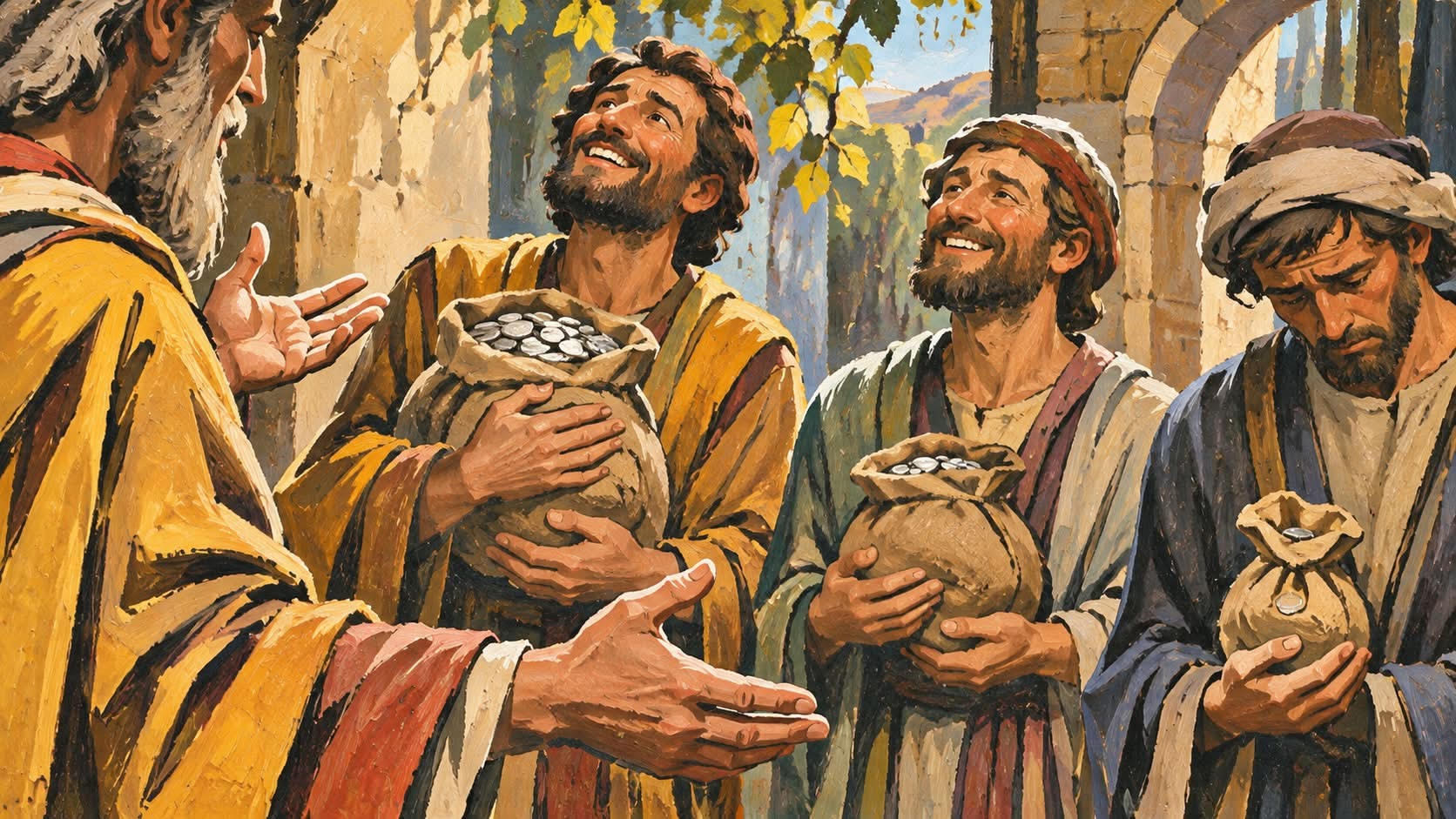
Then the image of talents needs to be clarified as well. The servants are not just given a few coins but a ridiculous amount of money. Do a Google search sometime. “A talent was an ancient unit of weight (roughly 80 pounds or 30-40 kg) of silver, gold, or copper. In New Testament Times a single talent of silver was worth about 6,000 denarrii – roughly equivalent to 15-20 years of wages.”[ii] In this parable, we are talking a ridiculous amount of money to catch our attention…millions of dollars.
However, Jesus is not talking just about money in the parable. (Money is not really the point.) He wants something priceless…our minds and hearts…all that we are and have. As Paul wrote the Romans, we are to become living sacrifices (Romans 12:1). When healthier, the Church understands that this passage reflects time, treasure, and our modern understanding of talent…our capacity to do good and make a difference in the world. How we do our work, how we rest, how we relate to others, it all matters. So, we are asked to invest ourselves in the name of Jesus Christ into the world…in our context where planted or sent by God, and to the best of our abilities as given by God. For, not all of us have the same purpose.
As the master leaves on his journey, he promises to return. They are to work for the master’s welfare and fulfill his will while he is gone. They are his representatives. Likewise, Jesus will soon ascend to heaven after promises to return. So, we should watch what the servants do closely. Two of the slaves do their best to please their master. The third is afraid…afraid to take risk…afraid of failure…afraid judgement…afraid of the master’s response…afraid to love others one might say. This third servant is selfish, lazy, and indifferent to the task set before him. He’s being a dreg…failing at his mission and purpose.
Oh, this third servant knows the master, but he really doesn’t know him. He misunderstands the master. It is true, the master reaps where he does not sow and gathers where he does not scatter. The master is rightly blessed by our work and claims ownership over all of it. As our sovereign lord, everything we do should be for the master’s sake. Indeed, in the Greek, the word used for the servants can also primarily mean “slave,” and what are we, Paul argues often, if not “slaves to Christ.” We are asked to try to live fully, and joyfully for Jesus.
Much like us, Jesus already knows we won’t do so perfectly. That’s why Jesus died for us – for all our sin and imperfection – so that we might live with him forever…because he loves us. And while we wait for his return, we are asked to do our best and to persist in our faith; taking his charge to us seriously. And even then, Jesus seeks to help us succeed through his Spirit, through the relationships found as Church, through his words of both teaching and promise as found in scripture.
Ultimately, God’s Kingdom economy is not the world’s idea of success. More or bigger is not always better. Perfection in this fallen life is understood to be a lie. “The least of these,” the throw aways, the sinners, and the irredeemable matter to God even if they don’t to the world. Like a lost sheep (Matthew 18:14), our Father in Heaven wills that not one be lost while the world might not even care. According to Jesus, those who are humble and childlike prove the greatest in the Kingdom – not social media influencers, not politicians, not the popular pastors, not the powerful, and the list goes on. And whoever welcomes one such child in Jesus’ name welcomes Jesus.
Ultimately, what we find out is that the way that God operates is unfair…Grace is unfair! We don’t even deserve our salvation, but we are given it. Those who are the least are uplifted. Those who mourn will be comforted. This is only because of who God is…God is love. Clearly, the Kingdom economy and its judgements are not our own.
Consequently, in our ordinary lives, overlooked and misunderstood by the world (and sometimes we might not appreciate what God is doing in our lives too), the extraordinary and miraculous might happen at any moment that we risk offering love, kindness, empathy and compassion. Anytime we share our time, treasure, and talents, with a simple act of consideration or encouraging word, someone’s life course might change…Their entire life might change because you did a nice thing, and yet you might never see the result. Yet it can happen. I’ve seen it happen.
And when standing up to wrongs, well, that might start a domino of change. A lot of human beings will not act in a crisis until someone else acts. Then they follow suit. With every seed of faith shared, someone might go on to do more than we could in our situation. We aren’t all asked to move mountains, but we are asked to be like the widow who “out of her poverty, put in everything—all she had to live on” as an offering…a few pennies (Mark 12:43–44)
Ah…now we begin to see that this story is not ultimately about money, nor condemnation. As the Deaconess Community of the ELCA recently posted about, we are not our productivity, accomplishments, or mistakes. “In a world that constantly asks us to do more, achieve more, and be more, God’s grace reminds us of something extraordinary…Our worth was never something we had to earn.” You are valuable as you are to God.
And so maybe we should start asking what might be possible when we trust and seek to follow God. And with God, Jesus says, all things are possible (Matthew 19:26). Rather than ignoring what we can do or feeling stuck because we are small, young, old, imperfect, or uneducated…whatever we think our liabilities…we are asked to invest all that we are…as we can…into the world trusting God will use it for good. This is possible for each and every single one of us, for as Mother Teresa once quipped, “We cannot all do great things, but we can do small things with great love.”
One biblical scholar asked in summary regarding this parable, “What does faithfulness look like in a time of waiting? In Matthew’s Gospel faithfulness is emulating the ministry of Jesus. Jesus has announced the arrival of God’s kingdom by feeding the hungry, curing the sick, blessing the meek, and serving the least.”
As his body, each of us with varied gifts, planted in different places and vocations, we are asked to go and do likewise…not perfectly, but with faith, hope and love. Every life and moment matters to our eternal God, and in saving (or even just helping) one life, ancient Judaism (the Judaism that Jesus know) taught that “it can be considered as if we saved an entire world.”[iii] Just one person that we help is as if we saved the entire world.
Focusing on our fear instead of offering the joy that God is offering us is a grave mistake. Perhaps instead of feeling guilty, we should be excited. God wants to work through us…More than that, God loves us. Amen.
[i]Harrison, M. Law and Gospel. The Lutheran Witness. Downloaded at https://witness.lcms.org/2022/law-and-gospel/ on November 13, 2026.
[ii] Google. AI summary of search. November 13, 2026.
[iii] Mishnah Sanhedrin 4:5. The Babylonian Talmud, translated by Isadore Epstein, Soncino Press, [or reference a standard bilingual edition like the Sefaria digital library or The Schottenstein Edition]. Full quote: Whoever destroys a soul, it is considered as if he destroyed an entire world. And whoever saves a life, it is considered as if he saved an entire world.
Below, please find a video of our worship service. The sermon starts at about the 29:50 minute mark.
© 2026 The Rev. Louis Florio. All content not held under another’s copyright may not be used without permission of the author unless under terms of fair use and properly attributed. Scripture passages when used are from the NRSVue translation unless otherwise indicated.