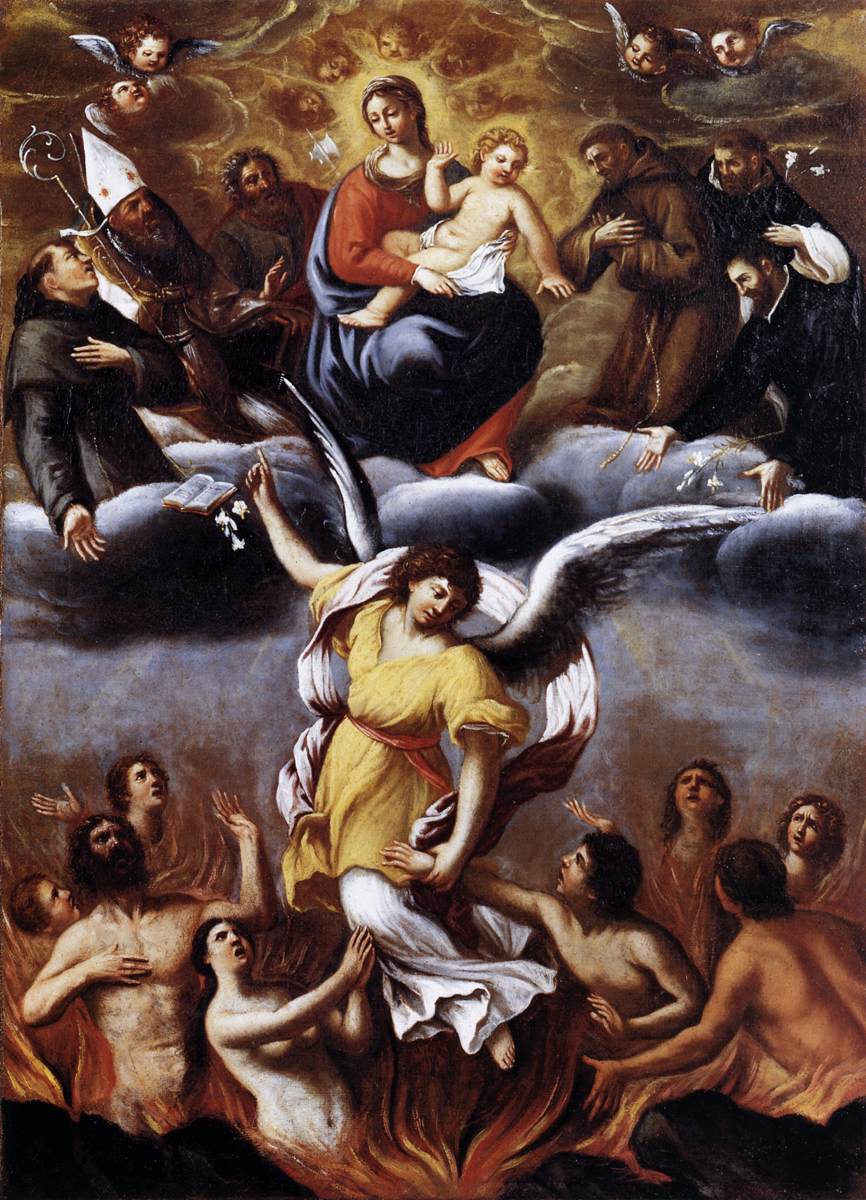
Recently, a congregant received a mass card from Roman Catholic friends after her mother died. A certain number of masses are going to be said at a church community or through a religious community on behalf of the beloved departed. I often get the question in such circumstances, “What is this all about?”
That’s a great and common question. It is all related to the idea of purgatory. From several verses in the Bible and the Apocrypha (Old Testament books not recognized at the level of scripture by Lutherans, but respected), Roman Catholics had developed the idea of purgatory – a place where our sins would be purged after death in order to make us worthy of living with God. More sin meant a longer time in purgatory perhaps hundreds or thousands of human years.
Thought to be a painful process or place, Roman Catholics discerned those languishing in purgatory might be helped with prayers offered for their sake. (Again, they did so using some scripture and Apocryphal sources, but also some questionable human mythic ideas that popped up over time.) In short, they began to think people could make sacrifices, pilgrimages, etc. to help the dearly departed or themselves. This eventually came to include paying money to satisfy any debt for sin. That’s where paid indulgences came into popularity and eventually Luther’s 95 Theses in opposition.
Although paid indulgences don’t exist as they did in the 16th Century, the Roman Catholic Church still holds onto the idea of purgatory and the need for additional satisfaction for sin. Although some modern Roman Catholic theologians now focus on purgatory being more of a process than a place, you still find literature and devotions allowing for a certain number of years off any time in purgatory based on prayers (rosaries said or novenas for example), masses said where the souls of those in purgatory are prayed for (usually for a donation), or specified approved service or pilgrimages (for example, some pilgrimage completed and 0 or 500 years off). At other times no such benefit is promised. The benefit is discerned by the Church leadership under the Pope, not locally. Despite some changes in or diversity amidst explanations offered, old ways die hard.
Although Lutheran’s often pray at the time of death, funerals, and committals that Christ accept the soul of the departed into his care and keeping, we don’t agree with the idea of purgatory per se. We don’t feel there is firm scriptural proof for it. Luther did for a time seem to hold onto the idea that some kind of purging would happen, but this did not necessarily mean a place existed nor was it anything faith in the death and resurrection of Jesus couldn’t cover. If there is any “purging” (or in effect “purifying”) this isn’t something we worry about or seek to describe. We are saved by grace through faith in Jesus. That’s all we know clearly from scripture. That’s what we trust in. Luther used to argue, “Remember you are baptized,” and “Jesus doesn’t lie.” If you are Jesus’ through faith and baptism, you are saved. Yet, Lutherans and other Protestants (particularly the Reformed) sometimes still talk in terms of “glorification” after death which might echo the Roman Catholic view somewhat. Yet again, we all basically reject the Roman Catholic construct of purgatory.
That said, when someone Roman Catholic has paid for masses to be said for the soul of someone who has died, a “mass card” is often sent to let the bereaved family members know. The mass is said as an offering for the person to be acceptable before God. (There might be other names prayed for at the same time.) It is meant to honor and help the departed and comfort the grieving, so I just say thank you instead of entering any theological debate. It was a gift offered in love and their faith. If they ask about our faith in regards to this practice, I’m honest. In my heart, I trust my loved one is already covered by grace through faith. On the negative side, some Roman Catholic agencies and parishes (not all) can use paid for masses as a form of fundraising – not so unlike Luther’s hated indulgences. Its problematic on many levels even among the Roman Catholic faithful, but sadly, it does happen.
Angels appearing before the shepherds, by Henry Ossawa Tanner
And suddenly there was with the angel a multitude of the heavenly host, praising God and saying, “Glory to God in the highest heaven, and on earth peace among those whom he favors!”(Luke 2:13-14)
What a powerful, enduring image – an angelic multitude proclaiming the birth of Jesus to poor shepherds in a field! In great works of art or on more humble Christmas cards or creches, even in our favorite carols, we imagine them in song with the shepherds below basking in the glory and love of our God. How much more should we let our lives sing a song of gladness? For Jesus came not to remain in that stable, but instead plans to come to us where we are. He desires to reside in our hearts.
Mary (1914), by Henry Ossawa Tanner
Yes, through our faith and baptism, we share a more similar experience to Mary’s own. She was a poor, relatively uneducated young lady; likely 13 to 15 years old. She had lots of questions, doubts and fears to wrestle with, yet when the angel announced she would become the mother of the one true God, she submitted. Her magnificat (a song of praise captured in Luke 1) declares with certainty, “My soul magnifies the Lord, and my spirit rejoices in God my Savior.”
Mary was God’s favored one, and we share in that favor. Truly, Jesus waits to be born in each of us and reborn each day. No matter how we perceive ourselves with our varied gifts and struggles, God has come to us declaring each of us beloved child. Prophets in the Jewish scriptures predicted a time when the Temple would be no more, for our bodies would become the place where the yet unknown Christ resides. The Angels in the field proclaimed that Jesus came for all of us who are poor, imperfect and in need of love.
In Jewish theology, our heart represents more than an organ or emotional passion, it reflects our utmost being – the depths and totality of who we are. That’s where Jesus wishes to reside. So, Jesus prayed that we be one as he and the Trinity are one. It is Jesus who chose and called each of us to follow him. It is he who wants to live inside us and through us so intimately in every moment that he names us as his body. This good fortune is offered as a certain gift to all who dare trust in his promises.
Surely, Christ’s presence will upset our lives. It might even make us the objects of scorn or worse. Yet, “Do not be afraid!” God’s favor will never disappoint. Walk on so that your life becomes his song. Walk on trusting that Christ walks with you and that many more miracles shall surely come. His presence will bless us beyond our expectations.
The Christian singer Francessca Battistelli in a recent song imagines these words coming from the heart of Mary and her own, “I am not brave. I’ll never be. The only thing my heart can offer is a vacancy. I’m just a girl. Nothing more. But I am willing, I am Yours. Be born in me.”
Do not doubt any longer, but believe. Open your heart and welcome Christ at each new sunrise or whenever darkness falls. The promises of God are fulfilled in your hearing. Blessed are you! Holy are you! Sing to the glory of God, so that all might believe!
Be born in me (Mary), Francesca Battistelli
This post was originally published in Messiah Lutheran Church and School’s newsletter, The Messenger (December 2014/January 2015).
Unless otherwise indicated, all scripture quotations for this article are from the New Revised Standard Version (NRSV) translation.
Abide in me as I abide in you. Just as the branch cannot bear fruit by itself unless it abides in the vine, neither can you unless you abide in me. I am the vine, you are the branches. Those who abide in me and I in them bear much fruit, because apart from me you can do nothing.(John 15:4-5; emphasis mine)
In Virginia, we are surrounded by a number of vineyards and wineries. Over the years, I have visited many and learned of the great efforts and loving, intentional care needed to help the plants prove fruitful. It is no accident that in Jesus’ own day without our modern agricultural skills Jesus spoke about our faith life in terms of a vineyard. Many people would have been familiar with them and the intensive work and oversight associated with them. The image of vineyard was common to Old Testament writings signifying safety, abundance, the people of Israel, as well as God’s harvest. Thus, Jesus used that same imagery, and bread and wine would become part of the sacraments Jesus would leave us; means of God’s grace.
Yet in John 15, Christ’s believers are invited to become intimately part of the vineyard. He is the vine, and we are the branches. His word and the gift of faith have already made us worthy to reside there. In John’s Gospel, Jesus is reported to use the Greek word for abide. It signifies that we are to do more than just stay with him. “Abide” (meinate) in John is used over and over to imply much more. Life springs from, stems from, arises from this relationship; a relationship that begins to bear fruit as soon as we say, “We believe.” God dwells in us, and the love which is God wants to grow and expand to fully bless us and others with a love that overflows. It is an image of intimacy, relationship, and abundance.
We are saved by grace through faith in Jesus Christ. This is most certainly true. Yet, for all those that grow tired from long hours at work, for those fatigued from dealing with strife or illness, for all those who hunger and thirst because of anything amiss in their life including sin, please remember the abundance Christ speaks of rarely if ever just grows on its own. Ultimately, it is a gift of the Spirit dwelling within our hearts, yet it helps for us to be intentional about our relationship with Jesus and his church. We must accept and cooperate with the grace offered us, for relationships deepen and mature over time shared with one another. So, all of us need to spend time together in worship, study, fellowship, and service. At home and work, we are richly blessed by caring for our own spiritual, emotional, and material needs, but even more blessed as we seek to care for and share faith with others.
These days, “Christian formation” is the phrase often bandied about for educational programs of the church. Like a potter with clay, God shapes our lives and future through such active, intentional times together. Perhaps it could rightly be called abiding in Jesus – a supernatural process of growth and new life rooted in Jesus while connecting us to one another. Yet such formation is ongoing. All we do and experience can become part of the process. Abiding in Jesus takes us out of the home, classroom, and sanctuary and boldly into the world!
Do you abide in Jesus? Does Jesus abide in you? If you have faith at any level, do not doubt that this is so. You are saved. Still, Jesus said he came that we may have life, and have it abundantly. Nurturing our faith and church, the days ahead might not necessarily be easy, but they can prove more fruitful – filled with Christ’s joy, peace and love.
Dare respond to his many invitations, and watch grace grow. “Abide in me. Follow me. Come, taste and see.”
Peace,
Pastor Lou
Unless otherwise indicated, all scripture quotations for this article are from the New Revised Standard Version (NRSV) translation.
A comet that gained an earthly following because of its bright tail visible from space was initially declared dead after essentially grazing the sun. Now, there is a sliver of hope that Comet ISON may have survived. (Source: AP, 11/19/13)
“For surely I know the plans I have for you,” says the Lord, “plans for your welfare and not for harm, to give you a future with hope.”(Jeremiah 29:11)
In Jeremiah’s letter to the Jewish people in exile, we hear God speak profound words of hope in the face of their doubt and darkness. God had not abandoned them. God did not stop loving them. The world seemed to be crashing down around them, and many were tempted to give up on forgiveness, salvation and new life. Yet, God would never give up on them. Rather than assimilating to the “realistic” outlook and ways of the world, they were invited to look to the Lord, have faith, and truly live.
No matter the generation, it is no different for us who dare to believe in God amidst our own struggles. Abraham hoped against hope; trusting that he would become “the father of many nations”[1] just because God had promised. We are told not to be jealous or measure ourselves against others. “Surely there is a future, and your hope will not be cut off,” Proverbs assures us.[2] In the face of many trials and losses, Moses and his people were still shown the way to freedom. They just had to trust, seek to follow God, and walk on.
Jesus himself tells us, “Do not worry about tomorrow.”[3] Instead, he only asks us to trust in him, follow his light, and reflect his love. He is our star of hope which no darkness – including our sin – can ever overcome. No matter our challenges, our lives are free to glorify God and rejoice, because of the hope laid up for us in heaven.[4]
Discussion question: How can living as a people of hope shape our lives?
The above reflection was originally published in Messiah Lutheran Church and School’s worship bulletin for the Fourth Sunday of Advent, 2013. It is meant to complement Creative Communications’ Bright Star of Bethlehem series for Advent and Christmas.
Unless otherwise indicated, all scripture quotations for this article are from the New Revised Standard Version (NRSV) translation.
This Hubble photo is but a small portion of one of the largest seen star-birth regions in the galaxy, the Carina Nebula.
Luther observed, “Our Lord has written the promise of resurrection, not in books alone, but in every leaf in springtime.” God is, was, and always will be part of the creation that surrounds us.
Yet in a fallen world, that wasn’t good enough. The works of sin, death, and the Devil enslave our lives, separating us from God and one another.
Instead, God longs for relationship and intimacy; to replace our hearts of stone with hearts of flesh. Through the prophets, God promised to make his home with us, not in some new stone temple, but in those same hearts so prone to wander and fail.
Into the world, God sent his only Son to fulfill this promise. Jesus would take on flesh for our sake. He would live for us, work for us, suffer for us, and die for us. From his resurrection, our own eternal life springs forth.
Through the mysteries of our shared faith and baptism, we now become a new creation, freed from our flesh and the limits of this world to be the children of God. We are saved to be his body which proclaims the Good News: Jesus has come into the world to offer new life to all.
Discussion questions: As part of God’s creation, the promise of resurrection is written in each of us, as we are now. How does your life signify or serve as a promise of the resurrection? How could you “shine more brightly” to better give God glory and point others toward Christ?
The above reflection was originally published in Messiah Lutheran Church and School’s worship bulletin for the First Sunday of Advent, 2013. It is meant to complement Creative Communications‘ Bright Star of Bethlehem series for Advent and Christmas.
Unless otherwise indicated, all scripture quotations for this article are from the New Revised Standard Version (NRSV) translation.
Thanks to all those who helped Messiah Lutheran Church and School celebrate our 45th anniversary. I created the above video to present during our worship service to help us reflect on our past, present and future together. It includes many (but not all) of our partners in ministry. For a small church, you’ll see once again that we have a long and loving reach! It is not by accident a Thrivent loan representative remarked that we do more than many congregations ten times our size.
At Messiah Lutheran, we live out many signs of discipleship: feeding the hungry, caring for the sick and those at risk, meeting the marginalized and loving them as they are. Our financial stewardship has increased each year (faster than our growing membership), and our volunteering and lay leadership at our congregation and in the community has increased even more so. We have many new partners and now friends in ministry that help us reach beyond Hanover County to the world. Firmly Lutheran, we open our hearts to work with other Christians as part of one universal church, the family of God.
Yet we aren’t just busy bodies. Our activities, programs, wealth, size or location don’t make us who we are. In fact, we sometimes “lack” in those areas by standards of the world. No, we seek to act in response to our greatest gifts from God – hope, faith and love – and that makes all the difference. It defines us, shapes us and is the source of our ultimate significance. It is what makes so many notice our small little church in Mechanicsville as something “different.”
Over six years ago, the love I saw you have for one another attracted me to say yes to the offer of a call as your pastor. It is your love, a reflection of Christ’s own, that inspires me still. It is what amazes so many I meet, and I see it changing the world a relationship at a time. God’s doing something here. Christ is being made known.
Sure we aren’t perfect, and we can always do better. A small church that seriously struggles at times, we have Jesus and we have each other. That’s more than enough, and so we keep on discipling…together…no matter what.
As my friend from the Congo wrote, “Glory be to God for his faithfulness, happy celebration to everyone at the Messiah Lutheran Church and School.” Indeed, it is God’s faithfulness that invited us to be church together and made our celebration possible. Thanks for letting me walk with you. It is my honor, privilege and joy.
Pastor Lou Christ the King Sunday November 24, 2013
(I hope you enjoy the video. Please feel free to share this video with your family and friends.)
As Thanksgiving approaches, I find a favorite movie has begun playing on television over and over again, Miracle on 34th Street. This year, I have been reminded that miracles can happen over and over again in real life as well – whenever people choose to love one another as Jesus asked.
This past All Saints Sunday, I was given permission to share a sacred story. It was a tale of a suffering saint, not from long ago, but of one in our midst. Our sister in Christ, Rachel[i], a long-time member of our congregation, a baptized and believing child of God, was in desperate need. She was alone, fighting mental illness, and at risk of becoming homeless.
Rachel is well known to many if not all in our congregation. She has been a congregational member since the 1990s, although she has attended on and off since that time. Of late, she has especially stood out. Visibly, she has grown weaker and distant. Flowing conversations have become more and more difficult. Recently, one might only be answered with a short phrase or a single word. Due to medical issues, she is often seen getting up and down during our worship – going outside the sanctuary to the rest room or for water – and then returning. To be frank, her demeanor, appearance and behaviors could easily put one off or prove annoying.
This situation is sadly not unusual. She shares a story with many who are without family and suffering from mental illness. It is a story that began perhaps before birth, as her mother is said to have suffered from both mental illness and addiction. (Such issues are believed by some to often be partly genetic.) Yet, Rachel also reportedly suffered severe abuse in her original home from others who should have loved her. It is quite a testimony to her tenacity and gifts that she escaped that environment to become a valued employee where she worked and love a family of her own.
Still like many with similar histories, married life proved a challenge. When her husband allegedly became abusive, she decided to divorce him and start again. Unfortunately, he was able to use her mental condition and lack of financial means against her. She lost her children to his custody, and the now adult children – seemingly not understanding mental illness nor family systems – continue to blame her for the dissolution of their family. There is no meaningful contact or support.
Although she had tried hard to provide for herself and for her children, life seemed to work against her as new problems and challenges arouse time and time again. With this, her mental illness seemingly began to take control of her life. She had lost family, and she now lost friends. She eventually lost her job. Initially, a neighboring family tried to help her, but they, too, ran into problems of their own in the difficult economy. They couldn’t help her any longer.
All along, members of our congregation were walking beside Rachel. Certainly, I offered pastoral care and counseling. On top of that (if not more importantly), she received help with food, shelter, and rides. People tried to be patient with her and relate to her; always welcoming her into our assembly. Several sought to be like family to her inviting her to share in holidays and celebrations in their home. Despite our congregation’s current financial challenges[ii] and being a relatively small congregation[iii] for our area, our council managed to quietly pay for her room for several months while she was staying with her neighbors. We also provided assistance with necessities. Our president captured the council’s collective feeling when he said, “She’s been our sister in Christ when it was easy and times were good. We can’t pretend she isn’t our sister now when it is hard. We need to help her.”
Indeed, Rachel is not her mental illness. She is the person who always volunteers to help others, especially children. She heard of a need for children’s sandals and shoes overseas from a veteran she knew, so she initiated a collection through our church. Hundreds of youth in Afghanistan benefited. She is always ready to help us with property needs, vacation bible school, or mission work despite her current limitations. She is one who walks miles to join us for worship or events if she cannot get a ride. She insists on donating money for our shared ministry even when she has little and is told to use it for her own needs. As another person who knew her well said, “Some people love this church, but Rachel LOVES this church. It is her family.” Rachel is our sister, Christ’s sheep, and remains a beloved part of our family of faith.
As with family, Rachel had given the local social services permission to cooperate with me in meeting her needs, but we were confounded as to what could be done when Rachel finally became homeless. The local county only had funds for short-term housing (2 weeks), and our congregation struggled to find the money to pay the discounted rent with her neighbors never mind at a hotel or apartment. It appeared Rachel would be moved into the sometimes rough Richmond homeless shelter system. This put her at further risk of being far removed from her church family, being set back and delayed in her disability claim, and starting anew with a different social worker in an overtaxed, urban environment.
As I pondered this situation, I recognized the great challenge before us to get the money we would initially need to care for Rachel – $2500 for the first few months of housing using the county’s vendor. It was the safest place, easiest transition, and best rate we could hope for, and yet we don’t have that kind of money lying around. As I prayed about it, it struck me that perhaps I was looking at this problem the wrong way. Yes, it is an enormous problem in many respects, but what if we just tried to address the need bit by bit, step by step, and day by day? We could have a special appeal in our church and ask friends in the greater community to help Rachel. If we just looked for fifty people to offer fifty dollars (about the cost of a family eating out in many cases or to attend a family outing), that could cover the initial need. For those who couldn’t give, they would be asked to pray, help Rachel in concrete ways when possible, and welcome her in our assembly.
Symbolically, fifty is a number of freedom and new life, and that is what we want for Rachel. Leviticus 25 describes a Year of Jubilee when debts were to be forgiven, forced servitude was ended, and people began fresh. We now had a chance to help free one of our own sisters in faith – just 50 people and $50 at a time. We would call it our 50 X 50 Campaign, multiplying the love we ourselves had received as individuals from Christ and assuring Rachel that she is not alone.
Announcing this at worship on All Saints Sunday, I was nervous as to how the congregation would respond. I was heavy in my heart because I knew well what was at stake. In past police, hospice care, and mission work with at risk youth in South Dakota, I carried too many memories of those who didn’t make it through such times. Yet our hope is in a God of steadfast love. It is a love of miraculous, healing power that often works through the lives of ordinary people in unexpected ways.
So, I took the risk and made the appeal trusting that “all things work for the good of those that love God,” and God answered through his Holy People. Despite our attendance being lower than average that morning[iv], over $4000 was raised to help Rachel. We have never collected that much money in any appeal that fast before, and I dare say, never for anything as important. Since then, money is still coming in. In a world where too many people wonder if anyone could love them as they are, Jesus spoke love to Rachel that morning. Through us, he is still speaking.
Over the past few weeks in worship, we heard once again about the Beatitudes and how we should love one another. We were urged that we should be patient with and support the weak. We were reminded – both Roman Catholic and Protestant Christians alike – that saints are needed for earth and not just for heaven. I can’t say how this particular sacred story about Rachel will end in the immediate future, but I know Jesus and his people are in it for the duration. We have to be, because that’s exactly the way Jesus asks it to be.
As church, we should never focus on how weak we are or the size of any challenge ahead of us. We just need to seek to love, and Jesus will do the rest. Thus, we are told that we can rejoice and do all things through Christ who strengthens us – even miracles – one relationship at a time…even from a small, old building on Atlee Road.
——————————————————————————————————————-
As Rachel’s needs are long-term and many others’ suffer as she does, donations are still being accepted for our benevolence and charitable work. If you would like to help, please send your tax deductible donation (noting “50 X 50” on the memo line) to:
Messiah Lutheran Church and School 8154 Atlee Rd. Mechanicsville, VA 23111
In hindsight, the above story is reminiscent of this song. Originally written at the time of the recent “Great Recession”, it reminds us all to love one another and boldly be ambassadors for Christ. We are never truly alone (Matt. 28:20)! Enjoy…
[i] For the sake of this public message, the woman’s name has been changed to provide for some privacy. It is a story shared with permission.
[ii] Although our financial situation has improved these past few years, it is still not unusual for us to struggle just to pay bills some months.
[iii] Messiah’s average attendance is about 95 with a bit over 200 members.
[iv] Attendance was in the mid-80s on November 3, 2013.
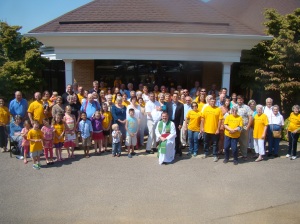
Messiah Lutheran Church Members & Friends, 8 September 2013
We want you to know, brothers and sisters, about the grace of God that has been granted to the churches of Macedonia; for during a severe ordeal of affliction, their abundant joy and their extreme poverty have overflowed in a wealth of generosity on their part. (2 Cor. 8:1-2)
Reading the above passage, I began to reflect upon our life together at Messiah Lutheran. Seeking assistance for a mission, Paul was encouraging the larger, more affluent congregation in Corinth to look toward the example of the struggling Christian community in Macedonia. I began to see a parallel. How has our little church faced with so many historic and current problems been used to encourage others?
Once a person mentioned to me in passing that it seemed our community is made of a “disproportionate number of people in need” and perhaps we would always remain small. This indeed might be true (only God knows the plans in store for us), yet I embrace that description. After all, Jesus came for the “least of these”: the hungry, the naked, the homeless and marginalized, even prisoners. Therefore at Messiah, we have intentionally forged strong relationships with those having intellectual, physical and mental disabilities. We have actively sought to support members of our community with food, clothing, and housing. Hospitality and authentic welcome are recognized marks of our ministry regardless of social, economic, political or other differences. Some of our members and neighbors have been helped to lift themselves out of domestic abuse, addiction, and even jail. We are truly trying to live as Christ’s disciples in mission, no longer Gentile or Jew, male or female, but all one in Christ. If two or three gather in his name, Christ is there, so our size doesn’t really matter either. Our congregation is exactly the kind of beloved community spoken about in scripture!
Despite our needs (or perhaps because of them), we have come together to rebuild and strengthen this congregation’s ministry, not perfectly but as best we can, and this has made a difference worth celebrating. Although we are still small and at times people might leave, worship attendance has increased over 35% since 2006. Giving has gone up about 10% per year no matter the ebb and flow of our national economy. We still struggle financially (sometimes wondering how we will pay our bills), but we have closed a $35,000 deficit while supporting others – fully funding our tithe to the greater church, ranking several years in the top 20 for donations to the Virginia Synod’s United Lutheran Appeal, starting new ministries in support of Lutheran Family Services, serving as a covenant congregation with Hanover Habitat, reinvigorating the shared, ecumenical food, clothing and benevolence ministry which is MCEF, and much, much more. Our outreach has dramatically increased and a number of long-time members have suggested our community is more spiritually oriented than ever before.
Thanks to the grace of God working through our lives together, we have all contributed to our “success.” A Thrivent loan officer remarked, “We have seen congregations ten times your size not do as much.” It is often why when I am at area events that people remark, “I hear things are going great at Messiah,” or “Your that church that is so active in the community.” In our welcoming of All Souls Episcopal to share our worship space, I have had three different Evangelical pastors comment at the great and unusual witness to Christian love being made manifest here. When we attended the Virginia Synod Assembly, other congregations have asked for appointments to discuss why and how things are “going so well” at Messiah for two years running. We are further affirmed as a community by the reality that 46% of our membership comes from outside of Mechanicsville. These people are willing to make drives of 30 minutes to an hour because they recognize that this community is indeed “different.”
Are we challenged as an institution in property and programs? Do we dine with people who are marginalized, hurting, sinful and alone? Do we struggle as individuals? You bet! We are real people with real problems, but we are a saved people all the more. Thanks be to Christ, we are the church! We seek to live as disciples more than as “members”; striving to concretely love God and neighbor. We are invited to walk on in a living hope of what is promised us in Christ’s victory, not based upon what we get or experience here and now.
In the end, we are ultimately a family of faith not defined by geography, finances, numbers or programs, and especially not our aging building. Instead, love, abundant joy and generosity – a response to what God has already offered us – describes us well. We are being recognized locally and beyond because as Jesus has promised, “By this everyone will know that you are my disciples, if you have love for one another.”
As we continue to celebrate our 45 years in ministry, I want to say that I am always proud and grateful to serve you as well as alongside you in mission. If you are a visitor or have been away, I invite you to come join our celebration; not an event but our shared life in Christ Jesus.
Peace,
Pastor Lou
Everyone makes a difference at Messiah Lutheran!
To see pictures from our God’s Work – Our Hands Day, click here.
Unless otherwise indicated, all scripture quotations for this article are from the New Revised Standard Version (NRSV) translation.
A cheerful heart is a good medicine, but a downcast spirit dries up the bones. (Proverbs 17:22)
I have been called many things in my life, but this past month I was called a clown. To be more precise, I was called to be a clown as part of our Vacation Bible School. Through skit and song, crafts and games, I was blessed to share a journey with forty youth and almost as many adults into deeper friendship with God and one another.
I find that relationships are most easily formed through joyful encounters and positive attitudes, and it isn’t much different for our relationship with Christ and his church. Our happy fellowship, laughter, and even a caring smile can serve as a witness to our faith and help sustain others, but I believe it also serves to encourage us in our work and shape our own futures.
What kind of joy is this? I am talking about much more than a positive attitude (although that helps). In fact, it ultimately isn’t about us at all. Trusting that no matter what happens we will always be cared for by Christ frees us to smile, to laugh, to risk relationship and love no matter the cost. We can be rejected, and yet our healthy self-esteem can continue unharmed because we are loved by God. We can seem to fail in our efforts and yet not worry; we share in Christ’s victory. Even as we struggle with sin or illness or tears, or anything else one can think of, we can trust with Julian of Norwich, “All shall be well, and all shall be well, and all manner of things shall be well.” God will use whatever happens for our good.
“Faith is a living, daring confidence in God’s grace, so sure and certain that a man could stake his life on it a thousand times,” declared Martin Luther. Yes, faith is God’s punch line to our world’s fallen reality. Faith surprises and empowers us. Even amidst difficulties or tears, it manifests itself through the fruit of the Spirit: love, joy, peace, forbearance, kindness, goodness, faithfulness, gentleness and self-control. It keeps us going in the face of great obstacles, and in answer to death, it births an abundant life.
Long ago, Francis of Assisi and his followers encountered Christ’s love in their midst through active fellowship, service and worship together. This radical communal lifestyle raised the eyebrows of many who called them “Fools for Christ,” yet that way of life brought Francis, his friends and those they served an abundance of joy – not sour, pious faces, rigorous religiosity, or burdensome obligations. Perhaps, they had the last laugh by adopting the name meant to deride them.
That is the kind of clown I hope I can be…that I believe Christ intends us to be together as church. Please help us together discover the gift of such joy this fall as we celebrate 45 years of ministry at Messiah. No kidding, it might just change the world.
May Christ’s peace and joy always reign in your life,
Pastor Lou
Unless otherwise indicated, all scripture quotations for this article are from the New Revised Standard Version (NRSV) translation.
“Other seed fell into good soil and brought forth grain, growing up and increasing and yielding thirty and sixty and a hundredfold.” (Mark 4:8)
Summer is a season of growth. Planting is done, but there is much watering, weeding and tending left to do before the harvest. Sure, we can plant seed in the best soil available, then walk away and hope things grow by the grace of God. Yet, our plot probably won’t bear as much fruit, vegetables or flowers without our active, attentive, intentional involvement. Life might never sprout at all.
We, too, grow by the grace of God. The seed of faith has been planted in our hearts, and our history, surroundings and dispositions affect us much like soil. Worse, life can be hot and dry or too stormy; threatening to wither us, outside of our control. So like the local fields, we need tending. Our summer travels can be part of that, refreshing and renewing us, yet we can’t ever think rest alone is enough to make us yield thirty, sixty or a hundredfold. God has to be in the mix, for only God makes things grow and become greater (1 Cor. 3:7).
To help with this, Messiah is offering a number of opportunities to encourage individual growth, as well as the growth of our congregation and greater community. We’ll have a series of unified services with special offerings from visitors wishing to minister to us – including their use of liturgical music and performing arts. We’ll celebrate our full communion and shared ministry with All Souls Episcopal in worship together and pulpit exchanges. We will minister to others through our Lutheran Family Services Picnic for adopted and foster care families, the summer program at our school, our popular vacation bible school, and more. These efforts will certainly bless our neighbors this summer, but volunteers time and again report the multiplied blessings they have encountered through building relationship with others and in serving together. Yet, that’s not all. Opportunities continue for bible study, contemplative prayer, Christian formation, and active service including with our many partnering non-profits. We’ll also have youth and adults attending Caroline Furnace Lutheran Camp, mission trips, and other retreats for all ages. God will be active here. Why not you?
Growth requires balance – daily rest and work centered on and fed by the love of God. Yes, near or far, at rest or active in service, we remain the church. We have nothing to fear from darkness, storm or death, for eternal life will be ours through faith. Still, our shared hope remains as in Paul’s long ago prayer; that all of us together may lead lives worthy of the Lord, fully pleasing to him, as we bear fruit in every good work and as we grow in the knowledge of God (Col. 1:10).
No matter our circumstance, we find ourselves always in a mission field. Jesus has come so that we might have life, and have it abundantly (John 10:10) while in that field and beyond. On vacation or not, no matter the season, let us heed Christ’s invitation, cooperate with the grace offered us, and intentionally strive to nurture his life in our hearts and the hearts of others.
Peace,
Pastor Lou
The above pastoral letter was originally published in Messiah Lutheran Church and School’s newsletter, The Messenger (July 2013 edition). To view the entire issue of The Messenger or to see the full calendar of events, visit: http://www.mlcas.org
Unless otherwise indicated, all scripture quotations for this article are from the New Revised Standard Version (NRSV) translation.
Husband, Pastor, Law Enforcement Chaplain, and member of the Clerical Errors (aka "The Three Priests"), I'm sharing my two cents with anyone who cares...
You can also find me on social media as Loudluthrn (Lou-d-Luthrn or Lou the Lutheran). It is a moniker given me while attending a Presbyterian Seminary, but I'm a loud and proud Lutheran too (just not too loud and proud, mind you).












 2pennyblog