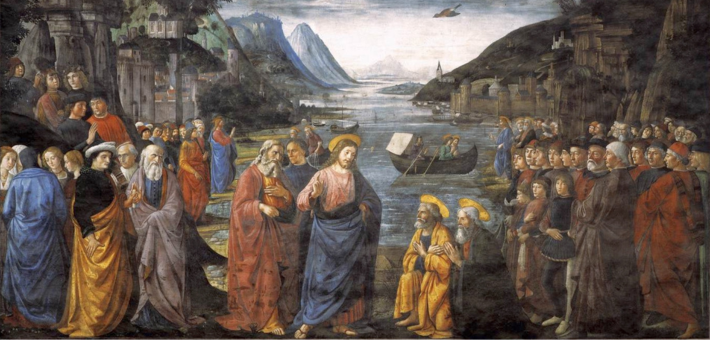
The readings for the 3rd Sunday After Pentecost, Yr. A were: Exodus 19:2-8a; Psalm 100; Romans 5:1-8; Matthew 9:35—10:23. This sermon was preached at Grace & Glory Lutheran Church in Palmyra, VA on June 7, 2026.
As the Twelve Tribes escaped Egypt with God’s help, we can sometimes wrongly assume too much about them. They did not initiate the Exodus on their own. It was God’s will…God’s loving actions freed them. Indeed, God’s intention all along was to rescue them due to God’s previous promises to Abraham, Isaac, and Jacob.
Yet after generations of slavery, they had lost themselves in those dehumanizing, traumatic, and I must emphatically say evil conditions…I have to say this because despite what people like Doug Wilson and others might be saying on the national stage or social media, slavery is evil and not the will of God. [Just because God tolerated our sin historically does not mean that’s God’s will for us. God wishes the slave to be set free.] And sadly, I know firsthand that some people still abhorrently and ignorantly try to use scripture to make that sin of slavery more palatable within our American history.
Yes, slavery can be on the personal level soul crushing, but it also serves an effective form of cultural destruction if not genocide. Empires and other entities throughout history have treated people like property, but they also in many cases, as with ancient Egypt, sought to erase those they considered “the other.” After the Israelites 400 to 430 year experience, the Israelites were not unified. They were more tribal (more divided) than when their sojourn in slavery began. Thus, God had lots of work to do. They needed time and care to recover from that horrific generational experience. The situation necessitated that they get to know and trust who God was again, but they also had to relearn how to love one another.
So, God would affirm Moses as their leader, God’s prophet, and eventually seventy elders would be appointed to help him. And God would soon (a chapter later) give them the Ten Commandments or as some of our Jewish siblings call them, The Sayings of God, to help build them up and shape them into the people of God our God intended. Yet, it is easy to miss what matters most. God names them saying, “Indeed, the whole earth is mine [everything including you and me], but you shall be for me a priestly kingdom and a holy nation” (Exodus 5c-6a). Deuteronomy recalls God naming them similarly, and perhaps most importantly, a lasting “Holy People of God” (Deuteronomy 26:19 and Deuteronomy 28:9). And within this naming, this proclamation by God, we discern their vocation which shapes all that comes after in the Bible including our Christian texts. God will steadfastly love and help them, but also God’s going to use them to spread faith, hope, and love throughout the Earth. Ultimately, God has set them aside for a holy purpose. Despite sin, despite failure and infighting, gossip and unfair criticism of one another…God will remain willing to forgive and intends to keep them part of God’s plan.
Now after this foundational context, let’s fast forward to our reading about Jesus today. It’s Good News. Jesus’ ministry is up and running. His capabilities and authenticity are starting to attract great crowds, and in the midst of these crowds, his heart is moved toward compassion. In direct opposition to what some religious but un-Christlike people are claiming in the United States these days, compassion is not a sin…Compassion is not a sin….We might err in how we offer our compassion, but Jesus who was without sin, Jesus had compassion on others…the poor, sick, the lame, the poor and cast aside.
We are told in English that these people were harassed and helpless. In the original Greek, the word for harassed literally means flayed, skinned or mangled. This wording as used here signifies that Jesus saw people who were “tired to the bone, continuously annoyed, and beaten down by life’s burdens including by too many of the religious leaders.”[i] By helpless, the text means “thrown down, cast off, and abandoned…unable to pick themselves up again.[ii] Many of these folks were beyond desperate…some near death in body if not spirit. They were too often enslaved by sin, the powers of death, and the Devil. These many stories of healings, exorcisms, and other miracles accomplished by Jesus out of compassion will reveal him to be the promised Messiah, “God with Us” – but in a bigger way than anyone expected. And as people start to see…dare to hope…that there’s something special going on in and through Jesus, the fully human while fully divine Jesus requires help as Moses did before him.
You see, this work is physically taxing. You will hear that he sometimes needed downtime with prayer in the mountains just to recharge his human body as we all must do at times. Yet, his methodology is not pure circumstance. Jesus knows his mission. Jesus knows the time he has left to complete it and all the effort that will be necessary. And Jesus knows that he wants to create – not just a nation, nothing cultural or political per se – but a vastly expanded “Holy People of God” beyond anyone’s imagination which will ultimately be called, Church. Jesus has come to call all people to himself (John 12:32).
Now, someone at the Lectionary Bible study asked a wonderful question that got me really thinking. He calls all people to himself, and yet, it seems quite peculiar and perhaps counter to his intention to instruct his new Apostles, “Do not go among the Gentiles or the Samaritans.” That is not in the other Gospels, only Matthew. And Matthew, a Jewish believer himself, was writing particularly for a Jewish-Christian community and those who might join them. If you want to help people identify Jesus as the Jewish promised Messiah to Jewish people, you help them through your story telling…the rhetorical focus of your written or spoken witness. You use these devices to point out things that you think will guide them to a correct understanding of Jesus as Son of the Living God, the fulfillment of all of God’s previous promises to the Jews.
Thus, the Gospel According to Matthew (his account or witness), is chalk full of scriptural citations pointing particularly to the prophets’ description of the Messiah. You can say, “Oh, that sounds like Jesus…that sounds like Jesus. Jesus must be the one promised.” When Jesus teaches, he reports that he did so and was recognized as if he was a wondering prophet or a Pharisee. They were called Rabbi, or teacher. Matthew tells the story in such a way that there are five discourses of Jesus. Five in ancient Jewish numerology already represented and helped identify something having a deep connection to divine power, spiritual elevation, and God’s interaction with the physical world. Jesus gave many discourses as a traveling rabbi. We should not assume there were just five, but Jesus embodies or reflects this cultural understanding and expectation. He wants his audience to come to understand that Jesus is God. Even Jesus being named Emmanuel, God with Us, reflects back to Isaiah, but also Isaiah’s understanding that no matter what happened to the kingdom or its people, God’s promise to Moses still stands. It would makes sense to Matthew’s earliest audiences that Jesus focused on the Jewish people first, for God had promised to “keep them as a treasured possession out of all the peoples” (Exodus 5b). Again, it was through them that all the world would be blessed. So, it makes sense within the Jewish expectation that the promised Messiah would go to the Jewish people first.
Yet in going to the Jewish people first, this does not mean Jesus did not love the Gentiles. His Church, despite hesitation and challenges, would grow out of the Jewish people and mix in people of all races and places where there is no longer Jew or Greek, nor male or female. Why? For as Church, “all of you [the Church, the saints, the Children of God…those saved by through the gifts of our faith and baptism] are one in Christ Jesus” (Galatians 3:28). God used the Jews to move toward a next step in unity, but God has not forsaken God’s promise to the Jews. And God is using us now, too, alongside those with the faith of Abraham. For according to Saint Paul, “For not all who are descended from Israel are Israel,” he says in Romans 9. Or Jesus says that not all who cry our “Lord, Lord!” will be saved (Matthew 7:21).
And so in Matthew 9, we see Apostles chosen and sent first to Jewish inhabitants of the land, but the mission won’t end with them either. Seventy disciples will be sent, then more, from the Jewish people to the Gentiles and throughout the Earth…until Jesus sends you and me. The needs are great, and there will never be enough workers in this world to heal all the pain and suffering. Yet, Jesus will finish this task…when he comes back again to establish a new heaven and earth. And while we wait, we serve. We love. We call others to work with us not using guilt or threat but by invitation. “Come and see. Come and help.”
We are asked to look at the way Jesus walked, and we are to listen to him, not only for our own spiritual benefit, but for the benefit of others. This is not for extra credit either. As Christians, we are supposed to understand and believe that even faith is a gift, and we cannot earn our salvation….not a smidgen of it. It is all about Jesus and what Jesus did. As Martin Luther famously said, “God does not need your good works, but your neighbor does.” What he’s saying is, “Have compassion on them…like Jesus. They are suffering. They are broken and wounded. Have compassion on them like Jesus.”
There are people in need, people without a shepherd feeling lost and alone, and Jesus wants to send you and me. Those people might “coincidentally” cross our path unexpectedly, or we might have to seek them out, but they are out there…It might be just one person that you are supposed to impact, but they are out there. Every sheep matters to Jesus. If you help just one person in your entire life discover Jesus’ love for them…Oh, my goodness. Your life is worth living. Everything you lived through was worth it for that one person who needs to know Jesus. Yes, people are waiting, hungering, to hear about Jesus and be healed. And in our Lutheran tradition, you might recall that we often speak of the priesthood of all believers. We might have slightly different calls, roles, and abilities…we might have different challenges…but Jesus calls us all to do something…something…out of his compassion for the world.
Remember, the time Jesus walked the earth among us as a human being remained close to an indigenous worldview in many ways…It was still tribal and more connected to the natural world than we might be. So, Professor Zaccharias of Divinity College pointed out in an essay, “In many Indigenous cultures [and I have seen this too having worked in Native communities and nonprofits), leadership is not about hierarchy (Who am I in charge of?) but about service (Who can I help?). A true leader is one who cares for the people, ensuring their well-being. Much like a Wisdom Keeper or Medicine Man, Jesus responds to the needs of the people, embodying a leadership that is deeply relational and motivated by compassion.”[iii] And if you ever saw those eagle feathers that they wear, they can receive those for bravery in battle, but also for the compassion and generosity they show others. We, my fellow Holy People of God, share that exact, same sort of call.
Yet, before anyone starts to feel guilty about not doing enough, you like Jesus need to be realistic about your bodies and other limits, too. It is ok. You might need restorative time in the mountains. And like Paul, hopefully you understand that your call is not my call, and we each have our unique gifts of time, treasure and talent to offer, along with uniquely varied health, abilities, and obstacles. We have to discern what I can do. Furthermore, our calls can change. Being a pastor, for example, is not who I am but what I do.
Amidst this diversity of skill and need, laborers are indeed few. And just as there was an urgency to the Apostles mission due to the cross, there’s an urgency to our mission because Jesus is coming soon and very soon. “You received without payment; give without payment,” Jesus commands us. What can you, me, and all of those who believe do in thanksgiving for the grace and love that we have received? We are being asked to be as patient, generous, hospitable, kind, and generally loving as possible. We are asked to embody and share the Good News of Jesus until our last breath.
Rather than worrying about what we cannot do, consider what we can do. We are the called, chosen, and set apart people of God after all. Life might get harder. We might die before Jesus returns. Yet, we already share in Jesus’ victory. That’s God’s promise too. Be wise but be caring. Value justice but offer mercy. Be good stewards but also be generous. Be bold, but flee or step back if one must at times for our health or wellbeing. You will know when you need to be a martyr. Don’t assume. It is not selfishness to care for oneself if it helps us love God and others all the more tomorrow.
Friends, there will always be poor among us, and we will never get to everyone no more than the Apostles will reach all of Israel, but the promises of God last forever. The mission will be completed to its fulness on the Last Day by Jesus. And yet, he longs for us to share his compassion and love while we wait for the blessed day. Amen.
[i] Etheredge, C. (u.d.). How to Identify Disciples: Helping the Harassed and Helpless (3 of 3). As downloaded at https://discipleship.org/blog/how-to-identify-disciples-helping-the-harassed-and-helpless-3-of-3/
[ii] Ibid.
[iii] Zacharias, D. (2026). Commentary on Matthew 9:35—10:8 [9-23]. Working Preacher. As downloaded at https://www.workingpreacher.org/commentaries/revised-common-lectionary/ordinary-11/commentary-on-matthew-935-108-9-23-3.
Below, please find a video of our worship service. The sermon starts at about the 31:37 minute mark.
© 2026 The Rev. Louis Florio. All content not held under another’s copyright may not be used without permission of the author unless under terms of fair use and properly attributed. Scripture passages when used are from the NRSVue translation unless otherwise indicated.