Tag Archives: baptism

Jesus was baptized for you

You can find a recording of this sermon on my blog’s companion podcast located here.

Grace and peace to you from God our Father and the Lord Jesus Christ. Amen.

Today’s sermon is a little different. You see, I have been reminiscing a bit more than usual through the holidays and with the New Year. I think that’s not uncommon at such times. Then, the Facebook memories function went ahead and reminded me of a momentous day in my life. It is hard for me to believe, but as I reflected upon today’s text about Christ’s baptism, I remembered my own…60 years ago, this coming December 2023. Wow, it blows my mind that so much time has passed, and yet it remains one of the most profound and sometimes underappreciated events of my life in my busyness. Hopefully, your baptism is recognized for its profound and lasting impact, but I must confess that I sometimes don’t stop to remember the power of my own.

Now, I am not trying to suggest you remember the day in detail. Afterall, I certainly don’t. I was only 11 days old. Yet I do know the stories and people involved thanks to my family. For one thing, with baptism, I officially received my “Christian name.” That’s commonly called being “christened.” In Martin Luther’s time, one practice was to be named after the “saint of the day” on the liturgical calendar. So, Martin, born on November 10, is named after St. Martin of Tours, the saint remembered on Luther’s baptism day of November 11. As is a tradition among some Italian families, my dad was named after his maternal grandfather, Luigi Marini, and Luigi after his maternal grandfather before that. The name was ultimately in honor of a popularly venerated saint, Aloysius of Gonzaga (in Latin). He is more commonly called Luigi of Gonzaga in Italian. Born in the US, my dad’s name was Americanized, so you narrowly escaped having a Pastor Luigi standing before you today. Yet with my name, in my baptism, I was encouraged to represent myself well. For though it and my life, I represent the legeacy of my genetic family, my Christian family today and throoughout time, and Christ’s own name. I come to bear the name of Jesus Christ. That’s no small thing.

And thus, as I was baptized, I was also gifted two wonderful, loving godparents, ultimately what we often call sponsors today…to be with me at my baptism, to speak for me, and there, promise to love, help, and guide me (the best that they could) into a life of faith. (In the old days, there might even be an expectation of adoption if the parents died, but that’s not the case today.) Arthur Coughlin, my godfather, was a dear friend of my dad’s. He ultimately co-owned one of the most successful sporting goods stores in the Boston area, Holovak and Coughlin. Yet what he was most known for was his deep religious faith that one could see evident in the way he walked through daily life, in his long-lasting friendships, and perhaps most especially from his generosity. He and his business donated lots of money and time to those in need. And, he was among one of the first people to sense a special call by God in my life. I remember clearly the exact moment he asked me about this at my eldest sister’s wedding…He had seen me help at the service, and refelcting upon what he knew of me and my life, he asked, “Have you ever considered being a priest?” An important seed was planted. (And as Pastor Anne can tell you as a member of the Virginia Synod vocations team, that’s a thing we look for – not just an interior sense of call, but that someone sees something at work in you.) Meanwhile, my godmother, Anna Kendrick, was my mother’s cousin. She was never married but worked all her adult life with an accounting firm. Yet what stood out to me most, once again, was her love, grace, and piety. She humbly and efficiently cared for and loved her widowed mother, who was declining with an early onset of dementia. All the while Anna kept working, sacrificing, and keeping the extended family going. Through both people, I was gifted with their prayers, a willingness to love and support me, but perhaps most wonderfully, a witness to faith that went beyond words. They helped preach those sermons I could see.

So, now you know that I was baptized as an infant, and that leads to a third, likely most significant impact leading to many other countless ramifications…many I won’t likely ever recognize in this life…In baptism, I became a child of God in a special way. Through the Water (a sign) and the Word (the promise of God), my intimacy with God changed. Did you catch that nuance? All members of humanity are at some level created in love by God and loved by God as children. And explicitly according to scripture, Jesus came to call all people into relationship. Yet, we also know that there are some who respond to God’s call through faith more than others; while some not at all. Thus among the faithful, we hopefully seek to listen to and follow Jesus Christ. And one of his most important commands was made to his new Church as he prepared to ascend to heaven. As recorded (in Matthew 28:18-20), “All authority in heaven and on earth has been given to me. Go therefore and make disciples of all nations, baptizing them in the name of the Father and of the Son and of the Holy Spirit and teaching them to obey everything that I have commanded you. And remember, I am with you always, to the end of the age.” In Mark 16, he goes so far to declare one who believes and is baptized will be saved (Mark 16:16a). And so today, the Sunday following Epiphany, as the Church sets out into another new year, we annually remember Jesus’ own example. We stop and ask, “Why is baptism so important that Jesus, born without sin, be baptized? Why should we be baptized? So, let’s gather at the river for a moment and take a closer look.  

As we heard during Advent and hopefully over the years, John was the greatest of all prophets according to Jesus. He had the special job of preparing the way. He called people into repentance, and he baptized them as a symbol of their new start. Yet he wasn’t the first to baptize. Baptism was already a ritual of the Hebrews. Each synagogue had ritual baths for people and items to help them fulfill Levitical and rabbinic laws and teachings. The Mikvah, or bath, was used and is still used by our Jewish siblings, for full immersion in water of people and things for ritual purification…the restoration to a condition of “ritual purity” in specific circumstances. I’ve read it was not called baptism per se, but it is like baptism. Also in John’s time, the Essenes, a mystic Jewish sect, lived out in the wilderness as they sought to separate themselves from the sin of the world. They shared a communal life. They committed to practice piety toward God and righteousness toward their neighbor. Many of the Essene groups appear to have even been celibate. They lived a spartan life, as John did, as a sign of their heart’s desire to repent. And as new members joined their community, they were invited to be immersed…to be baptized. Yes, John’s activity was firmly rooted in what came before and other practices around him…and yet…and yet…he pointed to something new. He pointed to Jesus and a new baptism. “I baptize you with water for repentance,” he cried, “but one who is more powerful than I is coming after me…He will baptize you with the Holy Spirit and fire.” And so, Jesus did come, and John resisted baptizing one he knew to be the Son of God, one without sin. “I need to be baptized by you,” John argued.

This is a critical passage. This is a major event. At some level, our baptism is meant to be a physical sign of a new covenant, a loving promise more than a contract, in a long line of increasingly intimate covenants. God has reached out over and over again to humanity, whereby now, we can be marked by the cross of Christ and sealed by his Holy Spirit through baptism forever. Indeed, God’s promise made to us at baptism is more important than any of those we make near a font, pool, or river. Using baptism, God is fulfilling an ancient promise made for the final age. It is found through the words of the prophets, such as Ezekiel (36:26), “I will give you a new heart and put a new spirit in you; I will remove from you your heart of stone and give you a heart of flesh.” John knew that his baptism was for repentance, a symbol. With Christ, access to something new came…baptism of fire and Spirit.

No, our Christian baptism isn’t just a bath. It is not just about ritual purification or blessing. It isn’t just a symbol of new birth or entrance into a community. It is these things, BUT it is more than those things. Baptism as understood by the majority of Christians across the world…the vast majority today and throughout time…has been recognized as transforming. Baptism changes us. The Spirit claims us…grabs hold of us in love, and never wants to let us go. Throughout one’s life, the Spirit is at work. Sometimes easily seen, that work can be subtle as well. Luther used to say God seemed often hidden, yet God never stops working to call us more deeply into relationship…to make us holy…to save us. In baptism (as with the Lord’s Supper), we are promised that God touches us with grace in a most intense way. It is a means of grace…a way of grace to strengthen us on our way. It saves us as we become part of God’s most intimate family, the church. It saves us as the Spirit tries to protect, bless, and guide us each day. It will help save us as we appear before the throne of God to face judgement, not because we did something to earn salvation, but because in baptism, God has gifted us something which enfolds us more fully into Jesus’ own saving ministry… his own life, death, and resurrection. (See Romans 6:3-11 for example.)

In the early Church, baptism was thought so important, converts in biblical times would be baptized by household – fathers, mothers, grandparents, children, servants and yes, even slaves. As the church formalized, baptism became part of the worshipping community’s activities, often celebrated at the high feast of the Resurrection of our Lord, commonly called Easter. Throughout Lent if not longer, adult converts would be called catechumens and be prepared to receive the sacrament…to try to teach them about a mystery that no one can ever know enough about…a love so vast that no human mind or words can ever capture it. And so, because we can never know or do enough, there also remained the practice to baptizing infants among the faithful. For whom can ever know enough to earn God’s grace…do enough…no one can but Jesus is worthy. Thus, two or three (or more) gathered in Jesus’ name gathered (and continue to gather) at a river, pool, or font…turn to God and ask in faith for the Holy Spirit to be present in that infant’s life…not just that day…but forever. And it is Jesus himself who says that God will surely answer such prayers.

Yes, some who are baptized can wonder away. Not all the slaves baptized likely had any heart of faith. Even adults can think they are ready to commit to Christ but fall into grave sin after baptism. Yet the Church says, echoing promises of scripture, even then…even if you were to give up on God…God will not give up on you. God will never give up on you. I see that in my own life looking back. Despite my good start, the world was hard. You’ve heard some stories before today, and we don’t need to revisit them now. Just know that I wondered far. Trusting in God’s grace, I confess openly that I deeply hurt myself and others. Yet I can look back on my life and now see people, places, and events…even an interior stirring (or burning of the heart as Wesley and other saints have spoken about)…calling me back by name…inviting me into a living forgiveness… allowing me a new start each day…calling you, too.  

In Jesus’ baptism, we hear an affirmation of his sonship. We learn that the Spirit will affirm him, drive him forward, and sustain him. Jesus humbled himself. As Paul writes, he emptied himself by taking the nature of a servant. (See Phil. 2) Thus, his baptism teaches us of our own. As Professor John Yieh proclaims, “For Jesus and for Matthew, the righteousness of God is a gift from God that requires believers’ commitment to hunger and thirst for it (5:6, 10), to practice (5:20), to seek (6:33), and to bear its fruit (3:8; 21:43). In other words, Jesus is showing his followers how they should take seriously the ritual of baptism, the life of repentance, and the pursuit of righteousness as he did through his humble baptism by John in the Jordan, and in his whole life” (Workingpreacher.org, January 8, 2023).

As this new year begins, no matter what we have done or failed to do, no matter what questions we still have about our worthiness or purpose…in baptism, God has declared us loved and God’s own. Don’t give up, but seize the day…seize the gift being offered you…no matter how hard. For, God is not done with you yet. Or as Martin Luther puts it, even more forcefully: God, who cannot lie, has bound himself in a covenant with [us], not to count [our] sin against me, but to slay it, and blot it out’” forever. (Treatise on Baptism).

Whatever comes, seek to remember your baptism, for God remembers you. God has chosen to love us forever…And if you haven’t been baptized? In the name of Jesus Christ, we invite you to do so. For God loves you, too, child of God, and is calling you by name. Amen.

Unless otherwise indicated, all scripture quotations for this post are from the New Revised Standard Version Updated Edition (NRSVue) translation.

© 2023 The Rev. Louis Florio. All content not held under another’s copyright may not be used without permission of the author.

1 Comment

Filed under Uncategorized

What have you to do with me, Jesus?

  • Second Sunday after Pentecost, Year C
  • Texts: Isaiah 65:1-9; Galatians 3:23-29; Luke 8:26-39
  • Pastor Lou Florio – June 23, 2019

Evil…There is something about evil in the world that frightens us. And yet, it can simultaneously have the power to entice us…to draw us in. Slowly but surely, if we don’t reject and repent from the evil of the world around us, it can seem to become part of us…It can in a way consume us. In just about every culture of our world, faith traditions try to warn us. “Stay back from evil! Turn away! Repent! Focus on the goodness and promise of this life, or else we risk becoming possessed by the evil we fear.” Our lives can indeed become consumed by the tempting evil around us and the sin at work within us. Life itself can become a kind of nightmare.

Now certainly, we might not always recognize many of our struggles as demonic spirits at work like our ancient forbearers tended to do. Yet after so much time spent as a missionary among Native Americans who see the world in grand, interactive spiritual terms, I can’t say there isn’t a spiritual element to many of our problems. It is indeed the same worldview of the Gospels, and I’ve seen and experienced too much. The many twelve step groups that deal with varied addictions (and have been used by God to help so many) assert this as well. Much of our foibles and sin at some level grow out of an unanswered spiritual hunger or emptiness within us. Yet rather than turning to God, we tend to seek our own way, and that’s when we risk getting lost.

And so, as we approach today’s Gospel story, I would implore us to keep an open mind. We moderns like our demons in movies, not in life. Yet, I would argue we all have demons we deal with at some level. And there certainly seems to be powerful, explicit evil force at work in the world if not our lives as we struggle with sin, death and the Devil each day.

Therefore, however it happened, I feel deep compassion for this man calling himself Legion. I wonder how he got to live naked and alone among the tombs of Gerasene. Did he give in to temptation one too many times? Or perhaps beaten up by the world, did he withdraw from reality and loose himself on the way? Or, he could have even dabbled in magic or other black arts while trying to control the world around him…evil making itself slowly at home in his mind and his heart over time?

We don’t know the answers to how he got to be seemingly consumed by evil. We don’t have his history, but we do know that the path of sin leaves wreckage in our wake: broken relationships, isolation, a loss of our identity as beloved children of God. Sin, our sin and the sin and evil we encounter systemically in the world, has the power to destroy us and all we hold dear. This, to me, is perhaps the scariest part of the story: I fear the deep pain growing in his heart as he began to hate the world around him, our shared life, and most likely even himself.

Yes, this demon possessed man might have forgotten who he was intended to be, but Jesus didn’t. As part of the Triune God and the promised Messiah, Jesus’s actions will embody the Good News as well as fulfill the words of the prophets of old. Jesus will get into a boat to cross the sea of Galilee. It almost seems like a whimsical decision. “Let us go across to the other side of the lake,” Jesus says. And so, they put out. And on that trip, they face death in a storm that Jesus will calm – as only a god could do.

Then, he next arrives in a land occupied by outsiders to their faith, the gentile Gerasenes. Here, he will show his power over the spiritual realm. Right away, he is met by a man who lives among the dead; who claims the name Legion. (This term, recall, is a military unit of 6,000 Roman soldiers and thus perhaps an indication of the many demons hidden but at work inside him). The man cries out at the top of his voice (in Greek the words indicate a deep, guttural, almost painful cry), “What have you to do with me, Jesus, Son of the Most High God?” (“What business do we have in common?” is another translation.) Why do you care for or bother to come to me?

Jesus lives his answer. He has come to defeat sin, death and the Devil…to trample it underfoot as one of our communion prayers reads. He has come to call the lost, save the sinner, offer mercy and abundant, eternal life to all those that suffer in mind, body or spirit. He will even die for all, so that we might live forever with him. Jesus embodies the promise of Isaiah, the very attributes of God, as he reveals himself to those who did not ask for him and will be found by those who did not look for him (see Isa. 65:1).

Jesus will save this man with amazing grace. He will send that man – now healed and whole – back to his home to share the good news of what God has done for him…to share his faith in Jesus. Jesus loved this man, and he has crossed the waters to save him. Nothing else is reported from this trip, only this one story. It seems as if Jesus has come only for him…loved him as if he were the only one because that man needed Jesus.

Certainly, this is an ancient story with an ancient worldview, but it remains a story that plays out in our modern lives. Jesus comes for us who are broken hearted, who hate how we behave, who are lonely, who struggle valuing ourselves and the life that we have been given…a sometimes very difficult life. Think of whatever the deepest most hidden sin you struggle with, or consider your greatest fear, and then ask Jesus, “What business do you have with me? Why should you even care?” The answer remains the same, “I wish to share everything I have with you, because I love you.”

So here he is, Immanuel (God with us)…Jesus…reaching out to us, but too often, we are afraid to believe…afraid to trust him. We doubt the power of his cross to make a difference in our lives. “It is too good to be true,” we might say. “My sin is too big to be forgiven.” “I am unlovable and worthless.” To be honest, as a human in need of saving, I’ve heard these phrases in different forms whispered in my own mind at times. Also time and again, as a missionary, chaplain and pastor, I have heard these fears shared by others using varied words. It seems part of our shared, earthly experience – our corrupted spiritual DNA perhaps. These lies (and that’s what they are) tend to haunt us.

In response, always remember that Jesus speaks to us too: in our life among God’s faithful people; in hearing the Word and sharing the Lord’s Supper; in our proclaiming the Good News of Christ through word and deed; as we serve all people following the example of Jesus and strive for God’s justice and peace…Yes, in faithfully living our promises of baptism, we, too, are blessed and healed while evil is sent running away.

Jesus uses these lived promises to perform miracles. He draws us away from the powers of this fallen world and closer to himself. I know it can remain scary to leave what we know (even sometimes the pain of sin itself) in order to embrace this new life in Christ, but Jesus has come far to lead us home. Believe in him, hold on to his promises, and do not be afraid, for we are about to witness miracles beyond our wildest dreams. Amen.

Photo credit: sl3p3r on pixabay.com

Unless otherwise indicated, all scripture quotations for this article are from the New Revised Standard Version (NRSV) translation.

© 2019 The Rev. Louis Florio. All content not held under another’s copyright may not be used without permission of the author.

Leave a comment

Filed under Uncategorized

You’ve already passed

Pentecost. Image by Holger Schué from Pixabay
Pentecost Sermon, Year C
Texts: Genesis 11:1-9; Acts 2:1-21; John 14:8-17
Christ Lutheran Church, Fredericksburg, VA
June 19, 2019

The great St. Paul, surprising Apostle to the Gentiles, once confessed, “When I was a child, I spoke like a child, I thought like a child, I reasoned like a child; when I became an adult, I put an end to childish ways” (1 Corinthians 13:11). Thanks to the Holy Spirit, his faith and understanding evolved, deepened and grew as he journeyed through life – as it intends to do during all of our lives.

As I turned to the Holy Spirit in prayer this week, I asked for help with today’s message. That’s always a good place to begin, and after some time, this particular passage came to my mind and just wouldn’t go away. It just seemed so appropriate in light of our reading on the Tower of Babel, as well as our having nine of our youth recognized as adults though the ritual of confirmation, and one adult choosing to affirm their faith this day as well. You’ve probably heard it before at a wedding or other community focused worship event, as Paul seeks to address the importance of the faith, hope and love we all share as Christians.

As I said, this quote came to my mind as I reflected on the Tower of Babel. I was fascinated by this story as a child with its dynamic images of a tall tower reaching towards heaven. I thought it was so cool. And then, we get to hear of punishment…or at least, that what it sounded like to me. In my juvenile mind, I saw the tower come crashing down in God’s anger with fire and brimstone or perhaps a mighty wind – much like I might have torn down my Lego towers while playing. I pictured this destruction even though scripture tells us no such thing. Scripture reveals that the tower survived unfinished, and the people were only scattered throughout the earth, never destroyed or abandoned. This was just as God intended when Adam and Eve were told to go forth and multiply and inhabit all the earth. The people of Babel would spread over time with new languages and eventually dynamic, beautiful new cultures. Each of these cultures conribute to a remarkable tapestry that makes our world a better place and helps glorify God. My childhood brain could certainly understand consequences for wrong behavior…but the wideness of grace and mercy? Apparently, I wasn’t quite ready to understand that.

This sacred story often shared even in preschools is at its depths no kid’s story. It is a mythic tale, and by that I don’t mean false, but a teaching story rooted in the past and revealing ultimate truths about ancient peoples, ourselves, and the sacred activity of God woven through it all. If you listened closely, you heard that the people of God, yet once again, have sought to be like God. They are chasing after the power, wealth and glory of this world and losing touch with who they were meant to become in the process. Much like Adam and Eve, they’ve reached for that unattainable fruit, and now, they face separation from God and one another. That’s always the way when we do such things, even today.

Like Adam and Eve, these people were sent out into the world, but just as Adam and Eve wouldn’t leave Eden without God’s grace and a plan for restoration, neither will the people of Babel. Adam and Eve would be provided clothing, protection and family. The people of the tower will receive something even better. God will make eternal good come from bad. Among all these new peoples, one people would be set apart. Remember the “children of Abraham?” Abraham would be given a trust in God that would rush and wind its way down through a very troubled, often sinful family line. This was often a family that fought amongst themselves, who were selfish and lazy, or sometimes meanspirited and lacking faith. They struggled with faith and often sinned. Yet, they spread out into the world and became what we know as the people of Israel. The Jewish people, a small, enslaved and often conquered people, would be used to fulfill promises delivered by the prophets. Through the Jewish people, all nations would become blessed. It was the Jewish people who lead us to Jesus, and some from this people will number among his first followers. Today, our confirmands claim their share in that sacred inheritance.

Yes soon, moments from now, our confirmands will be welcomed as adults in the church. They have been offered a choice to affirm the promises of their baptism…to seek to love Jesus by following his commands. Yet as they have hopefully learned (and all we Christians should understand), we can topple as easy as the people on that tower of Babel. We are they, and they are us…flawed, sinful, never able to be perfect on our own…people. We are just people. And so as we set off in the world with good intentions, Jesus offers us hope, help and a way forward. An Advocate was sent to live with us and in us. It came to us through the promises of our Baptism whether we feel it or not; understand it or not. For, it is God’s promise to us!

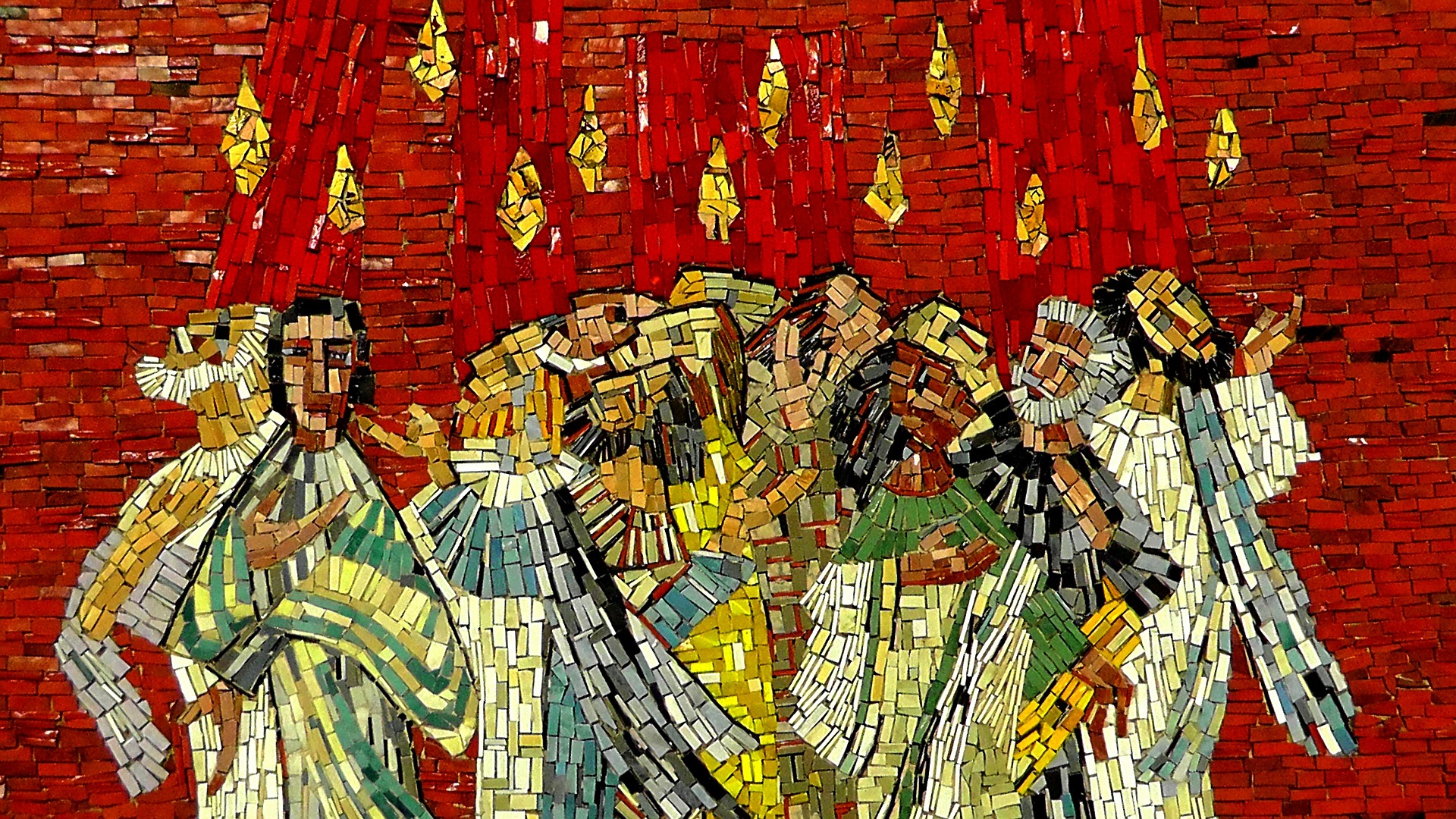
Now, as a child (even into my young adult years), I understood this wrongly. Yes, people promise (or have sponsors promise on their behalf when too young to do so themselves) to seek to follow Christ. Publicly proclaiming and affirming our faith is a great and appropriate thing to do each and every day, but if we are honest, we know our promises will break now and again. Fortunately, baptism is not ultimately about us. It is more about God’s reaching out to us. And so daily through our lives, the Holy Spirit…the One who came upon us at our baptism…who claimed us as God’s own at our baptism…who set us apart to bless nations…that very same Spirit will seek to affirm and fulfill a godly, perfect promise again, and again and again…even when we goof up… even when we don’t deserve it. With that Spirit’s first coming to dwell in the hearts of the Apostles, we were given a sign to help us believe. Recall, “All of [the disciples] were filled with the Holy Spirit and began to speak in other languages as the Spirit enabled them (Acts 2:4).” What had seemed a curse for the people of Babel had now become blessing in the hands of our God…a gift meant to unify and call people of all nations home. They would be called through the voices of ordinary people.

Yes, it is true that through the ages we have inherited a sometimes fractured, imperfect faith skewed by human sin, but the Spirit makes even faith much smaller than a mustard seed “count,” or in other words have a powerful affect. Faith can impact us and transform our life. Our shared faith has made it to us through torture and persecution, corrupt church government and fallen preachers, and even our ancestors (sinner-saints all; people just like us). it couldn’t be stopped. It has come to rest upon us all these centuries later…lives inside us. Yet while the Spirit invites us to faith, it never forces. It challenges us each day to say publicly we believe (and also live like it too). God’s deep desire is to have all nations and peoples praise him in those many languages. And today on Pentecost, we are reminded that we have been chosen to become part of God’s story, the one who spoke us into being with a purpose.

When I was seeking to become a police officer, I had to take a complete physical exam testing both mind and body. I was younger back then, and I had no glasses. As I went through the eye test looking through a scope to read those small, random, letters in a line, they grew smaller and smaller. “What do you see know?” the technician asked over and over and over again. As it went on and on, I became confident that I had failed the test, and I finaly gave up. I was defeated, and I assumed my dreams were dashed. And so, I finally admitted that I could no longer make any letters out. It was only then the technician laughed and said, “No worries. You have excellent vission. I was just seeing how far we could go.” I share this story with you, because I had already passed the test without even knowing it.

As you, our confirmation candidates, come to profess your faith publicly today, you might not see clearly where your future lies. You might not fully understand how God intends to use you or has been using you already. You might even fear you are not up to the test before you or have doubts or struggle with even the idea of faith…so might we all admit such things at times if we are adult about it…but fortunately that’s not the key to this day or any of our days with Jesus. Jesus has passed the test for us. We need not worry, only believe.

Yes, we are already declared acceptable to God and deeply loved through this gift of our faith and baptism. As the head of our Synod’s Youth Council rightly proclaimed yesterday before the assembled “wiser” adults, youth are not the future of the church, they are already the church – now and into the future. With the Spirit’s presence in your lives (in all of our lives), I trust that even greater things are yet to come just as Jesus promised. I urge you to seek out the Spirit, and try to hold onto it. For when you have faith, you are in for one amazing ride. Amen.

2 Comments

Filed under Uncategorized

A Paschal People

Christ Lutheran’s font ready for an Easter baptism (2019).

As I write this, we have just entered the Church’s most special time of celebration. (Yes, even more special than Christmas.) We are celebrating the Three Days (also called the Triduum). During this time, we remember Jesus giving us a new command to love one another, but also to share in the Lord’s love for us, Holy Communion. “Do this in remembrance of me.” We then recall Christ’s suffering for our sake. On Good Friday, Jesus gave his life so that we might live with him forever. Christians argue about the mechanics of this mystery, but somehow, someway through the love of God, those who trust in Jesus will share in eternal, abundant life. And finally, we celebrate Easter (traditionally called Pascha) with shouts, “Jesus is risen! He is risen indeed!” We welcome the day and one another in celebration of Christ’s resurrection.

But is that really, finally it? No! The Church celebrates the gifts of Easter for fifty days. During the Season of Easter, we will hear tales of the early Church and promises of Christ coming again. The Easter cycle concludes with Pentecost, the day we remember the Holy Spirit descending upon the first people who will become “Church.” Empowered by that same Spirit through our faith and baptism, we share in all the gifts of being Church together with them and all those saints who will come after us.

And even then, it isn’t over. Each Sunday is meant to be a little Easter. We welcome new members to Christ’s family through baptism. We regularly recall and share in the Lord’s Supper. We remember the sacred stories of God’s love for us and especially the Risen Christ. We are a Paschal People called to gather so that we can be sent out to point others to the love of God; the love made most clear through Christ’s suffering, death and resurrection for our sake.

In our life together, Jesus proclaims we are to be his body. People will see Jesus through our shared fellowship, worship and service as we love one another. And as with the disciples on the road to Emmaus, we might just catch a glimpse of the Risen Christ on our way. The promises of scripture might even begin to burn just a bit more warmly within us, perhaps with greater clarity and certainty, as we walk this road together.

Dear Church, I pray we experience a blessed Easter, a life with Christ which lasts forever in joy.

“Praise the Lord, all you nations! Extol him, all you peoples! For great is his steadfast love toward us, and the faithfulness of the Lord endures forever. Praise the Lord!” (Psalm 117)

Originally published in the May 2019 newsletter of Christ Lutheran Church, Fredericksburg, VA.

Unless otherwise indicated, all scripture quotations for this article are from the New Revised Standard Version (NRSV) translation.

© 2019 The Rev. Louis Florio. All content not held under another’s copyright may not be used without permission of the author.

Leave a comment

Filed under Uncategorized

“Still Glides the Stream”

The Hub, Feb. 20, 2019

As my installation ended and the party began, I was presented a gift from our congregation: a beautiful new stole. Stoles have been a sign of public office since the days of the Roman Empire. As stoles became identified with worship leadership in the growing Christian faith, they grew more ornate often with symbols from scripture, the sacraments or church year. My new stole is white, a liturgical color associated with the feasts of Easter, Christmastide, and other high festivals of the church. The white stole is richly decorated with a dynamic stream of varied colors and symbols. The artist’s inspiration was “the river of life.”

Grounded in the waters of our baptism, what a marvelous and appropriate gift. Where have we come from? Where will we be led? With former church members from Mechanicsville, colleagues from my past hospice work, social ministries and seminary studies, as well as members of Christ Lutheran gathered, we represented Lutheran, Episcopalian, Methodist, Presbyterian, Orthodox, and Roman Catholic believers. It was a small but mighty subset of the “great cloud of witnesses,” each with gifts to offer. We are certainly part of something much bigger than ourselves; driving us together, pushing us on, churning us with change and renewal.

One of my favorite poets, William Wordsworth, reflected on the River Duddon, “I see what was, and is, and will abide; Still glides the Stream, and shall forever glide…” Soaked through with the love of God and one another, we are in for a great adventure. God’s grace has set us free.

Originally published in The Hub, a weekly email of Christ Lutheran Church, Fredericksburg, VA.

© 2019 The Rev. Louis Florio. All content not held under another’s copyright may not be used without permission of the author.

Leave a comment

Filed under Uncategorized