A comet that gained an earthly following because of its bright tail visible from space was initially declared dead after essentially grazing the sun. Now, there is a sliver of hope that Comet ISON may have survived. (Source: AP, 11/19/13)
“For surely I know the plans I have for you,” says the Lord, “plans for your welfare and not for harm, to give you a future with hope.”(Jeremiah 29:11)
In Jeremiah’s letter to the Jewish people in exile, we hear God speak profound words of hope in the face of their doubt and darkness. God had not abandoned them. God did not stop loving them. The world seemed to be crashing down around them, and many were tempted to give up on forgiveness, salvation and new life. Yet, God would never give up on them. Rather than assimilating to the “realistic” outlook and ways of the world, they were invited to look to the Lord, have faith, and truly live.
No matter the generation, it is no different for us who dare to believe in God amidst our own struggles. Abraham hoped against hope; trusting that he would become “the father of many nations”[1] just because God had promised. We are told not to be jealous or measure ourselves against others. “Surely there is a future, and your hope will not be cut off,” Proverbs assures us.[2] In the face of many trials and losses, Moses and his people were still shown the way to freedom. They just had to trust, seek to follow God, and walk on.
Jesus himself tells us, “Do not worry about tomorrow.”[3] Instead, he only asks us to trust in him, follow his light, and reflect his love. He is our star of hope which no darkness – including our sin – can ever overcome. No matter our challenges, our lives are free to glorify God and rejoice, because of the hope laid up for us in heaven.[4]
Discussion question: How can living as a people of hope shape our lives?
The above reflection was originally published in Messiah Lutheran Church and School’s worship bulletin for the Fourth Sunday of Advent, 2013. It is meant to complement Creative Communications’ Bright Star of Bethlehem series for Advent and Christmas.
Unless otherwise indicated, all scripture quotations for this article are from the New Revised Standard Version (NRSV) translation.
When they saw that the star had stopped, they were overwhelmed with joy. (Matthew 2:10)
The word joy is one of the most frequent words found in scripture – about 200 times depending upon the translation you read. This might surprise some people who think of faith as a burden. Yet, joy is exactly what God desires for us.
Oh, it isn’t that joy we get as we open a new Christmas gift. Nor was it fully reflected in the joy of the Magi as their journey came to an end by the manger. No, this joy goes deeper, lasts longer, and never ends. It is the joy that Christ gives us through trusting in his love for us. It is the kind of joy that can’t help but overflow.
Indeed, Jesus is our joyful gift; to welcome into our hearts or reject freely. Rather than forcing us to come to him, he comes to us. He put people in your life to invite you, challenge you, and call you to himself. He saves you because he delights in you (Psalm 18:19). You bring him joy! In fact, he says he chose you as you are, so that you can share in his mission of bringing his joy to others and find joy along your way.
Jesus said that his life, teachings and example were given for us “so that my joy may be in you, and that your joy may be complete.” This joy isn’t something we chase after or hide away. Instead, it is something we live in community – whenever we love one another as Jesus taught.
Discussion questions: How are you personally called to bring the joy of Christ to others? What joy do you share with your family of faith?
The above reflection was originally published in Messiah Lutheran Church and School’s worship bulletin for the Third Sunday of Advent, 2013. It is meant to complement Creative Communications’ Bright Star of Bethlehem series for Advent and Christmas.
Unless otherwise indicated, all scripture quotations for this article are from the New Revised Standard Version (NRSV) translation.
An image of a ‘light echo’ produced by the glare from a star that was, for one brief shining moment, the brightest star in the night sky – V838 Monocerotis (Source: Daily Mail)
“And I, when I am lifted up from the earth, will draw all people to myself.” (John 12:32)
Through the fall, the world suffered what seemed to be irreparable separation from God. Instead, the rest of scripture reveals God’s ultimate plan, the reconciliation and unity that occur through Jesus Christ.
In the Jewish scriptures, God promises time and again to use the Jewish people as a means to bless all nations. In the Gospels, we see Jesus preach, teach and do miracles in ways that heal the world and draw people together in his love. As the church begins, we learn from the Spirit that there is no longer gentile or Jew, male or female. Economic and political differences, ethnicity and language are moot points when it comes to the reach of God’s love.
In the end of time, all promises will be fulfilled. Jesus will come again as “the bright morning star” announcing:
“The Spirit and the bride say, ‘Come.’
And let everyone who hears say, ‘Come.’
And let everyone who is thirsty come.
Let anyone who wishes take the water of life as a gift.” (Rev. 22:17)
Until that day, we have been called together to be his one body, the church. On his behalf and with his authority, we have the honor and duty to share the water of life and invite all we meet, “Come, follow Jesus. Be one with us in his love.”
Discussion questions:
What gets in your way of a deeper relationship with Jesus? How do you live as one with his church? How can you invite others into such a relationship?
The above reflection was originally published in Messiah Lutheran Church and School’s worship bulletin for the Second Sunday of Advent, 2013. It is meant to complement Creative Communications’ Bright Star of Bethlehem series for Advent and Christmas.
Unless otherwise indicated, all scripture quotations for this article are from the New Revised Standard Version (NRSV) translation.
This Hubble photo is but a small portion of one of the largest seen star-birth regions in the galaxy, the Carina Nebula.
Luther observed, “Our Lord has written the promise of resurrection, not in books alone, but in every leaf in springtime.” God is, was, and always will be part of the creation that surrounds us.
Yet in a fallen world, that wasn’t good enough. The works of sin, death, and the Devil enslave our lives, separating us from God and one another.
Instead, God longs for relationship and intimacy; to replace our hearts of stone with hearts of flesh. Through the prophets, God promised to make his home with us, not in some new stone temple, but in those same hearts so prone to wander and fail.
Into the world, God sent his only Son to fulfill this promise. Jesus would take on flesh for our sake. He would live for us, work for us, suffer for us, and die for us. From his resurrection, our own eternal life springs forth.
Through the mysteries of our shared faith and baptism, we now become a new creation, freed from our flesh and the limits of this world to be the children of God. We are saved to be his body which proclaims the Good News: Jesus has come into the world to offer new life to all.
Discussion questions: As part of God’s creation, the promise of resurrection is written in each of us, as we are now. How does your life signify or serve as a promise of the resurrection? How could you “shine more brightly” to better give God glory and point others toward Christ?
The above reflection was originally published in Messiah Lutheran Church and School’s worship bulletin for the First Sunday of Advent, 2013. It is meant to complement Creative Communications‘ Bright Star of Bethlehem series for Advent and Christmas.
Unless otherwise indicated, all scripture quotations for this article are from the New Revised Standard Version (NRSV) translation.
Thanks to all those who helped Messiah Lutheran Church and School celebrate our 45th anniversary. I created the above video to present during our worship service to help us reflect on our past, present and future together. It includes many (but not all) of our partners in ministry. For a small church, you’ll see once again that we have a long and loving reach! It is not by accident a Thrivent loan representative remarked that we do more than many congregations ten times our size.
At Messiah Lutheran, we live out many signs of discipleship: feeding the hungry, caring for the sick and those at risk, meeting the marginalized and loving them as they are. Our financial stewardship has increased each year (faster than our growing membership), and our volunteering and lay leadership at our congregation and in the community has increased even more so. We have many new partners and now friends in ministry that help us reach beyond Hanover County to the world. Firmly Lutheran, we open our hearts to work with other Christians as part of one universal church, the family of God.
Yet we aren’t just busy bodies. Our activities, programs, wealth, size or location don’t make us who we are. In fact, we sometimes “lack” in those areas by standards of the world. No, we seek to act in response to our greatest gifts from God – hope, faith and love – and that makes all the difference. It defines us, shapes us and is the source of our ultimate significance. It is what makes so many notice our small little church in Mechanicsville as something “different.”
Over six years ago, the love I saw you have for one another attracted me to say yes to the offer of a call as your pastor. It is your love, a reflection of Christ’s own, that inspires me still. It is what amazes so many I meet, and I see it changing the world a relationship at a time. God’s doing something here. Christ is being made known.
Sure we aren’t perfect, and we can always do better. A small church that seriously struggles at times, we have Jesus and we have each other. That’s more than enough, and so we keep on discipling…together…no matter what.
As my friend from the Congo wrote, “Glory be to God for his faithfulness, happy celebration to everyone at the Messiah Lutheran Church and School.” Indeed, it is God’s faithfulness that invited us to be church together and made our celebration possible. Thanks for letting me walk with you. It is my honor, privilege and joy.
Pastor Lou Christ the King Sunday November 24, 2013
(I hope you enjoy the video. Please feel free to share this video with your family and friends.)
As Thanksgiving approaches, I find a favorite movie has begun playing on television over and over again, Miracle on 34th Street. This year, I have been reminded that miracles can happen over and over again in real life as well – whenever people choose to love one another as Jesus asked.
This past All Saints Sunday, I was given permission to share a sacred story. It was a tale of a suffering saint, not from long ago, but of one in our midst. Our sister in Christ, Rachel[i], a long-time member of our congregation, a baptized and believing child of God, was in desperate need. She was alone, fighting mental illness, and at risk of becoming homeless.
Rachel is well known to many if not all in our congregation. She has been a congregational member since the 1990s, although she has attended on and off since that time. Of late, she has especially stood out. Visibly, she has grown weaker and distant. Flowing conversations have become more and more difficult. Recently, one might only be answered with a short phrase or a single word. Due to medical issues, she is often seen getting up and down during our worship – going outside the sanctuary to the rest room or for water – and then returning. To be frank, her demeanor, appearance and behaviors could easily put one off or prove annoying.
This situation is sadly not unusual. She shares a story with many who are without family and suffering from mental illness. It is a story that began perhaps before birth, as her mother is said to have suffered from both mental illness and addiction. (Such issues are believed by some to often be partly genetic.) Yet, Rachel also reportedly suffered severe abuse in her original home from others who should have loved her. It is quite a testimony to her tenacity and gifts that she escaped that environment to become a valued employee where she worked and love a family of her own.
Still like many with similar histories, married life proved a challenge. When her husband allegedly became abusive, she decided to divorce him and start again. Unfortunately, he was able to use her mental condition and lack of financial means against her. She lost her children to his custody, and the now adult children – seemingly not understanding mental illness nor family systems – continue to blame her for the dissolution of their family. There is no meaningful contact or support.
Although she had tried hard to provide for herself and for her children, life seemed to work against her as new problems and challenges arouse time and time again. With this, her mental illness seemingly began to take control of her life. She had lost family, and she now lost friends. She eventually lost her job. Initially, a neighboring family tried to help her, but they, too, ran into problems of their own in the difficult economy. They couldn’t help her any longer.
All along, members of our congregation were walking beside Rachel. Certainly, I offered pastoral care and counseling. On top of that (if not more importantly), she received help with food, shelter, and rides. People tried to be patient with her and relate to her; always welcoming her into our assembly. Several sought to be like family to her inviting her to share in holidays and celebrations in their home. Despite our congregation’s current financial challenges[ii] and being a relatively small congregation[iii] for our area, our council managed to quietly pay for her room for several months while she was staying with her neighbors. We also provided assistance with necessities. Our president captured the council’s collective feeling when he said, “She’s been our sister in Christ when it was easy and times were good. We can’t pretend she isn’t our sister now when it is hard. We need to help her.”
Indeed, Rachel is not her mental illness. She is the person who always volunteers to help others, especially children. She heard of a need for children’s sandals and shoes overseas from a veteran she knew, so she initiated a collection through our church. Hundreds of youth in Afghanistan benefited. She is always ready to help us with property needs, vacation bible school, or mission work despite her current limitations. She is one who walks miles to join us for worship or events if she cannot get a ride. She insists on donating money for our shared ministry even when she has little and is told to use it for her own needs. As another person who knew her well said, “Some people love this church, but Rachel LOVES this church. It is her family.” Rachel is our sister, Christ’s sheep, and remains a beloved part of our family of faith.
As with family, Rachel had given the local social services permission to cooperate with me in meeting her needs, but we were confounded as to what could be done when Rachel finally became homeless. The local county only had funds for short-term housing (2 weeks), and our congregation struggled to find the money to pay the discounted rent with her neighbors never mind at a hotel or apartment. It appeared Rachel would be moved into the sometimes rough Richmond homeless shelter system. This put her at further risk of being far removed from her church family, being set back and delayed in her disability claim, and starting anew with a different social worker in an overtaxed, urban environment.
As I pondered this situation, I recognized the great challenge before us to get the money we would initially need to care for Rachel – $2500 for the first few months of housing using the county’s vendor. It was the safest place, easiest transition, and best rate we could hope for, and yet we don’t have that kind of money lying around. As I prayed about it, it struck me that perhaps I was looking at this problem the wrong way. Yes, it is an enormous problem in many respects, but what if we just tried to address the need bit by bit, step by step, and day by day? We could have a special appeal in our church and ask friends in the greater community to help Rachel. If we just looked for fifty people to offer fifty dollars (about the cost of a family eating out in many cases or to attend a family outing), that could cover the initial need. For those who couldn’t give, they would be asked to pray, help Rachel in concrete ways when possible, and welcome her in our assembly.
Symbolically, fifty is a number of freedom and new life, and that is what we want for Rachel. Leviticus 25 describes a Year of Jubilee when debts were to be forgiven, forced servitude was ended, and people began fresh. We now had a chance to help free one of our own sisters in faith – just 50 people and $50 at a time. We would call it our 50 X 50 Campaign, multiplying the love we ourselves had received as individuals from Christ and assuring Rachel that she is not alone.
Announcing this at worship on All Saints Sunday, I was nervous as to how the congregation would respond. I was heavy in my heart because I knew well what was at stake. In past police, hospice care, and mission work with at risk youth in South Dakota, I carried too many memories of those who didn’t make it through such times. Yet our hope is in a God of steadfast love. It is a love of miraculous, healing power that often works through the lives of ordinary people in unexpected ways.
So, I took the risk and made the appeal trusting that “all things work for the good of those that love God,” and God answered through his Holy People. Despite our attendance being lower than average that morning[iv], over $4000 was raised to help Rachel. We have never collected that much money in any appeal that fast before, and I dare say, never for anything as important. Since then, money is still coming in. In a world where too many people wonder if anyone could love them as they are, Jesus spoke love to Rachel that morning. Through us, he is still speaking.
Over the past few weeks in worship, we heard once again about the Beatitudes and how we should love one another. We were urged that we should be patient with and support the weak. We were reminded – both Roman Catholic and Protestant Christians alike – that saints are needed for earth and not just for heaven. I can’t say how this particular sacred story about Rachel will end in the immediate future, but I know Jesus and his people are in it for the duration. We have to be, because that’s exactly the way Jesus asks it to be.
As church, we should never focus on how weak we are or the size of any challenge ahead of us. We just need to seek to love, and Jesus will do the rest. Thus, we are told that we can rejoice and do all things through Christ who strengthens us – even miracles – one relationship at a time…even from a small, old building on Atlee Road.
——————————————————————————————————————-
As Rachel’s needs are long-term and many others’ suffer as she does, donations are still being accepted for our benevolence and charitable work. If you would like to help, please send your tax deductible donation (noting “50 X 50” on the memo line) to:
Messiah Lutheran Church and School 8154 Atlee Rd. Mechanicsville, VA 23111
In hindsight, the above story is reminiscent of this song. Originally written at the time of the recent “Great Recession”, it reminds us all to love one another and boldly be ambassadors for Christ. We are never truly alone (Matt. 28:20)! Enjoy…
[i] For the sake of this public message, the woman’s name has been changed to provide for some privacy. It is a story shared with permission.
[ii] Although our financial situation has improved these past few years, it is still not unusual for us to struggle just to pay bills some months.
[iii] Messiah’s average attendance is about 95 with a bit over 200 members.
[iv] Attendance was in the mid-80s on November 3, 2013.
In case you come across this article by Thomas Cahill as I have being reposted and misused by some Roman Catholic brothers and sisters (along with some rather un-Christian remarks), be assured the author misses the mark somewhat when it comes to Luther’s psychology and theology. His take is too simplistic.
Luther’s efforts to reform the church (especially at the start) weren’t about ego alone, but about the Word of God being adhered to without mental gymnastics to make them fit corrupt and superstitious practices of the day. He was a pastor caring for his people, and a teacher seeking truth. His intent was not to be independent, revolutionary, or famous.
Unlike the short quote within the article, Luther’s words at Worms were more nuanced [please note the points I emphasize]:
“Unless I am refuted and convicted by testimonies of the Scriptures or by clear arguments (since I believe neither the Pope nor the Councils alone; it being evident that they have often erred and contradicted themselves), I am conquered by the Holy Scriptures quoted by me, and my conscience is bound in the word of God: I can not and will not recant any thing, since it is unsafe and dangerous to do any thing against the conscience.” (History of the Christian Church, vol. VII, ch. 3, sec. 55).
Martin Luther was posting an academic disputation – a common practice of his day – and wrote later writings to be discussed in community. He wasn’t looking for a fight nor a break with the church catholic, and his efforts were shaped by much more than just a matter of an individual’s ego.
True, self-interpretation of scripture has its weaknesses and excesses, but Luther wasn’t guilty there either. His focus remained on the assembly (the church) in relationship with one another and Christ. (This is made quit clear in his Large Catechism and other theological writings.) The church guided by the Spirit and tested by the divine revelation of scripture is the corrective for us all when it comes to interpretation, for Luther knew we all can err as much as popes and councils. We need to open scripture, listening for the Spirit and to one another.
As the debates rolled on and intensified, Luther failed to do that at times himself. Much like those posting anti-Lutheran insults and commentary, he let his anger and disappointment (and perhaps later his mental illness) govern some of his responses. After all, many people wanted to see him dead and weren’t exactly charitable either.
Martin Luther was human, and he realized it. In reviewing much of his writings, you will see him hesitate to state things definitively rather than to risk error. He critiques himself and his lack of ability. You will see calls for discernment rather than name calling over theological issues. He turns toward grace to light his way forward and not some internal power of his own.
I think such an attitude represents a very human, Christian humility and maturity rather than egocentricity. Adapted beyond theology discussions to a way of life, such an attitude will likely prove the best answer to what gridlocks us in our politics and divides our culture today.
As St. Paul reminded Luther and reminds us all, “And do not grieve the Holy Spirit of God, with which you were marked with a seal for the day of redemption. Put away from you all bitterness and wrath and anger and wrangling and slander, together with all malice, and be kind to one another, tenderhearted, forgiving one another, as God in Christ has forgiven you.” (Eph. 4:30-32). Even amidst important theological or other disputes, we are to remain one family of faith, the holy people of God.
Unless otherwise indicated, all scripture quotations for this article are from the New Revised Standard Version.
Each year, we hear debates among Christians regarding Halloween. With all its secular, commercial and bewitching components and hoopla, should Christians celebrate? I argue, “Yes!” If one considers the history of the day and its likely very intentional relationship to the start of the Protestant Reformation, it is impossible to deny the Christian faith’s connection to Halloween. We should celebrate with vigor, yet we should also understand its origins, purpose and potential.
Historically, the word Halloween is a contraction of All Hallows Eve. You might recall that hallow is an Old English word for “to be made holy” (as a verb) or saint (as a noun). Halloween is the evening before the Feast of All Hallows (or in modern English, Saints). Today, we know this religious celebration more commonly as All Saints Day, November 1st.
During All Saints Day, many in the Western church remember with thanksgiving the saints who are now with God. (Orthodox Christians celebrate this feast the Sunday after Pentecost.) Originally, the feast seems to have been celebrated intermittently and not uniformly on May 13th. That’s when Pope Boniface IV consecrated the Pantheon in Rome, a temple formerly dedicated to all gods, in about 609 CE. Thereafter, it became a church dedicated to Mary, the Mother of God and All Martyrs, those who died for their Christian faith. Since the Renaissance period, the building has served as a tomb rather than a church.
This ancient All Saints Day became a time to remember martyrs of the faith and later all canonized saints. During the reign of Pope Gregory III (731-741), the feast day was officially moved to November 1st. Some argue this was done to help combat and suppress the particular pagan Celtic practice of Samhain, a celebration on or about sunset 31 October to sunset 1 November.
Samhain and other similar pagan festivals marked the end of the harvest season and the beginning of winter. It was a time of growing darkness when the Celtic culture and many others – including many early superstitious Christians – believed the lines between our world and the place of the dead became blurred. Stories of hauntings and practicing divination were deeply associated with the pagan holiday.
As with Jewish custom, Christian worship practices recognize the next day begins at sundown. This allowed for a “vigil mass” or service to be held the evening before All Saints Day. This further helped coopt that evening of October 31st into a firmly Christian celebration.
Over the years, the Christian liturgical calendar continued to develop. A Commemoration of All Faithful Departed, not just martyrs or those declared to be saints through canonization, was officially added on November 2nd.[i] In Roman Catholic theology, the belief in purgatory (a place of purging sins to help make one worthy of heaven) had become accepted. This added religious feast day would serve to remember those faithful not yet in heaven and pray for their quick release from purgation. It was intimately associated with the practice of indulgences; pardons earned by works or paid for to free oneself or a loved one from purgatory more quickly.
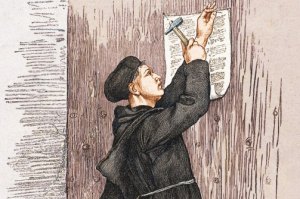
With the many obvious medieval abuses of this teaching and his own spiritual awakening, Martin Luther began to wrestle with the contemporary practices of the Western church, especially indulgences. A biblical professor and Roman Catholic priest, he wrote 95 points (or theses) he wished to debate regarding how one is saved. Could one buy forgiveness paying for what was called an indulgence? Is it possible to earn your way into heaven or to prove yourself worthy of salvation? These were his ultimate questions.
From studying scripture, the answer had become obvious to Martin Luther. Faith comes down to trusting what Jesus did for us on the cross and through his resurrection. Jesus’ holy work was enough to cover all our sins – past, present and future – just as Jesus promised in scripture, “So if the Son makes you free, you will be free indeed.”[ii]
Although I personally have not yet found any writings explicitly connecting Luther’s posting of his 95 Theses on 31 October 1517 to Halloween, it seems exceedingly likely. Luther would expect large crowds to be present at church for the feast days ahead. Further, this educated man probably recognized the propriety of discerning about indulgences and purgatory as the Western church prepared to celebrate All Hallows Eve or Halloween, the Feast of All Saints, and the Commemoration of All the Faithfully Departed (now commonly known as All Souls Day). His 95 Theses specifically addressed beliefs, practices and excesses associated with these celebrations.
Understanding that we are saved by grace through faith in Jesus Christ, Lutherans no longer recognize purgatory or All Souls Day, but Halloween as well as All Saints Day remain on many of our personal and religious calendars. (For Roman Catholics and some others, many still look at the three days of October 31st through November 2nd as intimately connected and call it “the triduum of Hallowmas.”)
As a Protestant Christian, Halloween need not be a time where we find ourselves over focusing on evil, commercialism, violence or anything else. It can become a time of worship and spiritual formation. Despite its origins and relationship with pagan practices, it can now serve as the perfect time to remember what ignited the Protestant Reformation and particularly the saving work of Jesus Christ. We can celebrate both the love and memories of the faithfully departed as well as share in family fun – yes, trick-or-treating, trunk-or-treating or parties included. Like all things in life, our Halloween celebrations can be whatever we choose to make of them including something appropriate for all Christ’s sinner-saints[iii] still here on earth. How we celebrate can witness to our shared faith in Jesus and love for one another.
Some practices you might like to consider:
Visit grave sites of loved ones to place flowers, candles or luminaria (as allowed by regulation or law). Pray with thanksgiving for how God shared love with you through their lives.
In your faith community, share the names of those who have died over the last year perhaps ringing a bell for each one. You might allow for a special wreath where flowers can be added to symbolically represent those God used to shape your life and faith. Pray for all those who continue to mourn.
Talk about your ancestors and family history together. Share stories of faith. How did your family communicate and pass down their faith in Jesus? Where do you see God’s steadfast love at work in the stories of the past or in your present lives?
Have a Reformation Day party or reenact Martin Luther’s posting of the 95 Theses.
Instead of dressing up as a ghost or goblin, consider positive role models such as faith-filled saints of the past or inspiring heroes of the present.
Share in a bonfire and hymn sing with friends and family or attend a fall festival.
For something different, carve pumpkins with religious or Reformation themes.
We need not grieve like the rest of humanity over those who have died. Sin, death and the Devil no longer have a hold over us thanks be to Jesus Christ, so there is no cause to be afraid. As the children of God, we have a multitude of reasons to celebrate for all eternity. So, why not celebrate Halloween?
[i] Recognitions similar to All Souls Day seem to have been a practice from early Christianity, but they varied greatly in timing and scope. CatholicCulture.org reports this about the origin of All Souls Day: “Masses for the dead are found in the fifth century. But it was St. Odilo [c.962 – c.1048], fourth abbot of Cluny, who was responsible for the institution of the general commemoration of all the faithful departed; he instituted it and fixed its celebration on November 2, the day after All Saints. The practice spread to the rest of Christendom.” (Others claim the three day celebration stems from an order by Pope Gregory IV in the 8th century.) Indulgences are still attached to All Souls Day in the Roman Catholic Church. Learn more at: http://bit.ly/Hstmm5
[iii] Luther came to argue that Christians remain simultaneously sinners (still struggling with sin) yet saved (through faith in Jesus Christ). We should strive to follow Christ, but we must accept our constant need for grace. Jesus is the only source of our salvation, not our works.
Unless otherwise indicated, all scripture quotations for this article are from the New Revised Standard Version (NRSV) translation.
The image “pumpkin of Luther posting his 95 Theses” used above with this post is believed not to be copyrighted. If I am in error, please contact me, and I will remove it or provide proper attribution as desired. Efforts were made to identify its source but unsuccessfully.
Rejoice always, pray without ceasing, give thanks in all circumstances; for this is the will of God in Christ Jesus for you. (1 Thess. 5:16-18)
How can we properly give thanks to God? According to Paul’s letter to the community of faith in Thessalonica (Thessaloníki), it isn’t just by our words alone. As his letter comes to a close, Paul reminds the local congregation that Jesus is coming. We don’t know when, but we are asked to be prepared to welcome him. We are to remain sober, “putting on faith and love as a breastplate, and the hope of salvation as a helmet,” and all the while trusting that he will remain true to all his promises.
In other words, yes, we will share in Christ’s ultimate victory through faith, but we aren’t to be lazy while we wait for it. Our salvation isn’t just about our needs and our feelings. We are part of a much bigger, cosmic battle and purpose where we are to live – and yes, in some ways die – for one another: “encourage one another and build each other up”; “acknowledge those who work hard among you,” loving them and respecting their call to leadership; “warn those who are idle and disruptive, encourage the disheartened, help the weak, be patient with everyone.” It might require putting our needs behind the needs of others. We might need to forgive someone who hurt us or be gentle in our reproach. Ultimately, we are to humbly love and serve one another and all those entrusted to our care. That can be hard!
Yet actively discerning our call from Christ, we are empowered to go forward in confidence. Victory is assured. We respond in thanksgiving by seeking to follow his Holy Spirit wherever it leads, no matter the risk or cost. Our Christian lives prove to be a great and noble effort based solely upon the love of our God and never our own legacy. We give thanks by being more than “country club” church members. We are to live actively as Christ’s disciples and saints, for by grace through faith that is exactly who we are.
So, yes I give thanks in prayer for all that we have shared and accomplished these past five years together at Messiah. I give thanks for our wonderful shared legacy of forty-five years serving Mechanicsville, Hanover County, and beyond. I remain thankful for all the saints in my own time and before who continue to inspire me. Yet most of all, I rejoice with you in our call to shared life and ministry; one that might prove hard at times but always consists of a future full of hope. It is together as church where we find the abundant life that Jesus promised us, and I am grateful for living as church with you.
This life of discipleship is Christ’s way, leading us and all the saints to the eternal feast of thanksgiving yet to come. To help celebrate, I invite all of us to reflect upon how we can live out Messiah’s mission more fully, “To share the good news of Jesus Christ and to invite all to join us in faith, worship, and service,” for there always remains room at Christ’s table.
Christ’s peace be with you always. I send you my prayers for a blessed Thanksgiving. Please pray for Kristine and me as well.
Your brother in Christ,
Pastor Lou
Unless otherwise indicated, all scripture quotations for this article are from the New Revised Standard Version (NRSV) translation.
Messiah Lutheran Church Members & Friends, 8 September 2013
We want you to know, brothers and sisters, about the grace of God that has been granted to the churches of Macedonia; for during a severe ordeal of affliction, their abundant joy and their extreme poverty have overflowed in a wealth of generosity on their part. (2 Cor. 8:1-2)
Reading the above passage, I began to reflect upon our life together at Messiah Lutheran. Seeking assistance for a mission, Paul was encouraging the larger, more affluent congregation in Corinth to look toward the example of the struggling Christian community in Macedonia. I began to see a parallel. How has our little church faced with so many historic and current problems been used to encourage others?
Once a person mentioned to me in passing that it seemed our community is made of a “disproportionate number of people in need” and perhaps we would always remain small. This indeed might be true (only God knows the plans in store for us), yet I embrace that description. After all, Jesus came for the “least of these”: the hungry, the naked, the homeless and marginalized, even prisoners. Therefore at Messiah, we have intentionally forged strong relationships with those having intellectual, physical and mental disabilities. We have actively sought to support members of our community with food, clothing, and housing. Hospitality and authentic welcome are recognized marks of our ministry regardless of social, economic, political or other differences. Some of our members and neighbors have been helped to lift themselves out of domestic abuse, addiction, and even jail. We are truly trying to live as Christ’s disciples in mission, no longer Gentile or Jew, male or female, but all one in Christ. If two or three gather in his name, Christ is there, so our size doesn’t really matter either. Our congregation is exactly the kind of beloved community spoken about in scripture!
Despite our needs (or perhaps because of them), we have come together to rebuild and strengthen this congregation’s ministry, not perfectly but as best we can, and this has made a difference worth celebrating. Although we are still small and at times people might leave, worship attendance has increased over 35% since 2006. Giving has gone up about 10% per year no matter the ebb and flow of our national economy. We still struggle financially (sometimes wondering how we will pay our bills), but we have closed a $35,000 deficit while supporting others – fully funding our tithe to the greater church, ranking several years in the top 20 for donations to the Virginia Synod’s United Lutheran Appeal, starting new ministries in support of Lutheran Family Services, serving as a covenant congregation with Hanover Habitat, reinvigorating the shared, ecumenical food, clothing and benevolence ministry which is MCEF, and much, much more. Our outreach has dramatically increased and a number of long-time members have suggested our community is more spiritually oriented than ever before.
Thanks to the grace of God working through our lives together, we have all contributed to our “success.” A Thrivent loan officer remarked, “We have seen congregations ten times your size not do as much.” It is often why when I am at area events that people remark, “I hear things are going great at Messiah,” or “Your that church that is so active in the community.” In our welcoming of All Souls Episcopal to share our worship space, I have had three different Evangelical pastors comment at the great and unusual witness to Christian love being made manifest here. When we attended the Virginia Synod Assembly, other congregations have asked for appointments to discuss why and how things are “going so well” at Messiah for two years running. We are further affirmed as a community by the reality that 46% of our membership comes from outside of Mechanicsville. These people are willing to make drives of 30 minutes to an hour because they recognize that this community is indeed “different.”
Are we challenged as an institution in property and programs? Do we dine with people who are marginalized, hurting, sinful and alone? Do we struggle as individuals? You bet! We are real people with real problems, but we are a saved people all the more. Thanks be to Christ, we are the church! We seek to live as disciples more than as “members”; striving to concretely love God and neighbor. We are invited to walk on in a living hope of what is promised us in Christ’s victory, not based upon what we get or experience here and now.
In the end, we are ultimately a family of faith not defined by geography, finances, numbers or programs, and especially not our aging building. Instead, love, abundant joy and generosity – a response to what God has already offered us – describes us well. We are being recognized locally and beyond because as Jesus has promised, “By this everyone will know that you are my disciples, if you have love for one another.”
As we continue to celebrate our 45 years in ministry, I want to say that I am always proud and grateful to serve you as well as alongside you in mission. If you are a visitor or have been away, I invite you to come join our celebration; not an event but our shared life in Christ Jesus.
Peace,
Pastor Lou
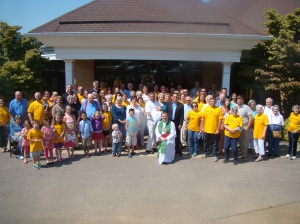
Everyone makes a difference at Messiah Lutheran!
To see pictures from our God’s Work – Our Hands Day, click here.
Unless otherwise indicated, all scripture quotations for this article are from the New Revised Standard Version (NRSV) translation.
Husband, Pastor, Law Enforcement Chaplain, and member of the Clerical Errors (aka "The Three Priests"), I'm sharing my two cents with anyone who cares...
You can also find me on social media as Loudluthrn (Lou-d-Luthrn or Lou the Lutheran). It is a moniker given me while attending a Presbyterian Seminary, but I'm a loud and proud Lutheran too (just not too loud and proud, mind you).








 2pennyblog