Tag Archives: grace

God is our defender

This sermon was preached on the Sixteenth Sunday after Pentecost (September 25, 2022) at Christ Lutheran Church in Fredericksburg, VA. You can listen to this sermon at my podcast, 2 Penny Blog.

           As one reads through Genesis, we are taken from the macro level to the micro level…a cosmic scale to the personal. After creation related stories (which include the Flood and the Tower of Babel), we have a cycle of stories about Abraham, followed by a cycle about Jacob, later renamed Israel, Abraham’s son, and finally the famous story of Joseph, Jacob’s most beloved son. Roughly fourteen of fifty chapters of Genesis deal with the saga of Joseph, so we can expect that the story just might be an important one.  

         Many of us are familiar with the story – Joseph’s amazing, valuable “coat,” a gift from his father, setting off the jealousy of his brothers. This leads him to be cast into a pit and eventually into slavery. It is in that darkness that his gift of God’s favor, exemplified by his ability to interpret dreams, his uprightness, and skills, lead him into an historic rise to eventually sit in a seat of power by the side of Pharoah. Yet today’s part of the story is often overlooked. It is quite scandalous after all. It is uncomfortable. Joseph is accused of one of the most violent and horrific crimes one can commit against another.

         Here, we have a slave, who by the norms of the time did not even own his own body, reject the advances of his master’s wife because he knew it would dishonor his master and more importantly his God. The commandment against adultery did not exist yet, but even the ancients understood such betrayal can lead to great harm and even greater violence. Potiphar’s wife coveted Joseph in his youth. Once denied, she betrayed him further. Holding onto his cloak as Joseph ran away, his cloak, his nakedness, would be used to prove the case of violent sexual assault that she would raise against him.

As an aside, I find it interesting that just as a cloak caused him to be cast into slavery, a second cloak now would be used to cast him further down into prison – if not toward death itself.[i] Further, I think it is interesting to note that the Hebrew verb often used for garments and cloaks, beged, sounds very much like the noun, bagad, the word sometimes used for marital unfaithfulness (as in Jeremiah 3:7-8, 20; Malachi 2:14).[ii] Perhaps these similar repetitions help reflect the ancient oral roots of this story before it was even written down. Repetition and rhyming would help people remember the story. We just don’t know for sure.

In any event, we have a man falsely accused and testified against. Potiphar’s wife seeks to discredit him not only as someone guilty of sexual assault but also, worse than being a slave perhaps, he’s labeled as a foreigner. She would use whatever bias and accusation she could to diminish and punish Joseph even though she knew of the potential consequences. Poor old Joseph was cast into the pit once again, so to speak, and left for dead. This time, he was in prison perhaps for the rest of his life.

Yes, we likely want to judge Potiphar’s wife harshly. I’ve been at the receiving end of false accusations especially when a police officer – a few times very serious accusations – but fortunately, people recanted, or there was plenty of evidence to prove the accusations unfounded. Yet, each time I’d feel angry…wounded…set adrift as I waited for vindication. I imagine many here know of what I speak, even if the accusations and gossip you faced were not as serious. People can gossip and lie about us. Perhaps the wrongs we think of were even committed by a family member. My goodness, I think my little brother’s favorite phrase in the English language was, “He did it!” whether I did it or not.

Joking aside, in families and society, we can be quick to judge and accuse. We can be like Potiphar’s wife. Sometimes the accusations and suspicions can be so severe that the victim of these lies suffers greatly and does not recover easily…an example might be Richard Jewel who was falsely accused of being the bomber of the 1996 Atlanta Olympics. (There’s a recent movie about his experiences.) At other times, we hear of people that harm themselves or others because of accusations, gossip, or doubts. It is hard to live among others when you feel everyone is judging you…has perhaps labeled you…in effect has abandoned you.  

Of course, sexual assault is very serious, but so is the act of false accusation itself. Such behaviors can tear a community or person apart. It can murder a person’s spirit. A little lie can become a great injustice. Through the Ten Commandments, God will later appeal to Moses and the twelve tribes of Israel, descendants of Joseph and his brothers, to not bear false witness. God knows the disunity and violence that can result. Many moderns wrongly assume this alludes only to serious proceedings in court or the public square, but that’s not traditionally how it was understood among many earlier Christians. Some of the earliest leaders of the Church would argue that instead of accusing others, we should instead make excuses for our neighbor and judge ourselves harshly.[iii] St. Ephrem famously prayed, “Yes, O Lord and King, grant me to see my own faults and not to judge my brother, since you are blessed to the ages of ages.”[iv]

In his work of reformation and his own experience with grace, Martin Luther argued similarly but perhaps pushed it a bit further. Recognizing how important our reputations are (our honor) to living with others, he understood the theft of such honor…the killing of another’s honor through even the act of idle gossip…was a great sin. Indeed, in the Large Catechism as he examines the 8th Commandment as Lutherans count them (“Thou shall not bear false witness”), he argues we all have been guilty of it. In our own misuse of scripture or “other sins of the tongue whereby we may injure or approach too closely to our neighbor,” we violate this precept.

He writes: “Here belongs particularly the detestable, shameful vice of speaking behind a person’s back and slandering, to which the devil spurs us on, and of which there would be much to be said. For it is a common evil plague that everyone prefers hearing evil to hearing good of his neighbor; and although we ourselves are so bad that we cannot suffer that anyone should say anything bad about us, but everyone would much rather that all the world should speak of him in terms of gold, yet we cannot bear that the best is spoken about others.” Yes, we can grow jealous like Joseph’s brothers. If one doubts Luther’s insights, consider all the money made from gossip related articles, social media posts, and shows just over the last week about the royal family in England. Humans seem to hunger for gossip and scandal when it is about others.   

In Luther’s argument, “False witness, then, is everything which cannot be properly proved.” It can be rooted in our jealousy or judgement of others. We can acknowledge wrongs. Yet, we don’t have the right to judge anyone unless called to serve as a civic judge, or unless (ultimately) we erroneously think we are God. More than that, like the Patriarchs in the early church, Luther argues that we should always seek to speak the best of people…to reframe them and their behaviors in the best possible light…to be gracious to them as God is so gracious to us with all our own secret sin and shame.

In this sacred account, we don’t hear if Potiphar’s wife ever faced consequences for her sins, but we do see how Joseph responds. One might argue that he turned the other cheek. He does not obsess about her. Even as he acknowledges he had been wronged; we never hear that he cursed her to hell. Instead, we see a young man with seemingly everything against him who perseveres and preserves his own honor before God. He seeks to honor God through mastering his own behaviors and response. It reminds me of a 12 step maxim. When in relationship with other neighbors doing wrong, making a mess on their side of the street, all we can really do is clean up our own side of the street. That’s the only place we really have power. We do so and trust that God will make things work out in the end.[v]

The Psalms, often songs of lament, speak of such betrayal as well. A young couple I know, dear friends of mine, were recently tasked to write a song representing Psalm 109. The lyrics could be our own prayer when we are gossiped about or betrayed:

I come to you small and needy,

my heart knows many scars.

My friends have all betrayed me,

You know just who they are.

My enemies surround me, they curse me with their tongues,

repaying good with evil, returning hate for love.

So, I pray when my hands and heart are weak,

when there’s nothing left in me, you’re my Defender.

And through the night, you’re bringing truth to light,

So, I don’t have to fight, you’re my Defender.[vi]

Yes, as with Joseph, the Lord is our defender, and we don’t have to fight. We don’t have to lower ourselves to act like our accusers. We are asked only to trust God and love as best as we are able in Jesus’ name. For whatever others might say, Jesus says he loves us and is with us always. We are clothed in God’s grace, and our accusers, not even Satan himself, will ever win the day. Amen.


[i] Strom, B. (2017). “Luther on Do Not Bear False Witness Against Your Neighbor” downloaded from https://seekingvirtueandwisdom.com/luther-on-do-not-bear-false-witness-against-your-neighbor on September

[ii] Hamilton (2022). The Book of Genesis: Chapters 18-50. New International Commentary on the Old Testament Series, 465, as quoted in “Joseph’s Other Coat” at A Trivial Devotion blog downloaded at http://trivialdevotion.blogspot.com/2011/12/wrongfully-accused-josephs-other-coat.html on September 21, 2022.

[iii] Strom, B. (2017). “Luther on Do Not Bear False Witness Against Your Neighbor” downloaded from https://seekingvirtueandwisdom.com/luther-on-do-not-bear-false-witness-against-your-neighbor on September 21, 2022.

[iv] https://en.wikipedia.org/wiki/Prayer_of_Saint_Ephrem as quoted by Strom, B. above.

[v] Alcoholics Anonymous.

[vi] Labriny, S. and Henretty, N. (2022). “Defender.” Stewarding Praise (Psalms 107​-​112) by Cardiphonia Music.

Unless otherwise indicated, all scripture quotations for this post are from the New Revised Standard Version (NRSV) translation.

© 2022 The Rev. Louis Florio. All content not held under another’s copyright may not be used without permission of the author.

1 Comment

Filed under Uncategorized

God will never leave us to drown

Photo by Phillip Flores on Unsplash

In this sermon, I take a deeper look at how our interactions with “the floods” of our modern lives can be changed by reflecting upon the promise found in the ancient tale of Noah’s flood. I do not suggest that no one ever drowns, or suffers, or dies. In the real world, people do. Yet, thanks be to God, not even death need be the end of our story. This sermon was preached on the Fourteenth Sunday after Pentecost (September 11, 2022) at Christ Lutheran Church in Fredericksburg, VA. You can listen to the sermon on my companion podcast: S1, Ep19.

That such ancient stories as Noah’s ark should apply to us today, or even encourage us, might surprise some people…especially when the story of Noah is so violent and filled with death. If we think about it, despite the many baby rooms decorated with arks, animals, and rainbows, we don’t discover a children’s story. We encounter our God who goes to war against a prideful, self-centered, violent humanity. One point of the flood was to destroy and kill. (That does not seem like a very warm and fuzzy bedtime story to me.) Yet, we also should keep in mind that this God (our God) who judges, punishes, and destroys so often in the Hebrew scriptures is the same God who has come to save us. If we look deeper, we find God’s justice in tension with God’s mercy. We can find both law (a kind of accusation or judgement against us in our sin) and gospel (good news of God’s love come to save us). Remember, God also used the waters of the flood to make all things new.

         As humans, we tend to be myopic and dualistic in our thinking. We like to have things clearly labeled good and bad in our minds, but when the world is at its worst – if we step back – we find it is often somewhere in the in-between. In my own life, I know I can struggle with this at times. Some of you know that I have had a lot of challenges over the recent weeks. I could easily make a list of all the personal struggles and losses I have faced. Beyond personally having complications with COVID due to some immunity issues, I also had two extended family members die from COVID while I was recovering. That was sobering and a heavy burden. And while still ill, my truck broke down not once but twice. My trash disposal stopped disposing, and my air conditioner stopped conditioning on a ninety-degree day. There were other troubles too. I was like, “Where’s that kick me sign on my back. I want to get it off,” but I never found one. I was feeling overwhelmed and wondering what was going on.

Yet as I thought about it, I recognized that this is just kind of the way life goes sometimes. At times, problems do seem to come fast and furious, and things don’t work out. And, we actually know from research – and what we learn in the Bible bears this out – that if we can accept that we live in a fallen world and there are problems…if we can accept them, not meaning we never fight them by trying to do our best amidst them…yet if we accept them in the sense that we don’t dwell on them and recognize that God loves us and cares for us no matter what is going on…we actually can prove more resilient. We can do better fighting disease and in our relationships. We live in a troubled world, and sometimes troubles will come. We will be ok.

Yet even in the best of times, I could make a very long list of troubles at almost any time, because as a fallen human, my heart can easily focus on the bad, the fearful, my need for hope. Woe is Lou. Certainly, such troubles – some passing and some not in this life – can capture our attention. At some level, they need our attention, but we can go too far. We can dive to deep into our troubles. We can give up hope while focused solely on the bad, even though “no temptation has overtaken us except what is common to all of humankind.” And as Paul further suggests, when we are so tested, “God will provide us a way out.” (See 1 Corinthians 10:11-13.) These are common struggles and feelings that pop during dark or troubling times. My goodness, look in the Psalms and you can find such dilemmas of faith. Even Jesus on the cross (quoting the psalms) asked, “My God, my God, why have you forsaken me?” He might not have given up on God the Father, but Jesus in his humanity hurt. Although fully divine, he was fully humane too. His heart hurt, and he felt alone.

Like a horse, we humans tend to have blinders on while God wants us to take them off to see the bigger picture…so that we remember God’s promises. Instead, genetically, we tend to focus on the threat before us because that seems to need our attention most. Yet unlike the horses using blinders for protection (to keep them focused on their task), they don’t work so well for humans. We can miss opportunities and options with blinders on. We can overlook the good of God at work around us…the promise from God through Jesus that all things will work for the good of those that love God. It is a promise still being worked out even in the worst of times. We might forget that our story isn’t over yet…that God is still speaking…acting…loving. Indeed, God is still with us amidst any annoyance or suffering, even when we don’t see God. Jesus promises to always be with us to the end of the age.

So, how can a cataclysmic story like Noah’s help refocus our gaze….or help shape our own lives for the good that is promised us? Well, first off, in this story, we meet a God who isn’t far away…disengaged and thundering in the clouds. Our God cares…always cared…for us. Creation has come. The Fall has happened. Yet God doesn’t give up on us. God was paying attention to this world and its creatures, and God noticed there was a problem. Humanity had become consumed by evil thoughts and actions. Violence reigned in the world, and God cared that the fallen human condition did not reflect God’s will for humanity or even the tiniest of creepy crawly things crawling on the earth.

True, God’s sense of justice was pushed toward a breaking point back then. God was close to starting things over. Yet, God noticed one person, a man named Noah…just one in a world of many…and God’s own heart was moved to mercy. We hear that Noah found favor with God, not so much because Noah is perfect…we see later in scripture that he was not…but that Noah was righteous. “Noah walked with God,” we are told. In the Hebrew way of understanding…and remember this is a story preserved in the Hebrew scriptures…righteousness is not an abstract notion but rather consists in doing what is just and right in all relationships.[i] What is the fulfillment of the law? Not rigid perfection, but loving God with all that we are and our neighbor as ourselves. Noah finds favor with God because of his open heart…and thus God gifts Noah with unmerited grace.

Through Noah and his family, God will seek to correct humanity’s course…but not just humanity’s…all of creation’s course. And isn’t that also partly why we as Christians are told that we are gifted with God’s grace and saved through faith? Jesus came for the renewal of a fallen world…the ultimate creation of a new heaven and earth where we will live with our God forever. Notice…Noah’s call and Jesus’s own purpose are united in a shared goal. God’s vocation (so to speak) is seeking the welfare of the wider world, and we, as Christ’s body are invited to also play a part. We are part of that same story.

While the human heart can still turn from God and often tends to ignore God’s love, God turns toward the world and would not give up on it or us. Seeing the human heart in conflict with God’s own, the scriptures tell us that God’s heart filled with pain. God grieved and suffered much as a loving parent might when a child goes astray. Yet instead of turning away, God at the time of Noah decided to enter our brokenness[ii]…which of course, he will do even more intimately and ultimately through Jesus.  

No question, the flood was a horrific event with great loss from the human perspective. Yet, the flood also served to make all things new. People of that age saw God as a warrior, much as other gods were envisioned and understood at the time. And so, it is no small thing that God puts his bow down in the sky to declare peace. God covenants (or promises) to never destroy the world or its creatures in such a way again. God commands with steadfast love (as God first did at creation), “Be fruitful and multiply and fill the earth” (Gen. 9:1).

God’s decision for the flood was no arbitrary act. Amidst the flood, we find, as one scholar suggests, “a God who expresses sorrow and regret; a God who judges but doesn’t want to, and then not in arbitrary or annihilative ways; a God who goes beyond justice and determines to save some creatures, including every animal and bird; a God who commits to the future of a less than perfect world; a God open to change and doing things in new ways; a God who promises never to do this again.”[iii]

With the flood, there’s no real difference made in humanity, just less humans around.[iv] We remained sinners. Yet with God, through God, love has grown.[v] A new way is possible now. God commits to love us, not in spite of our sin, but because of it. Through the flood, we see the tension between God’s sense of justice and mercy resolved as God wills not to destroy but rather to save.[vi] And now, wrapped within that loving promise, Noah and Noah’s descendants can move forward through any challenges and horrors with confidence and hope…if they dare to believe.[vii]

When we face challenges…when we face pain…when we experience want or loneliness…we may encounter the same powerful God as Noah. We are asked to trust in God’s promises. Our hearts may cry, “Lord, save us! We are perishing!” Yet we should try to remember that God’s heart is oriented toward us in love even then… perhaps even more so then. Why are we afraid, we of little faith? Why do we only look for the bad and the fearful instead of to the hills for God’s coming help? At such times, our worry can become a flood,[viii] and those floods might seem to last for too long a time. Yet God’s love for us is more enduring still. God will never leave us to drown. Jesus who has power over wind and wave has power over death itself, and he wills to claim us as God’s own forever. He died to make it so. Amen.


[i] https://www.jewishvirtuallibrary.org/righteousness

[ii] The New Interpreter’s Bible, Vol 1. (1994). Nashville: Abingdon Press, p. 395.

[iii] Ibid.

[iv] Narrative Lectionary 324: Flood and Promise, a podcast by Working Preacher. September 2, 2018.

[v] Ibid.

[vi] The New interpreter’s Bible, Vol. 1 (1994). Nashville: Abingdon Press.

[vii] Ibid.

[viii] “Flood” by Jars of Clay.

Unless otherwise indicated, all scripture quotations for this post are from the New Revised Standard Version (NRSV) translation.

© 2022 The Rev. Louis Florio. All content not held under another’s copyright may not be used without permission of the author.

Leave a comment

Filed under Sermon

The Spirit is on the Move

Photo by Oliver Hihn on Unsplash

This sermon was preached on the Sixth Sunday in Easter (May 22, 2022) at Christ Lutheran Church in Fredericksburg, VA. You can listen to the sermon on my companion podcast: S1, Ep17, or watch it on our congregational YouTube channel.

         Grace and peace to you from God our Father and from the Lord Jesus Christ. Amen.

        Through our Gospel lesson this morning, we have just heard part of Jesus’ farewell discourse from the night before his death. As he speaks of his departure, his death, resurrection, and ascension as well, the Apostles suspect that there are many dangers which lie in wait for them. There’s both anxiety and questions in their life. There’s also misunderstanding. As Prof. Elisabeth Johnson points out, “First Peter (John 13:36), then Thomas (14:5), then Phillip (14:8), and then Judas (not Iscariot)[i] (14:22) ask for clarification about what Jesus is telling them,”[ii] as they gather for the last time.

        Not included in today’s assigned reading, the Apostle Judas (not Iscariot), sometimes identified as Jude, has just asked, “Lord, how is it that you will reveal yourself to us and not to the world?” The answer is not found in some secret spiritual knowledge. It is not a matter of extensive study or any kind of perfection. Jesus seeks to make clear that the Advocate, the Holy Spirit, will come in a new, intimate way as a gift. Those of the world will not recognize the Spirit any more than the world has recognized Jesus. Yet that won’t stop the Spirit’s purposeful movement or power. Jesus’ children will hear that voice, and as a result, those children will share the love of God with the world.

        Yes, Jesus reveals himself through the Holy Spirit, just one part of our one Triune (Trinitarian) God…a Spirit which was, is, and always will be one with Jesus. Through that Holy Spirit on the move through circumstances and individual hearts, Jesus continues to work in the world. As noted in many Bible commentaries, Jesus’ promise stands out “that the Father will send the Holy Spirit to be alongside his disciples, to teach them and remind them of all that Jesus has said to them (John 14:26).”[iii] As Advocate, the Spirit acts like our ambassador or attorney, conveying our needs to God and guiding us -advising us, counseling us. It empowers us through grace and forgiveness and thus makes us holy. The Spirit is also called the Paraclete, meaning “called along beside.” For as predicted through the prophets, the Spirit will finally come to reside in our hearts through the experience of Pentecost. The Spirit goes with us into the world, binding us with God and in communion with one another as one holy catholic (or universal) Church.

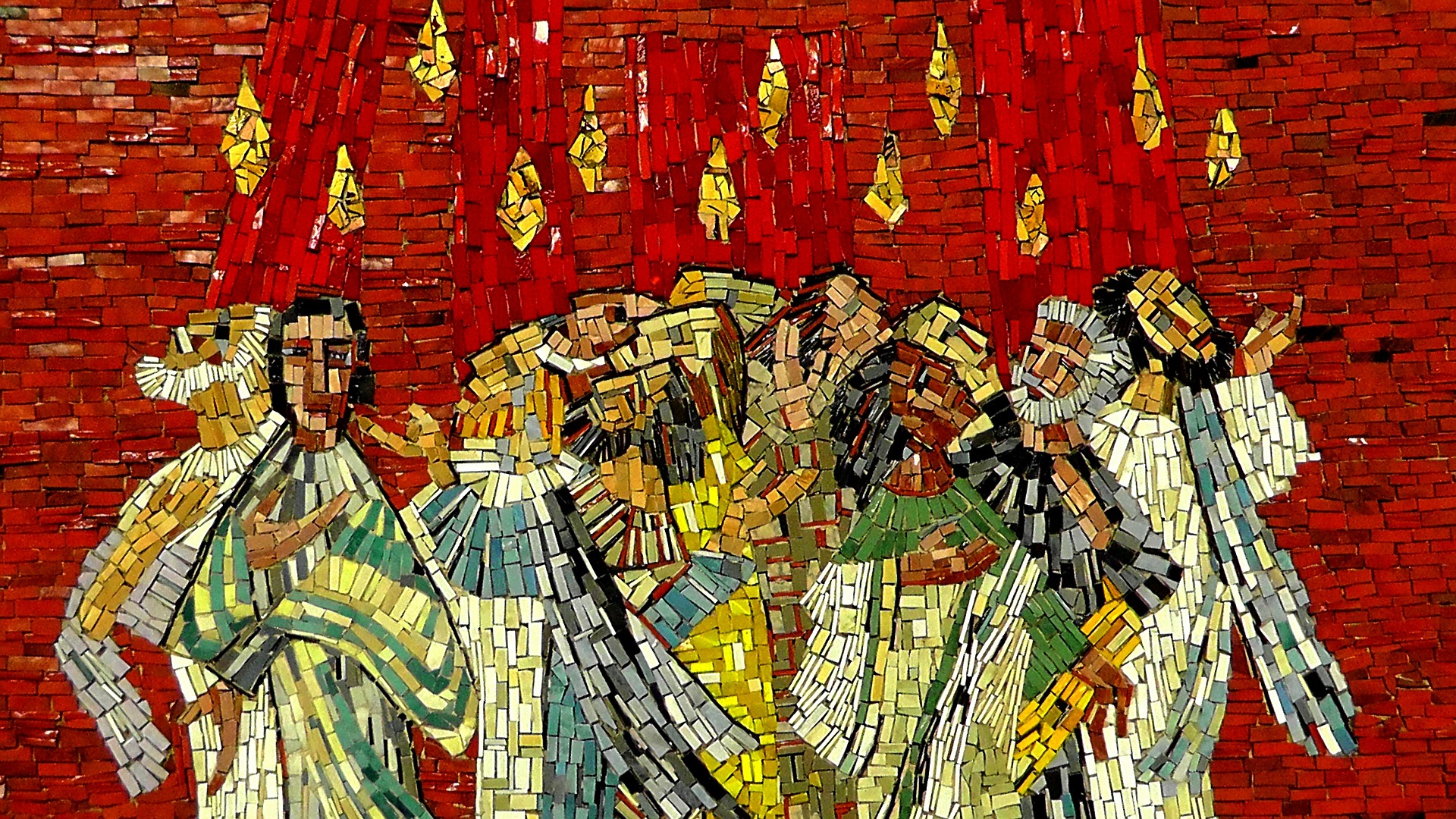
        Just as the earth was first shaped with the God’s breathing of commands (“Let their be light!”), life came into the first human beings through God’s breath, “the breath of life.” And as the Church comes into being, the risen Jesus will breathe upon his disciples to gift them peace and guide them. Finally with the event called Pentecost, the Spirit will come to the disciples in a locked room amidst a sound like the rush of a violent wind and appearing as if tongues of fire. The Spirit, often portrayed as wind or breath, comes to breathe life into our lives, comes to protect us in our life, and call us into deeper trust of God. It is through the Spirit that the disciples finally, truly became Church, and we ourselves have come to believe. For no one can come to acknowledge Jesus as Lord without the Spirit’s help (see 1 Cor. 12:3). No one can truly live or experience an abundant life without that “breath of life”…the gift of the ever active, always present, Holy Spirit.

          Now, we don’t have time to do this right now, but if we were to break into small groups and consider how God brought us to this place, as we are on this day, we would likely identify miraculous and expansive connections – an intermingling of events and people – that have guided us, shaped us, and perhaps even thrust us into this time and place as the people we have become. Without even knowing the details of your history, I know that nothing that you’ve experienced (good or bad), none of your weaknesses or strengths, nor even any of your relationships (no matter how deep, hurtful, or blessed) has been wasted by God. God has the will and the knack for using everything for our good (see Romans 8:28) because God loves us.

        However, this love means that God is not done with us. We certainly aren’t keeping Jesus’ word perfectly even as we try to do so…that’s impossible for any human, imperfect sinner-saints that we are…so God through the Holy Spirit acts for us, and in us, and upon us. In a fallen world…a fallen life…God has not given up on you. God never gives up on us. The Spirit blows where it will, and in being part of our lives…in bringing us faith and peace…we are shaped and sanctified (made holy) over time through the Sacraments, the Word of God that we hear and read, and even through our experiences encountered through faith. We are blown forward toward God’s goal despite what choices we might make. God’s will will be done.

        Yes, with complete confidence, I can proclaim that all of us have been led here for a singular, shared – yet at the same time unique to each one of us – purpose. God is doing something in our lives whether we see it or not, feel it or not, or understand it or not. Indeed, not one of us came up with the idea of God or understanding of Jesus on our own. The Good News of Jesus was heard and received through others. It is exactly as Luther identified long ago, “[One] would find Christ must first find the Church.”[iv] You have to hear the Good News of Jesus Christ from somebody. When all is said and done, the Spirit spreads faith and increases the Church through imperfect, unfinished people like you and me.

        And is not that what we see today in Lydia’s life back in Philippi? Throughout all the Book of Acts? God’s love spreads (as an old French proverb suggests) similar to a disease…from person to person…but in a good way. Paul had a vision of someone calling for his aid, “Come over to Macedonia and help us.” As Lydia happened to hear Paul, Silas, and Timothy preach and teach, “The Lord opened her heart to respond to Paul’s message.” She already believed in God, but something changed. She grew in faith and understanding. She came to know Jesus. And that experience led her to welcome Paul into her home…welcome Jesus into her heart. That small home Church would eventually become the famous church of Philippi, and in her hospitality, we discover that relationship and community matter. Human relationship, community, is used by Spirit to make the Church and individual believers grow.   

        Throughout time, we see this repeatedly. For example, Martin Luther’s faith and understanding did not grow in isolation. He treasured the transcendent, heart-centered faith of the mystics before him (in the period of the 1000s to 1200s) – voices shared with him through both books and teaching. He learned from them of a loving God offering grace. He benefitted from the grace-filled, loving faith and guidance of his confessor, Johann von Staupitz. He learned from the witness of reformers like Jan Huss who came before him, even as he grew in the present from what became known as his Table Talks. These gatherings were simply where questions, doubts and faith were shared over food and beer among friends…perhaps as you might share about life and faith at your own table. Martin Luther and others grew in faith and found strength through such communal meals.  

        Later, Moravians, formally the United Brethren (followers of Huss’ teachings), came to better understand Martin Luther’s theology through a Lutheran named Zinzendorf who offered the Moravians protection from persecution in the early 18th century. Luther’s Catechism is still studied by the Moravians today. And as some Moravians read Luther’s Preface to the Epistle to Romans, sang and prayed, John Wesley overheard them and felt his heart “strangely warmed.” Wesley came to a deeper, more personal, enlivened faith;a witness that lives on in the faith tradition we know as Methodism. What we see here is an example of how the Holy Spirit works. Zigging and zagging through time and individuals, the Spirit draws us together, moves us apart, and drives us forward as much as Jesus was driven into the wilderness.

        So, how did you come to know Jesus? What parent, grandparent or friend spoke in such a way that opened your heart to Jesus? Was it an instantaneous change or did their faith plants seeds to grow yours over time? Perhaps you aren’t that far on your journey, and you come with deep questions…more questions than answers perhaps. Those are gift of the Spirit too. The Spirit was at work in all such moments. That’s worth thinking about, giving thanks for, and talking about perhaps as you go home today. Your story is connected directly from person to person all the way back to Paul and Lydia’s story and the story of all in the early Church. And you might not feel like it right now or recognize it, but listen closely….Your story is as sacred as what we find in any piece of scripture…your story, your experience, your struggles, your hopes are as sacred as what is recorded in the scriptures for God’s Spirit is there alongside you…in you.  

        For those here who already believe, your faith is not an accident. For those here who struggle to believe, don’t think for a moment that God is not reaching out to you. We are told that the Holy Spirit is always active, reaching out to one and all through the imperfect lives of those around us as well as through direct whispers, dreams and visions received through our hearts. We aren’t alone. The Holy Spirit is always with us even when we are not aware of it.[v] Just wait and watch. Seek and eventually, thanks to the Spirit, we will discover our sacred purpose within God’s own story and plan. Amen.


[i] “Judas (not Iscariot)” is used by the evangelist to differentiate this Apostle from Judas who betrayed Jesus. Outside of scripture, there arose a tradition to call him Saint Jude to help avoid this confusion.

[ii] Johnson, E. (May 1, 2016). Commentary on John 14:23-29. Downloaded from workingpreacher.org on May 14, 2022.

[iii] Ibid.

[iv] Martin Luther, “Sermon for the Early Christmas Service; Luke 2:15-20” (1521-1522). Luther’s Works, Sermons II. Ed. Hans J. Hillerbrand, Helmut T. Lehmann (Philadelphia: Fortress Press, 1974),  vol. 52: 39-40.

[v] “God of love, by the Holy Spirit you are always present. Your presence is invisible, but you live at the center of our soul, even when we are unaware of it.” – Br. Roger of Taizé

Unless otherwise indicated, all scripture quotations for this post are from the New Revised Standard Version (NRSV) translation.

© 2022 The Rev. Louis Florio. All content not held under another’s copyright may not be used without permission of the author.

1 Comment

Filed under Sermon

Rethinking the Civil War, It’s Legacy, & Me

Click this image to read the article alluded to below in my blog, “Why Do Confederate Lies Live On” in The Atlantic.

“When I was a child, I spoke like a child, I thought like a child, I reasoned like a child; when I became an adult, I put an end to childish ways” (1 Corinthians 13:11).

Recently, I came across an excellent article in The Atlantic called “Why Do Confederate Lies Live On.” It was written by Clint Smith, an African American staff writer with the magazine. Focused on his experience with the chapel at Blandford Cemetery, it gave me reason to pause and reflect about my own life.

VMI Cadet Hartsfield of the Battle of New Market is buried somewhere in the Blanford Cemetery in a grave lost to history. In 2014, Petersburg’s VMI alumni group asked me to offer an invocation and benediction for their recognition of the 150th anniversary of the Battle of New Market on May 15th. I was serving as a pastor in Richmond at the time. I naively expected a small, outside event from what I was told. It ended up being a larger event in this cemetery chapel. (I had never heard of this chapel before my visit.)

I was told a World War 2 veteran who survived landing just a day or so after D-Day and fought through the war would speak about his experiences. He did, and that was positive. I did not expect a local SCV color guard with the Stars and Bars battle flag or the explicitly Confederate windows. It was sort of creepy and fascinating at the same time.

My previously prepared prayer alluded to the errors and evils of the Civil War. Yet now, I wish that I had explicitly and strongly refuted slavery and racism as part of it. I mentioned how the cadets’ actions under fire likely helped lead to the preservation and restoration of VMI after the war and perhaps indirectly helped shape or inspire folks like George C. Marshall and Civil Rights Martyr, Jonathan Daniels, and others to bravery or to do their duty. (At some level, I think that remains true for me.) I realize that God can make good come from anything, even our sin. I prayed VMI and our nation would become ever better, more just, and reconciled.

On one hand, I was honored to be asked by fellow alumni, especially for this momentous 150th anniversary year of the Civil War. My fellow alumni were hospitable, and like many alumni including myself, love VMI. On the other hand, I wish I went further and spoke more clearly about the sins of racism, slavery and treason. I value history, but we need to tell the whole story – even the ugliest parts.

Even though I’m from the north, even though some of my ancestors fought for the United States during the rebellion, even though my First Class dykes (senior mentors are called dykes after the cross-belts or dykes worn as part of the uniform) used to have me answer, “The United States of America, Sir,” to the question at VMI about who won the Civil War, the Lost Cause Myth can insidiously take hold of a person if we aren’t wary. It can obscure our vision and understanding, as well as stir division or wound others unintentionally. The myth dresses up and softens what’s ugly. After all, that myth and racism in all forms are just more signs of sin at work in our lives and world. And, sin often traps us subtly over time.

I’m not the person I was in 2014. My attitudes have hopefully continued to evolve, and I pray I continue to grow in understanding and empathy. Wherever needed, I desire the wisdom to repent of my sin including any sin related to racism. I want the courage to challenge racism wherever it is encountered. I’m not looking to erase history. I understand all of us, even the best of us, can only be simultaneously sinner and saint and never perfect. It can be helpful to remember the past. Yet as Christians, we understand we are always reforming. We need to separate ourselves from rigid, dualistic (that everything is all good or all bad), or simplistic thinking and bravely embrace the truth of our past and our present whatever we might see. We can love and respect our enemies, even those of the past, even as we seek to see them and their failures as they truly are.

Want to learn more? I would highly recommend this additional text: Robert E. Lee and Me: A Southerner’s Reckoning with the Myth of the Lost Cause.

Unless otherwise indicated, all scripture quotations for this post are from the New Revised Standard Version (NRSV) translation.

© 2021 The Rev. Louis Florio. All content not held under another’s copyright may not be used without permission of the author.

Leave a comment

Filed under Church History

Turn the other cheek and scroll away

For those that might still be wondering what all the recent Facebook hubbub about Parler is about, here’s a pretty reasonable article. I’ve seen plenty of old friends announcing their migration to this newer social media platform. As for me? I don’t often use Facebook for political stuff. I prefer to talk in person about weighty issues. On Twitter, I share more news articles but from multiple sources and usually little or no commentary.

I know there’s a lot of junk on these sites. (To be honest, let’s admit it’s from both the left and right.) I recognize attempts at curtailing bad or untrue comments by the social media powers that be has been sloppy at best and often seemingly lopsided. And yes, these platforms seek to manipulate us and limit competition. So, I try to ignore the junk and educate myself from multiple news sources with varied perspectives off of Facebook. I actually talk to live people which includes a lot of listening.

If on social media, I much prefer looking at funny memes, or pictures from my friends garden in Africa, seeing a morning walk of a congregant, and sharing joyful events like births or even sad or troubling events like surgeries or deaths. These can help us feel connected and cared for. Heck, I even enjoy my friend’s post who shares his photos of small, rural post offices. Simple joys can matter. Through social media, I’ve found weightier things such as positive resources for prayer and meditation and even some resources to consider future travel when the pandemic ends (or at least dream about it).

That’s the better side of social media, and to make that my focus helps improve my attitude for the day as well as shape what I say or post. I don’t need to personalize or catastrophize everything. I can choose to be happy. I can try to be patient, kind and understanding. I don’t have to be compelled to comment on everything. Those are powers we all have with some intentionality and God’s help.

And in reality, I doubt Facebook will last forever. Younger folks have already tended to move on. It will likely go the way of Six Degrees or MySpace unless it changes drastically. Whatever the platform we choose, I’ve seen too many relationships broken needlessly, and I don’t need that in my life. The world can be hard enough on its own. We don’t have to let that happen or play along with those less healthy than we might be. At the same time, that doesn’t mean we should cut off from everyone who thinks different than us.

Instead, we can turn the other cheek and scroll or click away without total cut-off, or cancelling, or condemning anyone to the fires of hell. We are free not to feel obliged to answer in haste or perhaps at all. We can wish others well even as we disagree or are offended, pray for them, and perhaps model a better way forward if we are right. If we discover we are wrong, we might learn something from them as well.

As I’ve said elsewhere, a new “thing” will certainly come along, but I’m just not sure I need another or new social media platform of any type in my life right now. In fact, I’ve been using social media less. That’s certainly helped make this election cycle and my life better. There’s plenty of research indicating that too much social media has led to social isolation, depression and other concerns.

Paul wrote (Phil. 4:8): “Finally, beloved, whatever is true, whatever is honorable, whatever is just, whatever is pure, whatever is pleasing, whatever is commendable, if there is any excellence and if there is anything worthy of praise, think about these things.” If that doesn’t sound like our Facebook or other social media feeds, maybe it’s we who are doing it wrong and not just the platform. Changes can be made for good based on our desires, resilience and love for others. For all those migrating, or staying, or totally turning things off, go with God wherever you digitally find yourself. You can always contact me in the real world to share your news. I’d be happy to hear it.

© 2020 The Rev. Louis Florio. All content not held under another’s copyright may not be used without permission of the author. 

1 Comment

Filed under Community Life

An A+ Kind of Love

The Hub, October 15, 2019

This Sunday, I presided at a bittersweet wedding. The bride’s beloved grandfather had died unexpectedly this past year, and he was sorely missed. The grandfather’s absence was palpable, but there was a lot of joy as people shared stories about him. As part of this celebration of ongoing life and love, the bride’s grandmother gifted the bride with a Bible given to her at her own wedding over 60 years ago as a remembrance to be used during the service. Among the texts chosen was the popular John 15:9-12 where Jesus invites us to abide in his love.

The bride’s grandfather, John, was a very intelligent, loving, Italian grandfather, the kind who could lovingly dote on children without spoiling them. Indeed, he often became a surrogate grandfather to many children at my former congregation. Not only would he give them little penny candies, he often asked questions about their week. He would offer them advice and encouragement in response to their answers. He was never too busy for a child.

It had become John’s habit long ago with his own children to jokingly offer a grade whenever a task was performed, or a challenge met. No matter how well they did, it was a C (an average grade) – maybe on a very good day a C+. Perhaps this was meant to challenge people to increasingly do better, or perhaps it was offered for the laughs and smiles it would solicit as they heard this grade and saw his smile again, and again, and again. Whatever the reason, I found in it a loving reminder. We are all human. We can always do better, love better, be better, and we need one another.

The liturgical wedding service reminds all of us through its words that although life is filled with love and excitement, it can become overcast and hard. Yet, the service, especially the Gospel, also reminds us of an A+ kind of love.  It’s a love that we can rest in and find strength from. It is a love that helps us bear all things patiently, to wait with hope, to accept one another as we are and not for what we would hope to be. It is a love that grows and lasts; always protects, always trusts, always hopes, always perseveres. It is a love that forgives and never fails. It reflects our God who is love and loves us.

As individuals, couples or community, we might only reach the grade of C+ on our own (even at our best), but God’s love is transformative. It is an A+ kind of love that we can abide in each and every day. It has the power to make our lives significant and declare us perfectly forgiven and free.

Originally published in The Hub, a weekly email of Christ Lutheran Church, Fredericksburg, VA.

© 2019 The Rev. Louis Florio. All content not held under another’s copyright may not be used without permission of the author.

Leave a comment

Filed under Uncategorized

You’ve already passed

Pentecost. Image by Holger Schué from Pixabay
Pentecost Sermon, Year C
Texts: Genesis 11:1-9; Acts 2:1-21; John 14:8-17
Christ Lutheran Church, Fredericksburg, VA
June 19, 2019

The great St. Paul, surprising Apostle to the Gentiles, once confessed, “When I was a child, I spoke like a child, I thought like a child, I reasoned like a child; when I became an adult, I put an end to childish ways” (1 Corinthians 13:11). Thanks to the Holy Spirit, his faith and understanding evolved, deepened and grew as he journeyed through life – as it intends to do during all of our lives.

As I turned to the Holy Spirit in prayer this week, I asked for help with today’s message. That’s always a good place to begin, and after some time, this particular passage came to my mind and just wouldn’t go away. It just seemed so appropriate in light of our reading on the Tower of Babel, as well as our having nine of our youth recognized as adults though the ritual of confirmation, and one adult choosing to affirm their faith this day as well. You’ve probably heard it before at a wedding or other community focused worship event, as Paul seeks to address the importance of the faith, hope and love we all share as Christians.

As I said, this quote came to my mind as I reflected on the Tower of Babel. I was fascinated by this story as a child with its dynamic images of a tall tower reaching towards heaven. I thought it was so cool. And then, we get to hear of punishment…or at least, that what it sounded like to me. In my juvenile mind, I saw the tower come crashing down in God’s anger with fire and brimstone or perhaps a mighty wind – much like I might have torn down my Lego towers while playing. I pictured this destruction even though scripture tells us no such thing. Scripture reveals that the tower survived unfinished, and the people were only scattered throughout the earth, never destroyed or abandoned. This was just as God intended when Adam and Eve were told to go forth and multiply and inhabit all the earth. The people of Babel would spread over time with new languages and eventually dynamic, beautiful new cultures. Each of these cultures conribute to a remarkable tapestry that makes our world a better place and helps glorify God. My childhood brain could certainly understand consequences for wrong behavior…but the wideness of grace and mercy? Apparently, I wasn’t quite ready to understand that.

This sacred story often shared even in preschools is at its depths no kid’s story. It is a mythic tale, and by that I don’t mean false, but a teaching story rooted in the past and revealing ultimate truths about ancient peoples, ourselves, and the sacred activity of God woven through it all. If you listened closely, you heard that the people of God, yet once again, have sought to be like God. They are chasing after the power, wealth and glory of this world and losing touch with who they were meant to become in the process. Much like Adam and Eve, they’ve reached for that unattainable fruit, and now, they face separation from God and one another. That’s always the way when we do such things, even today.

Like Adam and Eve, these people were sent out into the world, but just as Adam and Eve wouldn’t leave Eden without God’s grace and a plan for restoration, neither will the people of Babel. Adam and Eve would be provided clothing, protection and family. The people of the tower will receive something even better. God will make eternal good come from bad. Among all these new peoples, one people would be set apart. Remember the “children of Abraham?” Abraham would be given a trust in God that would rush and wind its way down through a very troubled, often sinful family line. This was often a family that fought amongst themselves, who were selfish and lazy, or sometimes meanspirited and lacking faith. They struggled with faith and often sinned. Yet, they spread out into the world and became what we know as the people of Israel. The Jewish people, a small, enslaved and often conquered people, would be used to fulfill promises delivered by the prophets. Through the Jewish people, all nations would become blessed. It was the Jewish people who lead us to Jesus, and some from this people will number among his first followers. Today, our confirmands claim their share in that sacred inheritance.

Yes soon, moments from now, our confirmands will be welcomed as adults in the church. They have been offered a choice to affirm the promises of their baptism…to seek to love Jesus by following his commands. Yet as they have hopefully learned (and all we Christians should understand), we can topple as easy as the people on that tower of Babel. We are they, and they are us…flawed, sinful, never able to be perfect on our own…people. We are just people. And so as we set off in the world with good intentions, Jesus offers us hope, help and a way forward. An Advocate was sent to live with us and in us. It came to us through the promises of our Baptism whether we feel it or not; understand it or not. For, it is God’s promise to us!

Now, as a child (even into my young adult years), I understood this wrongly. Yes, people promise (or have sponsors promise on their behalf when too young to do so themselves) to seek to follow Christ. Publicly proclaiming and affirming our faith is a great and appropriate thing to do each and every day, but if we are honest, we know our promises will break now and again. Fortunately, baptism is not ultimately about us. It is more about God’s reaching out to us. And so daily through our lives, the Holy Spirit…the One who came upon us at our baptism…who claimed us as God’s own at our baptism…who set us apart to bless nations…that very same Spirit will seek to affirm and fulfill a godly, perfect promise again, and again and again…even when we goof up… even when we don’t deserve it. With that Spirit’s first coming to dwell in the hearts of the Apostles, we were given a sign to help us believe. Recall, “All of [the disciples] were filled with the Holy Spirit and began to speak in other languages as the Spirit enabled them (Acts 2:4).” What had seemed a curse for the people of Babel had now become blessing in the hands of our God…a gift meant to unify and call people of all nations home. They would be called through the voices of ordinary people.

Yes, it is true that through the ages we have inherited a sometimes fractured, imperfect faith skewed by human sin, but the Spirit makes even faith much smaller than a mustard seed “count,” or in other words have a powerful affect. Faith can impact us and transform our life. Our shared faith has made it to us through torture and persecution, corrupt church government and fallen preachers, and even our ancestors (sinner-saints all; people just like us). it couldn’t be stopped. It has come to rest upon us all these centuries later…lives inside us. Yet while the Spirit invites us to faith, it never forces. It challenges us each day to say publicly we believe (and also live like it too). God’s deep desire is to have all nations and peoples praise him in those many languages. And today on Pentecost, we are reminded that we have been chosen to become part of God’s story, the one who spoke us into being with a purpose.

When I was seeking to become a police officer, I had to take a complete physical exam testing both mind and body. I was younger back then, and I had no glasses. As I went through the eye test looking through a scope to read those small, random, letters in a line, they grew smaller and smaller. “What do you see know?” the technician asked over and over and over again. As it went on and on, I became confident that I had failed the test, and I finaly gave up. I was defeated, and I assumed my dreams were dashed. And so, I finally admitted that I could no longer make any letters out. It was only then the technician laughed and said, “No worries. You have excellent vission. I was just seeing how far we could go.” I share this story with you, because I had already passed the test without even knowing it.

As you, our confirmation candidates, come to profess your faith publicly today, you might not see clearly where your future lies. You might not fully understand how God intends to use you or has been using you already. You might even fear you are not up to the test before you or have doubts or struggle with even the idea of faith…so might we all admit such things at times if we are adult about it…but fortunately that’s not the key to this day or any of our days with Jesus. Jesus has passed the test for us. We need not worry, only believe.

Yes, we are already declared acceptable to God and deeply loved through this gift of our faith and baptism. As the head of our Synod’s Youth Council rightly proclaimed yesterday before the assembled “wiser” adults, youth are not the future of the church, they are already the church – now and into the future. With the Spirit’s presence in your lives (in all of our lives), I trust that even greater things are yet to come just as Jesus promised. I urge you to seek out the Spirit, and try to hold onto it. For when you have faith, you are in for one amazing ride. Amen.

2 Comments

Filed under Uncategorized

God hears us

Even when I cry out, ‘Violence!’ I am not answered; I call aloud, but there is no justice. (Job 19:7)

12809595_1148313495180921_4330328337464380992_nDuring our recent sermon series on the Book of Job, our congregation members and world faced its own share of challenges and loss: economic threats, deaths in our extended family, a terrorist attack in Orlando, even our own roof-ripping kind of “whirlwind.” The world can seem a terrible place, and like Job, we are tempted to cry out to some divine police officer, “Violence! Help us!”

If you missed our sermon series, know this. God hears us, and God cares. We might not always see God at work, but he promises to labor for our welfare not for woe (Jeremiah 29:11). Indeed, our God often works behind the scenes hidden from our human view. As Jesus proclaimed, “Peace I leave with you; my peace I give to you. I do not give to you as the world gives. Do not let your hearts be troubled, and do not let them be afraid” (John 14:27). Our sovereign, loving Lord is in control.

Still, Job was right in one sense. There is no perfect justice in our world. Bad things can happen to good people. Yet in an unfair world, we are gifted with an unfair grace. God loves us and plans never to abandon us.

No more than Job can I pretend to know why month after month it seems I am mourning with congregational members or my own family members over one thing or another. Yet, I know this. God is love…only love. Like a child, I can choose to trust my heavenly parent who created me and you out of love. It is all I really have – God’s promise to love me. Fortunately, God doesn’t lie. Jesus, our brother, Son of the Living God, proved this love through his death and resurrection for our sake. Hear God’s promise:

“For the one who sanctifies and those who are sanctified all have one Father. For this reason, Jesus is not ashamed to call them brothers and sisters, saying, ‘I will proclaim your name to my brothers and sisters, in the midst of the congregation I will praise you.’ And again, ‘I will put my trust in him.’ And again, ‘Here am I and the children whom God has given me.’ Since, therefore, the children share flesh and blood, he himself likewise shared the same things, so that through death he might destroy the one who has the power of death, that is, the devil, and free those who all their lives were held in slavery by the fear of death.’” (Hebrews 2:11-15).

Job did not live in this world long enough to see justice reign in fullness, and we might not either. Still, even Job knew his Redeemer lives. We must as well and share that good news with others. God’s justice is breaking into our world. While we wait, we are only asked to trust in the love being offered us and share it. We must seek to give into love, not fear.

Yes, more trouble is in our future, but so is our Redeemer. He will return because he wishes to banish fear, tears, violence and evil forever. We might never understand the evil and struggle we face, but we can find courage. God loves us more than we could ever understand.

So in the face of much darkness, go ahead and pray. Go ahead and live in Jesus’ name.

I wish you Christ’s peace in all that you might face,
Pastor Lou

Originally published in Messiah Lutheran’s newsletter, The Messenger (July 2016).

Unless otherwise indicated, all scripture quotations for this article are from the New Revised Standard Version (NRSV) translation.

© 2016 The Rev. Louis Florio. All content not held under another’s copyright may not be used without permission of the author.

Leave a comment

Filed under Pastoral Letter, peace

Be born in me, again and again

Angels appearing before the shepherds, by Henry Ossawa Tanner

Angels appearing before the shepherds,                                     by Henry Ossawa Tanner

And suddenly there was with the angel a multitude of the heavenly host, praising God and saying, “Glory to God in the highest heaven, and on earth peace among those whom he favors!”(Luke 2:13-14)

What a powerful, enduring image – an angelic multitude proclaiming the birth of Jesus to poor shepherds in a field! In great works of art or on more humble Christmas cards or creches, even in our favorite carols, we imagine them in song with the shepherds below basking in the glory and love of our God. How much more should we let our lives sing a song of gladness? For Jesus came not to remain in that stable, but instead plans to come to us where we are. He desires to reside in our hearts.

Mary (1914), by Henry Ossawa Tanner

Mary (1914), by Henry Ossawa Tanner

Yes, through our faith and baptism, we share a more similar experience to Mary’s own. She was a poor, relatively uneducated young lady; likely 13 to 15 years old. She had lots of questions, doubts and fears to wrestle with, yet when the angel announced she would become the mother of the one true God, she submitted. Her magnificat (a song of praise captured in Luke 1) declares with certainty, “My soul magnifies the Lord, and my spirit rejoices in God my Savior.”

Mary was God’s favored one, and we share in that favor. Truly, Jesus waits to be born in each of us and reborn each day. No matter how we perceive ourselves with our varied gifts and struggles, God has come to us declaring each of us beloved child. Prophets in the Jewish scriptures predicted a time when the Temple would be no more, for our bodies would become the place where the yet unknown Christ resides. The Angels in the field proclaimed that Jesus came for all of us who are poor, imperfect and in need of love.

In Jewish theology, our heart represents more than an organ or emotional passion, it reflects our utmost being – the depths and totality of who we are. That’s where Jesus wishes to reside. So, Jesus prayed that we be one as he and the Trinity are one. It is Jesus who chose and called each of us to follow him. It is he who wants to live inside us and through us so intimately in every moment that he names us as his body. This good fortune is offered as a certain gift to all who dare trust in his promises.

Surely, Christ’s presence will upset our lives. It might even make us the objects of scorn or worse. Yet, “Do not be afraid!” God’s favor will never disappoint. Walk on so that your life becomes his song. Walk on trusting that Christ walks with you and that many more miracles shall surely come. His presence will bless us beyond our expectations.

The Christian singer Francessca Battistelli in a recent song imagines these words coming from the heart of Mary and her own, “I am not brave. I’ll never be. The only thing my heart can offer is a vacancy. I’m just a girl. Nothing more. But I am willing, I am Yours. Be born in me.”

Do not doubt any longer, but believe. Open your heart and welcome Christ at each new sunrise or whenever darkness falls. The promises of God are fulfilled in your hearing. Blessed are you! Holy are you! Sing to the glory of God, so that all might believe!

Be born in me (Mary), Francesca Battistelli 

This post was originally published in Messiah Lutheran Church and School’s newsletter, The Messenger (December 2014/January 2015).

Unless otherwise indicated, all scripture quotations for this article are from the New Revised Standard Version (NRSV) translation.

© 2014 The Rev. Louis Florio. All content not held under another’s copyright may not be used without permission of the author.

1 Comment

Filed under Advent, Christmas, Grace

I give thanks

psalm 118


This fall has seen a flurry of activity at Messiah: new audio-visual assets installed in the sanctuary; a very successful and well attended effort during God’s Work – Our Hands Day; a growing craft fair and pet blessing; wonderful and numerous contacts made at the county’s community fellowship festival; and of course an attention getting but very helpful effort by Kevin Hendrickson and our Virginia Synod team at Over the Edge for Special Olympics. I could make a longer list if I cared to do so. In short though, it has been a busy but productive time, and it couldn’t have happened without your support. I give thanks to you and our God for all the mighty things that God has accomplished through our small church family and its shared ministry.

As we continue into November, things will seem only to get busier. I would encourage all of us (me included) to not get lost in the hustle and bustle. Turn toward God and his church instead. Remember we were created to be human beings, not human doers. God reminds us, “Be still and no that I am God” (Palm 46:10). Let’s take time to reconnect with friends and family, as well as our family of faith. Let’s take time to be together and to rejoice in the love that we share. If you have been away, we invite you to come back and join our celebrations. Let’s give thanks together.

The truth remains, we need one another, and the world needs our witness. As Jesus reminds us, “Wherever two or three are gathered in my name, I am there” (Matthew 18:19-20). Yet also we are told that we proclaim the risen Christ through our gatherings, service and celebrations. “By this all people will know that you are my disciples, if you have love for one another” (John 13:35). Jesus needs to be invited into our lives and thus made manifest in the world. Do you already sense his presence, or is he perhaps inviting you to seek him out? Either way, we’ll find our place at his table when we live as church together.

I pray that the holiday season ahead serves to bless you to be a blessing to your family, your congregation, and the world. Come, taste and see that the Lord is good; his love endures forever. His love is at work in you.

Happy Thanksgiving!

Pastor Lou

This post was originally published in Messiah Lutheran Church and School’s newsletter, The Messenger (November 2014).

Unless otherwise indicated, all scripture quotations for this article are from the New Revised Standard Version (NRSV) translation.

© 2014 The Rev. Louis Florio. All content not held under another’s copyright may not be used without permission of the author.

Leave a comment

Filed under Pastoral Letter, Uncategorized