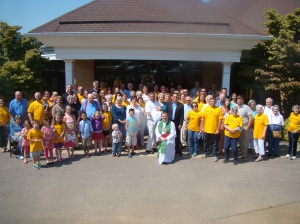
Messiah Lutheran Church Members & Friends, 8 September 2013
We want you to know, brothers and sisters, about the grace of God that has been granted to the churches of Macedonia; for during a severe ordeal of affliction, their abundant joy and their extreme poverty have overflowed in a wealth of generosity on their part. (2 Cor. 8:1-2)
Reading the above passage, I began to reflect upon our life together at Messiah Lutheran. Seeking assistance for a mission, Paul was encouraging the larger, more affluent congregation in Corinth to look toward the example of the struggling Christian community in Macedonia. I began to see a parallel. How has our little church faced with so many historic and current problems been used to encourage others?
Once a person mentioned to me in passing that it seemed our community is made of a “disproportionate number of people in need” and perhaps we would always remain small. This indeed might be true (only God knows the plans in store for us), yet I embrace that description. After all, Jesus came for the “least of these”: the hungry, the naked, the homeless and marginalized, even prisoners. Therefore at Messiah, we have intentionally forged strong relationships with those having intellectual, physical and mental disabilities. We have actively sought to support members of our community with food, clothing, and housing. Hospitality and authentic welcome are recognized marks of our ministry regardless of social, economic, political or other differences. Some of our members and neighbors have been helped to lift themselves out of domestic abuse, addiction, and even jail. We are truly trying to live as Christ’s disciples in mission, no longer Gentile or Jew, male or female, but all one in Christ. If two or three gather in his name, Christ is there, so our size doesn’t really matter either. Our congregation is exactly the kind of beloved community spoken about in scripture!
Despite our needs (or perhaps because of them), we have come together to rebuild and strengthen this congregation’s ministry, not perfectly but as best we can, and this has made a difference worth celebrating. Although we are still small and at times people might leave, worship attendance has increased over 35% since 2006. Giving has gone up about 10% per year no matter the ebb and flow of our national economy. We still struggle financially (sometimes wondering how we will pay our bills), but we have closed a $35,000 deficit while supporting others – fully funding our tithe to the greater church, ranking several years in the top 20 for donations to the Virginia Synod’s United Lutheran Appeal, starting new ministries in support of Lutheran Family Services, serving as a covenant congregation with Hanover Habitat, reinvigorating the shared, ecumenical food, clothing and benevolence ministry which is MCEF, and much, much more. Our outreach has dramatically increased and a number of long-time members have suggested our community is more spiritually oriented than ever before.
Thanks to the grace of God working through our lives together, we have all contributed to our “success.” A Thrivent loan officer remarked, “We have seen congregations ten times your size not do as much.” It is often why when I am at area events that people remark, “I hear things are going great at Messiah,” or “Your that church that is so active in the community.” In our welcoming of All Souls Episcopal to share our worship space, I have had three different Evangelical pastors comment at the great and unusual witness to Christian love being made manifest here. When we attended the Virginia Synod Assembly, other congregations have asked for appointments to discuss why and how things are “going so well” at Messiah for two years running. We are further affirmed as a community by the reality that 46% of our membership comes from outside of Mechanicsville. These people are willing to make drives of 30 minutes to an hour because they recognize that this community is indeed “different.”
Are we challenged as an institution in property and programs? Do we dine with people who are marginalized, hurting, sinful and alone? Do we struggle as individuals? You bet! We are real people with real problems, but we are a saved people all the more. Thanks be to Christ, we are the church! We seek to live as disciples more than as “members”; striving to concretely love God and neighbor. We are invited to walk on in a living hope of what is promised us in Christ’s victory, not based upon what we get or experience here and now.
In the end, we are ultimately a family of faith not defined by geography, finances, numbers or programs, and especially not our aging building. Instead, love, abundant joy and generosity – a response to what God has already offered us – describes us well. We are being recognized locally and beyond because as Jesus has promised, “By this everyone will know that you are my disciples, if you have love for one another.”
As we continue to celebrate our 45 years in ministry, I want to say that I am always proud and grateful to serve you as well as alongside you in mission. If you are a visitor or have been away, I invite you to come join our celebration; not an event but our shared life in Christ Jesus.
Peace,
Pastor Lou
Everyone makes a difference at Messiah Lutheran!
To see pictures from our God’s Work – Our Hands Day, click here.
Unless otherwise indicated, all scripture quotations for this article are from the New Revised Standard Version (NRSV) translation.
“Other seed fell into good soil and brought forth grain, growing up and increasing and yielding thirty and sixty and a hundredfold.” (Mark 4:8)
Summer is a season of growth. Planting is done, but there is much watering, weeding and tending left to do before the harvest. Sure, we can plant seed in the best soil available, then walk away and hope things grow by the grace of God. Yet, our plot probably won’t bear as much fruit, vegetables or flowers without our active, attentive, intentional involvement. Life might never sprout at all.
We, too, grow by the grace of God. The seed of faith has been planted in our hearts, and our history, surroundings and dispositions affect us much like soil. Worse, life can be hot and dry or too stormy; threatening to wither us, outside of our control. So like the local fields, we need tending. Our summer travels can be part of that, refreshing and renewing us, yet we can’t ever think rest alone is enough to make us yield thirty, sixty or a hundredfold. God has to be in the mix, for only God makes things grow and become greater (1 Cor. 3:7).
To help with this, Messiah is offering a number of opportunities to encourage individual growth, as well as the growth of our congregation and greater community. We’ll have a series of unified services with special offerings from visitors wishing to minister to us – including their use of liturgical music and performing arts. We’ll celebrate our full communion and shared ministry with All Souls Episcopal in worship together and pulpit exchanges. We will minister to others through our Lutheran Family Services Picnic for adopted and foster care families, the summer program at our school, our popular vacation bible school, and more. These efforts will certainly bless our neighbors this summer, but volunteers time and again report the multiplied blessings they have encountered through building relationship with others and in serving together. Yet, that’s not all. Opportunities continue for bible study, contemplative prayer, Christian formation, and active service including with our many partnering non-profits. We’ll also have youth and adults attending Caroline Furnace Lutheran Camp, mission trips, and other retreats for all ages. God will be active here. Why not you?
Growth requires balance – daily rest and work centered on and fed by the love of God. Yes, near or far, at rest or active in service, we remain the church. We have nothing to fear from darkness, storm or death, for eternal life will be ours through faith. Still, our shared hope remains as in Paul’s long ago prayer; that all of us together may lead lives worthy of the Lord, fully pleasing to him, as we bear fruit in every good work and as we grow in the knowledge of God (Col. 1:10).
No matter our circumstance, we find ourselves always in a mission field. Jesus has come so that we might have life, and have it abundantly (John 10:10) while in that field and beyond. On vacation or not, no matter the season, let us heed Christ’s invitation, cooperate with the grace offered us, and intentionally strive to nurture his life in our hearts and the hearts of others.
Peace,
Pastor Lou
The above pastoral letter was originally published in Messiah Lutheran Church and School’s newsletter, The Messenger (July 2013 edition). To view the entire issue of The Messenger or to see the full calendar of events, visit: http://www.mlcas.org
Unless otherwise indicated, all scripture quotations for this article are from the New Revised Standard Version (NRSV) translation.
Effective June 2nd following our unified worship and picnic, Vicar Nathan Huffman[i] will have completed his first year seminary field work at Messiah. During his year, he spent 7-10 hours per week assisting at worship, visiting members, and receiving required vocational counseling. He also preached three Sundays and completed requirements to be accepted into the Navy’s chaplaincy program. (He was sworn into the Navy Individual Ready Reserves in May as an Ensign, and he will begin his military training this summer.) This is only the beginning of his journey toward ordained ministry. He has three more years of seminary training which will include a year assignment as a full-time intern, along with military chaplaincy training throughout.
It will be sad to say goodbye to Vicar Nate, but it is also a joy to know we have helped him on his way. He has learned more about himself, his call, and Christ’s church by sharing in our ministry and our lives, and we, too, have been blessed. Wherever he goes, we will be part of the blessing he brings, and he will remain part of the love our community shares. He’ll travel the world, but we will remain in communion through the love of Jesus Christ and our on-going shared mission.
As we move forward, council, the mutual ministry team and I intend to explore options for another field education or full-time intern placement. It has been a great experience for us, for Nate and the church. Why not let the good times roll?
Bon voyage, Nate. We hope our paths will cross again many times in the future. Until then, “We have this hope, a sure and steadfast anchor of the soul” (Hebrews 6:19), Christ is with us always and loves us. Our journey together will never end.
Peace,
Pastor Lou
[i] In the Evangelical Lutheran Church in America, the title “vicar” indicates a pastoral intern. Vicar Huffman is a first year student at Union Presbyterian Seminary in Richmond, VA.
The above pastoral letter was originally published in Messiah Lutheran Church and School’s newsletter, The Messenger (June 2013 edition). To view the entire issue of The Messenger or to see the full calendar of events, visit: http://www.mlcas.org
Unless otherwise indicated, all scripture quotations for this article are from the New Revised Standard Version (NRSV) translation.
So let us not grow weary in doing what is right, for we will reap at harvest time, if we do not give up. So then, whenever we have an opportunity, let us work for the good of all, and especially for those of the family of faith. (Galatians 6: 9-10)
I am tired: tired of wars and rumors of war; tired of terrorism; tired of illness and trials; tired of death.[i] I know I am not alone. Our nation and world has experienced much too much suffering these last few weeks. Just watching the news was emotionally draining, and many still feel alone and isolated. Others grieve or remain afraid.
Yet if we overly focus on this very real suffering and evil, is it any wonder we grow tired? It seems too much for us, because it is! We are not God, able to work healing, life-giving miracles at our whim. As frail, fallible humans, we are not able to stand alone. So what can we do?
At such difficult times, I don’t give up. I find comfort, strength and motivation in a promise – something not yet a reality, but definitely coming. We are told there will be a day with no more death, mourning, crying or pain. All will be made new.[ii]
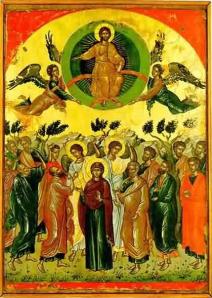
Oh, that day’s not here yet, but Christ’s ascension into heaven[iii] foreshadows his certain return.[iv] Although Jesus isn’t with us in body, it is Jesus himself who promises us, “I am with you always.”[v] Granted much stands against us, yet our God is for us and standing with us. We are already conquerors sharing in Christ’s victory over sin, death and the Devil no matter how we might feel about it.[vi]
This promise is our inheritance and claims us as Christ’s people – a people of living faith, hope and love.[vii] It turns our eyes to look beyond our own suffering and fears toward how we are called to help answer such pain and injustice in the world.[viii] Indeed, in Jesus’ physical absence, we serve as his body.[ix] Our feet are those which bring his good news to dark places.[x] Our hands are those that bring his healing.[xi] Our shared ministries are used to create miracles and give life in his name.[xii]
This is no time to run and hide. It isn’t time to be caught asleep or medicating ourselves with escapist, self-indulgence. Instead, Jesus invites us to truly live saying, “Don’t be afraid. Follow me.” Jesus is coming, and we have much left to do in preparation.
No, we still aren’t God, but we are God’s people. At home or away, at work, school or vacation, even in places of emergency, we remain his church – together with Jesus and never alone. When people look to the hills for help[xiii], it might just be us whom Jesus has sent to be his living answer to their cries for help.
So, let us rest when needed, mourn if we must, support one another, pray and wait with patience, but never give up. There will be a day when there will be no more broken hearts. Until then, Jesus asks us as his body to surrender our hearts to his own – trusting in his promises; fulfilling his Father’s will; freed to love God and our neighbor as his Spirit leads us with all that we are, wherever we might be, whatever might happen. In the face of death, it is time to live.
Just as Jesus came when the time was right[xiv], he sends us now to a world in need of his love – a world where we will meet the Risen Christ on our way already waiting to sustain us with his joy and peace.
At a time of terror or indeed any time, it proves a blessing to take up our cross and seek to do what is right. All will be well, for we always belong to Christ.[xv] Jesus never grows tired, and he will never give up on us.
As I posted this pastoral letter, I recalled this song by Stephen Curtis Chapman. Inspired by the Book of Acts, it often comforted me as a police officer and since. I believe it echoes the above message shared with my community:
[i] Read Jesus’ teaching on such signs in Matthew 24.
[iii] Read about Jesus’ physical ascension into heaven here.
[iv] Read for example Matthew 24:30-31 and 1 Thessalonians 4:13-18. Although some biblical scholars argue these passages are metaphorical or symbolic of his return, orthodox Christians maintain Jesus will somehow return to earth for the final resurrection and judgment – whether we understand the details of how or not.
[xv] “All shall be well, and all shall be well, and all manner of things shall be well.” Julian of Norwich
The above pastoral letter is adapted from one originally published in Messiah Lutheran Church and School’s newsletter, The Messenger (May 2013 edition). To view the entire issue of The Messenger or to see the full calendar of events, visit: http://www.mlcas.org
Unless otherwise indicated, all scripture quotations for this article are from the Today’s New International Version translation.
As the Passion ends, we leave with Jesus laid in the tomb. Was he asleep? No, scripture clearly strives to prove and proclaim that Jesus truly died on that cross. Did he go to heaven? Actually, scripture leads us to believe that Jesus was somehow still miraculously at work but not in heaven.
Our Lutheran confessions state that “we believe simply that the entire person, God and human being, descended to Hell after his burial, conquered the devil, destroyed the power of Hell, and took from the devil all his power.” (See Solid Declaration, Art. IX.) Luther seems to have believed it an ultimate mystery that Jesus descended. Nothing tells us if he did so in “humiliation” or in glory, but we should just believe the faith in which we baptize (see the Apotles’ Creed: Jesus descended into sheol – in Hebrew the place of the dead, sometimes called hades).
Early Christianity believed this and scripture alludes to it in such passages as 1 Peter 3:18-20: For Christ also suffered for sins once for all, the righteous for the unrighteous, in order to bring you to God. He was put to death in the flesh, but made alive in the spirit, in which also he went and made a proclamation to the spirits in prison, who in former times did not obey, when God waited patiently in the days of Noah, during the building of the ark, in which a few, that is, eight people, were saved through water.”
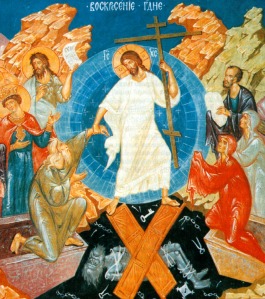
In the Old English, harrowing was the term used to describe Christ’s descent. Ancient icons often show Jesus amidst previous saints of the Jewish Testament, standing on the gates of sheol now opened. The gates are often an “X” or Chi in Greek, reminding us that Jesus is Χριστός, or Christ – the Annointed One and our Messiah come to save us from sin, death and the Devil.
Christians may debate whether Jesus entered triumphantly or suffered more indignities, but mainstream Christianity looks to both scriptures and the faith handed down to us. Jesus’ entrance into the grave was not the last of his journies for us. With sundown, his burial was complete. The Jewish sabbath had begun, and Jesus went to work. The Saturday of our Holy Week is indeed good (holy), and we rightly rejoice even as we wait for the Day of Resurrection. Jesus has come to save all his people.
Unless otherwise indicated, all scripture quotations for this article are from the New Revised Standard Version (NRSV) translation.
Grace and peace to you from God our Father and from the Lord Jesus Christ. Amen.
Every year as we approach Lent, I am surprised at how many comments I hear or read about indicating that “Lent is not biblical.” When I come across such comments, I bristle a bit. I feel disappointment and frustration, and yes, sometimes even some anger when the person is particularly snarky about it. Of course, it isn’t biblical! No one is claiming that the season of Lent is biblical. It is no more biblical than Christians arbitrarily deciding upon December 25th as a good day to remember Jesus’ birth is biblical – not in the strictest sense anyway.
Yet, I fear these folks are missing the forest for the trees. They are sadly missing an opportunity to be blessed. There is no specific call for Lent in the Bible (no one is arguing that), and still, isn’t it remarkable that the earliest Christians found designating such a season spiritually helpful? During these forty days (not counting Sundays which are remembered as days of Resurrection), special disciplines are encouraged as they serve to nurture faith in the individual even as they might serve to witness to our faith and grow Christ’s Church. This season…a season designated by the community of faith for the good of all and to honor God…was found to be a meaningful, beautiful time of preparation for Easter. So, it became a yearly practice and was given a suitable name. The season became known as Lent, an old English word meaning spring.
Yes as with spring, we may witness new growth and new life during Lent. This is what we hope for during these forty days, but we may prevail upon its disciplines at any time of year. Such disciplines don’t lead to a reward for our goodness. They aren’t something we do to become holy, for we cannot become holy by our own power. Instead, such practices become our opportunity to “live in Christ” – to live out our faith concretely nurturing our love for God and others and thereby offering us a chance dwell in God’s grace and love for us. It is for that reason that we find such disciplines commended in the Law and the Prophets, and even by Jesus himself.
The Psalms[1] are filled with such spring-like imagery as are the prophetic texts[2], and some of Jesus’ own parables[3]. Our life with God is always filled with bounty and blessing, often symbolized by natural things: the streams that refresh us; or the trees that serve as protection or a home for God’s beloved creatures. For the many disciplines of Lent – reflection upon one’s life and repentance, fasting, prayer, and most certainly almsgiving and acts of mercy – they can become like the tall cedars of our faith providing us a safe dwelling place in this world of trouble…a place of comfort and shade, strength and renewal. Amidst their many branches, God embraces us. God can even transform us. This Lenten invitation to take actions rooted in our faith in Christ serves only as a reminder of what Paul said in his letter to the Romans, “God’s kindness is meant to lead us to repentance.”[4] It leads us toward a deepening unity with Jesus, both his life and in his church.
Indeed as someone said recently, “Ashes don’t say we’re holy. They say we’re sinners.” They are to reflect the ongoing prayers of our hearts, “I’ll try to be better. I’ll do what Lent asks: more prayer, more sacrifice, more almsgiving.”[5] Western Christians whether Roman Catholic or Protestant desire to remember their total reliance upon God’s grace. “Remember you are dust, and unto dust you shall return,” we are told. This life is fleeting, sometimes dangerous, and we at our best are only sinner-saints.[6] We need the grace of Jesus Christ to help us make it through. The church as a community, as the body of Christ, commends these practices to us. Through them, we may be built up by God and encouraged to build up one another.
Using varied words throughout Christ’s diverse and universal Church, we hear as much during community worship on Ash Wednesday. For example, the Episcopal Book of Common prayer (not too unlike our Lutheran commendation to a holy Lent heard earlier tonight) rightly proclaims, “The first Christians observed with great devotion the days of our Lord’s passion and resurrection, and it became the custom of the Church to prepare for them by a season of penitence and fasting. This season of Lent provided a time in which converts to the faith were prepared for Holy Baptism. It was also a time when those who, because of notorious sins, had been separated from the body of the faithful were reconciled by penitence and forgiveness, and restored to the fellowship of the Church. Thereby, the whole congregation was put in mind of the message of pardon and absolution set forth in the Gospel of our Savior, and of the need which all Christians continually have to renew their repentance and faith.”[7]
So, we begin this season of Lent with ashes – a broken, struggling people – but also gathered together as one holy people of God. Our sin is systemic, shared and individual, but we are also chosen and loved. God plans for our redemption. In a time of trial for the nation of Israel, Joel commended these same types of behaviors.[8] By their apathetic faith, unholy alliances with powers of this world, and acts of selfishness and sin, the people of God were at risk in those days. They were weakened as a nation by such behaviors, and a terrible plague of locusts put them further at risk – at risk of invasion, starvation, and suffering. Joel hoped that by immediate repentance the advancing threat would be turned aside by God.
Well, hear the Good News! Thanks be to Jesus Christ, we need not just hope. Salvation is ours. Forgiveness is possible, and it isn’t too late. No matter who we are, what we have done or failed to do, the grace of Jesus Christ invites us into his loving arms. These are days not of gloom and doom but of growing light. They are days to be celebrated. Through Christ’s cross, the sin of all who trust in him has been redeemed. His cross previously an instrument of torture and death became for us a forgiving place of shade where we can invite our friends and neighbors to also find rest. Through our baptism, we are clothed in Christ, the finest of garments, given new life and a new family of God. This is much as Zachariah and other prophets have promised throughout the ages.[9] It is a new day, a final age where Jesus is coming back to complete his work, and we are invited. In our hearing, all God’s promises have been fulfilled in Jesus Christ.[10]
As unworthy as we all might be, we are still loved by Jesus! And since we are so loved – loved unto his own death, Jesus invites us to gather, remember, and experience new life: remember our need for God; remember our failings and all the ways we turn away from God; and not least of all, remember all the grace-filled ways Jesus reaches out to us, drawing us back.[11] We have this shared forty-day journey to re-experience Jesus’ parable of the vine and the branches.[12] In this season, we will bear fruit by intentionally striving to remain in the vine which is Jesus. We admit openly that without Jesus we can produce no fruit, and so we turn to him all the more and hold on in faith. We will seek intentionally to better love God and our neighbor. We desire that this dedication and fruitfulness will not fade after forty days but instead last a lifetime. It will be Jesus who will use this time to prune us and bring new life. His light will overcome our darkness, and it will shine more and more brightly.
This is our Lent, our springtime given us as a gift in the present even as we await the eternal Easter of our future. Lent is more than a season of time. It is a call to a way of life, Christ’s way. It goes well beyond the Bible even as it is rooted in it, because together on this journey, we have the opportunity to personally encounter anew the living Word of God, Jesus Christ, our Lord and Savior. Amen.
The above pastoral letter was originally published in Messiah Lutheran Church and School’s newsletter, The Messenger (June 2013 edition). To view the entire issue of The Messenger or to see the full calendar of events, visit: http://www.mlcas.org
Unless otherwise indicated, all scripture quotations for this article are from the New Revised Standard Version (NRSV) translation.
I know it might seem strange to post about Super Bowl commercials on what is usually a blog dealing with spiritual issues, but I saw three advertisements which had a distinct spiritual and community dynamic. These stood out for their positive messages and in two cases, explicit reference to spiritual life. Others are here as they raise interesting theological points for discussion. We often say that “God is everywhere,” so why shouldn’t theology and advertisement meet?
Surely, as many scholarly books attest, I understand that consumerism can negatively impact and shape our spiritual views. Spirituality and community life can become just another marketing ploy. The “perfect life” can prove a hollow idol created by advertising executives and leading us away from God and our neighbor. These are true risks in our world.
In addition, some churches have adapted a sales approach to mission and ministry; striving to entertain an audience while seeking to outdo the competitor congregations through fresh, sometimes extreme marketing. This sometimes creates a church which one observant friend described as “theologically a mile wide but only an inch deep.” Such faith communities tend not to be rooted in the past nor truly engaging the inner lives of participants in the present. They can become not much different than the local car lot offering a special drawing or showplace just trying to fill seats and maximize the take.
Still, I found these entries in the Super Bowl race for attention unique and worthy of mention. Perhaps they might seem hokey to some. Maybe the companies have some alternative, darker reasons behind the pitch. Conceivable, I can be making too much out of nothing. Yet when so many companies go for tasteless shock and awe, it was refreshing to watch these.
My Top 3 Super Bowl Ads for 2013:
1st Place – Ram: The Farmer
I appreciated that the video presentation seamlessly echoed the great Paul Harvey’s wonderful reflections on the often forgotten or underappreciated farmer. Having lived for a time in the mid-west, I remember well the hardworking individuals staying out all night in sub-zero weather to care for a calf. I saw them tend to their families, their fields, their animals, and their business with passion, dedication and love. I admired the magnificent images; many of them like artwork and showing the many facets of the people we call farmers. Subtly placed within the images are diverse people praying, hoping, and loving while trying to make a living. At the same time, they have the ability to make the world a better place. Indeed, the farmer shares a vocation in the purest sense. Their work is a call from God. Let’s pray that they succeed in nobley living up to that call.
2nd Place – The Jeep: Whole Again
In our small church community, we have had a number of people who have served in the military to include wartime. Some have suffered from post-traumatic stress decades after their experience, while others are younger and dealing with fresher but what will likely be long-lasting wounds. Fortunately, not all suffer in this way. Yet no matter their status, we have a very affirming community for our military veterans. Several military installations are nearby, and a number of our people in our community work in support of the military which defends us.
We read news items of deaths. We hear of injuries and disability. Instead of statistics, we see our family members, friends, comrades, and neighbors. We know families split apart for far too long of a time (and any length of time is too long, even if necessary). Through these shared experiences, we sense the validity of Martin Luther’s reflections on the military being a vocation, a sacred calling:
…In the same way, when I think of a soldier fulfilling his office by punishing the wicked, killing the wicked, and creating so much misery, it seems an un-Christian work completely contrary to Christian love. But when I think of how it protects the good and keeps and preserves wife and child, house and farm, property, and honor and peace, then I see how precious and godly this work is; and I observe that it amputates a leg or a hand, so that the whole body may not perish… (excerpted from Martin Luther’s Whether Soldiers Too Can Be Saved)
With the historic love affair between jeeps and the military, along with this tasteful presentation (even explicitly yet subtley mentioning prayer no less), their advertisement doesn’t come across as jingoistic to me. It speaks of yearning, servant leadership, and love. We are not whole until there is peace and our military can be with us once again. The wounds of wars and a fallen world run deep, but there is hope. We can remain in a loving communion as we wait upon the Lord to restore peace and wholeness to our lives and our world.
3rd Place – Budweiser : The Clydesdales – Brotherhood
This ad could have perhaps made Francis of Assissi feel verklempt. Although fictional, the love that can be shared between man and animal reminds me of the “pets” in my own life who teach me about laughter and love every day. These relationships are spiritual in nature. Genesis may indicate God shares his dominion over the world and all that’s in it with us, but we are not to be abusive lords. We are to be loving stewards, caring for creation and the lives within it. This tender commercial has touched the hearts of many. If only more people would look deeper to see how all creation points us toward the majestic love of our God.
Lastly, some may questions the use of a beer commercial on this blog, but recall that Martin Luther and his wife, Katie, made their own beer and even sold it to support their Reformation work. For the theological merits of making or imbibing alcohol, that must wait for another time.
Runner-Up:
Samsung Mobile USA: The Next Big Thing
Although snarky, this runner-up is mentioned not only for its humor, but how it reflects our all too common tendency to be “bent inward upon ourselves” (as Martin Luther used to say). Seth Rogan and Paul Rudd play themselves, called in to promote the next big thing from Samsung. They both assume they are being recruited as “the next big thing,” rising stars in a media culture. This flash point to humor reminds us of our shared Achilles heel, our hubris. It was, is and remains the source of our common Fall.
Questionable Mention:
Tide: No stain is sacred
Certainly, I could have picked many of the hyper-sexual, juvenile, or abusive ads seeking to attract attention through shock. Instead, I will only mention this Tide commercial. I get the humor in it, but it also gave me reason to pause. Many people fall in the trap of a simple, superstitious faith where they see images and find meaning in questionable things – an image of Jesus on toast or a taco for example. Yet, there are other images such as Our Lady of Guadalupe that are much harder to explain away.
Lutherans (and Protestants in general) become cautious when discussing the mixing of spirit and matter, the gift of something spiritual – grace – by means of physical things. We do so because human nature often leads us toward excess. We have a tendency to create idols and pay for relics. We begin to worship things of humanity or earth rather than God. Lutherans do believe God can use the physical bound to the Word through faith as a means of grace (as in our two Sacraments, Baptism and the Lord’s Supper), but we would reject the superstitious sightings of grace so often merged with transitory things.
Martin Luther often used humor himself to attack this tendency in the church of his time (a church made of very fallible people just like today). Yet while on one hand I see the humor of this modern ad, I fear it might make people laugh at faith as a whole in some manner. I don’t personally like to mock my neighbors who might find spiritual meaning in such things, even if I don’t. I never hesitate to speak openly of my concerns about such behaviors, but hopefully, we can do so out of love for our neighbor and show them respect.
Unless otherwise indicated, all scripture quotations for this article are from the New Revised Standard Version (NRSV) translation.
Spring at Messiah. “Look at the birds of the air; they neither sow nor reap nor gather into barns, and yet your heavenly Father feeds them.” (see Matt. 6: 25-34)
I thank my God every time I remember you, constantly praying with joy in every one of my prayers for all of you because of your sharing in the gospel from the first day until now. I am confident of this, that the one who began a good work among you will bring it to completion by the day of Jesus Christ. It is right for me to think this way about all of you, because you hold me in your heart, for all of you share in God’s grace with me, both in my imprisonment and in the defense and confirmation of the gospel. For God is my witness, how I long for all of you with the compassion of Christ Jesus. And this is my prayer, that your love may overflow more and more with knowledge and full insight to help you to determine what is best, so that on the day of Christ you may be pure and blameless, having produced the harvest of righteousness that comes through Jesus Christ for the glory and praise of God. (Philippians 1:3-11)
On several levels, I have had a challenging year due to my health. First, I was adapting to life with newly diagnosed asthma. Second as the year came to a close, I faced an undiagnosed health issue causing me to be less available and to cut down on my hours working. The health issue is still under evaluation, but hopefully, it will prove a distant memory soon.
What I won’t ever forget is the patience, care, and kindness so many of you shared with me and Kristine as we began to deal with this new “imprisonment.” I am inspired at how your council leadership and ministry team leaders arose to the challenge too, as they adapted to my limitations and strove to provide you the highest level of spiritual care, Christian education and worship. Messiah is a great example of what it means to be part of the priesthood of all believers and cooperative ministry.
I am proud to serve Christ with you, and our many successes this year make me prone to boast in the great work Christ is doing in you and through you. As mentioned during worship, our congregation is held up these days by the Bishop’s staff and others as a model of ministry within our synod. Those that handled our consolidation loans marveled at how we do more than most congregations ten times our size. It brings me joy to have people identify us as “that congregation that does so much.”
Yes, it is not an over exaggeration or nicety when I say I love you all. It makes me excited to look forward to what God’s grace will do in our lives next!
Peace,
Pastor Lou
The above pastoral letter was originally published as part of Messiah Lutheran’s 2013 Annual Pastor’s Report. It has also been republished here and in Messiah’s newsletter, the Messenger. To view the entire issue of The Messenger or to see the full calendar of events, visit: http://www.mlcas.org
Unless otherwise indicated, all scripture quotations for this article are from the New Revised Standard Version (NRSV) translation.
The following are the three meditations I shared during our Family Christmas Eve Service at Messiah Lutheran Church and School in 2012. Our theme was “Sent into the World.” We remembered both how Jesus was sent into our world to save us as a newborn babe and how we are sent as his church out into the world. Thus, the service included many hymns and carols from all over the world. The three below were part of the meditation portion of the program, but it was a night filled with music and fun.
The Gift of Jesus
Reading: Isaiah 9:2-7
Prop: small Christmas tree ornament of the globe
“The people who walked in darkness have seen a great light; those who lived in a land of deep darkness—on them light has shined” (Isaiah 9:2).
Consider the world [holding up ornament]….Ok, it’s a bit larger than this ornament, but it’s a relatively small place in the vast, extensive darkness of space. Proportionally, this ornament in comparison to your own size is much, much larger – infinitesimally so – than what we would find with a God’s eye view of our planet. Our world is only a small rock in a vast galaxy that itself is only one of millions of galaxies. Our universe was created from a black void – both the Bible and science think so – and this poor little sphere spends much of its time suspended amidst that darkness; hidden by larger heavenly bodies, and threatened by them as well. Yes, our fallen world is filled with threats and horrors and many terrible unknowns, and it always has been. Yet, light breaks in to give warmth, nurture life, and bring joy. Amidst a cosmic battle, God doesn’t leave us unloved or alone in the dark. Instead, he chose to dwell among us…even became one of us on this tiny, out of the way planet we call home.
Long ago, the great prophet Isaiah lived in the 8th Century BC. It was a time of much darkness. Certainly, they didn’t have our modern conveniences or scientific knowledge, but they shared in our troubled humanity. Throughout Isaiah’s life, the nation of Israel faced wars and rumors of war. At least three times, the existence of Israel was at risk of obliteration and exile. It was a time of early death due to violence, famine and disease. There was seemingly too little joy and never enough peace. Yet, a son was born to a young maiden, wife of the king, and the prophet saw in this somewhat ordinary experience the promise that lay within. God would be faithful no matter how dark the days got. God’s plan to rescue his Holy people would never go unfulfilled. Later Christians would understand this same passage to testify to the coming of Jesus Christ.
Over the last few weeks, we have seen too much darkness. Many are still homeless in the northeast after Hurricane Sandy. Diplomats in Benghazi were horrifically killed. In Connecticut, we hear the cries of modern “Rachels” weeping as foretold by the prophet Jeremiah. (See Jeremiah 31:15-17 and Matthew 2) They cry over too many innocents and our own innocence lost in the safety of their small town school. Closer to home and only in these past few weeks, members of our community have suffered new joblessness, accidents and serious illness, and our beloved Assistant to the Bishop, Pastor Chip Gunsten, died unexpectedly. More tears. More death. Darkness. We might be tempted to echo the writer of Lamentations wondering, “Why God would allow such things? Why would he punish us so?” as we groan anew:
5 [God] has besieged and enveloped me
with bitterness and tribulation; 6 he has made me sit in darkness
like the dead of long ago. (See Lamentations 3)
Yet in these times of trouble, hear the promises that come to us through Isaiah. Much like that time long ago, there is a sign to remember and hope to be found amidst our darkness. When the time was right, a virgin did conceive, and a very different child was born…one like no one before or since…perhaps beyond Isaiah’s own understanding. He would be a miracle of light, giving hope, joy and love to all the nations. This king would not be a king in our political sense. Instead, he would suffer under the political forces of our world as we might. He would live amongst the ill and dying. His life would be continually threatened from the slaughter of the innocents in Bethlehem until his own death on a cross. God had come, not to punish us, but to share our lot and change it; to end suffering and bring everlasting peace. All authority rested on Jesus’ shoulders, and yet out of love, he took upon those same shoulders the weight of sin, death and the Devil to defeat them all and save us.
Like that original Christmas night long ago, Jesus comes to our tiny planet to touch our tiny lives and hearts today. He wishes to be God with Us, Emmanuel, and so none of the political chaos, evil or darkness is powerful enough to stop him. Although it might be hard for us to recognize him with our human senses at times, our faith hears his voice and trusts he is near. Together as church, we gather as one, holding on in the darkness and never alone. God does not will such suffering. God is only love. Jesus remains our proof, and the fullness of God’s Kingdom will banish our darkness forever when the time is right.
Until then, we testify to the light and hold on to one another – teaching, serving, worshipping, loving God and neighbor. For, “What has come into being in [that baby] was life, and the life was the light of all people. The light shines in the darkness, and the darkness did not overcome it (See John 1).”
Although we remain in this land of darkness, the light shines on us and through us still, and our Lord Jesus promises that it always will. No matter what worries us or threatens us…no matter the darkness we sense around us or in us, rejoice! Rejoice with the choirs of angels and all God’s saints for the promise of Christmas has come to us, and we will never again be separated from his love. Amen.
Carol, “Angels We have Heard on High,” Red, 289
The Gift of Grace
Reading: Titus 2:11-14
Prop: Wrapped package or gift bag – empty inside
One of my favorite traditions each Christmas Eve is to gather with my extended family and friends, share a special meal and open gifts. It is such a great joy to see the look of expectation through the eyes of my young nieces and nephews gathered together. Unfortunately sometimes…and I’m afraid it was the same when I was young too…the package comes all wrapped and beautifully bowed…it gets opened frantically, quickly…only to have the child move on just as rapidly to the next gift. The gift delights for a moment, but then the child moves on perhaps as if that beautiful gift box or bag was filled with nothing. [Emptying and examining package]
We, the children of God, spend much of our lives in a similar fashion. We chase after the next bobble or possession, seek positions of power that don’t last, and spend too much time in activities that can’t love us – costly time away from our family and friends. I often hear when someone has a near death experience or approaches the end of their life, “I wish things were different. I have wasted my life.” Yes, as children, we can easily lose our way.
Yet through Christ, a different gift lies before us; one that is eternal and can fill all our life’s empty places. We sense that something is missing, and that perhaps, we could do better. We somehow in our hearts expect more from this life. And so, Jesus calls us buy name, offering us the ultimate gift of his love and friendship.
The theologian Dietrich Bonhoeffer compared us to miners trapped underground. We might feel that we are without hope – waiting for death – until suddenly a voice is heard, calling from seemingly nowhere, yet calling in our darkness. “Where are you? Help is coming!” The helpless miner stands up, mustering strength to cry out in return, “Here I am! Come through to me and rescue me!” Faced with the inability to save himself, the miner admits his neediness, “I cannot come through. I cannot help myself. But I wait. I wait and will hold on until you come. Only come quickly.” The miner sees nothing, nothing at all to give him hope. He only hears the promise of the savior, “I am coming for you!” Blow after blow, the sound comes nearer. There is a last crashing, seemingly thunderous blow of the hammer…light breaks in…at first just a hope or glimmer of light…but yes, more…certainly more! One strike and he will be free. New life will be his.[i]
This story is a metaphor for the giftedness of our present life. Jesus has come to save us, he is with us, and he will come again. That saving work began in a small stable. It continued on a cross. It proceeded from a tomb. Yet this is only the first breaking in of his light and love. His saving work continues to dawn in our daily lives today. He calls us to wait…listen for his voice, hold on for his help, and live in his hope. Look up, raise your heads, and expect salvation…a salvation that not even the power of death can keep from us.
In return, we are only asked in the present age to seek lives that are self-controlled, upright, and godly, 13while we wait for the blessed hope and the manifestation of the glory of our great God and Savior,* Jesus Christ (see Titus 2:11-14). He will do all the heavy work, so that through faith, we receive a gift beyond price – a saving grace, a living grace…a grace that must be shared with others, so that we may one day taste our freedom fully together. With such a life reborn of faith, we’ll sense the light of Christ is near us even amidst our darkness. Amen.
Carol, “I Am So Glad Each Christmas Eve,” Red, 271
The Gift of Church
Reading: Luke 2:1-20
“Props”: the people of God!
In these modern times, skeptics demand proof. “Prove that the reason for the season is Jesus! Prove to me that God is love!” What signs can we give them?
Long ago, some less modern skeptics gathered in a field. They were of lowly status, shepherds of sheep. They were known for dirty bodies and dirty lives filled with drinking, lies, and even theft. They were a hard people shaped by the hardness of life, and they expected little.
“Then an angel of the Lord stood before them, and the glory of the Lord shone around them, and they were terrified. But the angel said to them, “Do not be afraid; for see—I am bringing you good news of great joy for all the people: to you is born this day in the city of David a Savior, who is the Messiah, the Lord. This will be a sign for you: you will find a child wrapped in bands of cloth and lying in a manger.” (see Luke 2)
The long expected sign for the King of Kings, the Messiah, our Savior…the one who would change all the world…was a baby! It was a poor infant from a poor family in poor circumstances. A child swaddled in simple, torn strips of cloth. That was the great sign of God’s love. God had come to share in the hardness of life and free us from it.
That child would grow to be a boy wise beyond his years. Then, he would become a man who preached and taught not as the scribes and priests did but as one with the authority of God. This great rabbi would travel the land by foot. He would walk far and wide reaching out not only to the expected Chosen Ones of God, but all people: the lepers, the wounded, and the greatest of sinners. Even on his cross, that man would share comforting words of God from scripture, pray for his persecutors, offer forgiveness to someone crucified beside him, care for his mother, and give up his own life so that others might live. Jesus’ life and being was and remains that greatest of signs of God’s love for us.
And so here we are, gathered as millions and millions of Christians have done over the millennia and do so tonight. We would not be here if Jesus hadn’t been born as one of us and risen from the dead…if people like us hadn’t been touched by the light of his life and past that light on to us through the ages (as we will symbolically do with candlelight later this evening). The incarnate Christ is who we worship…the ever so real and yet divine Jesus…and he is present in our world through the incarnate church, the embodiment of his teachings, life and love.
We can be a hard people with a hard life, and yet the angels speak to us…call us to become Christ’s messengers. “Do not be afraid! To you is born a Savior”…for you a Savior. He is a gift come to you, so that you with others might share one communal, eternal, joyful life with him. Through faith, we are to be his body, a sign of good news and great joy for all people.
As his body, we are asked to share in his life, suffering, death, and resurrection out of love. It is his Spirit that washes over us in our baptism, and his flesh and blood that touches our own in our sacred meal. Just as Jesus’ life is the final answer to sin, death and the Devil, he has spoken us into being for this time and this place with all its unique challenges. Look to your right and left…see yourself in a mirror. We are the church! We are to be Christ in the world!
We are called to be Christ’s church together, a gift to the world as Jesus was God’s loving gift to us. As the Spirit was a gift to the first disciples that same Holy Spirit seeks to empower us now. Therefore go and make disciples of all nations (see Matthew 28:16-20)…be zealous in good deeds (Titus 2:14)…walk in his light (Isaiah 9:2)…For God so loved the world that he sent his only Son into our world to rescue us and dwell in our hearts (John 3:16-17). Out of that same love, God sends us back out into that hard, dark world – strengthened and never alone – to share his light not just on this holy night, but always.
May we like those shepherds, praise God and share with one and all what we have seen and heard. Amen.
Carol, “Infant Holy, Infant Lowly,” Red, 276
[i] Paraphrase of a portion of a sermon by Dietrich Bonhoeffer as translated in Robertson, E. (trans. And ed.) (2005) Dietrich Bonhoeffer’s Christmas Sermons. “How a prisoner awaits for his release.” December 3, 1933. pp. 88-90.
Unless otherwise indicated, all scripture quotations for this article are from the New Revised Standard Version (NRSV) translation.
The following is a short sermon I preached to my congregation at Messiah Lutheran Church and School, on the Third Sunday of Advent, often called Gaudete (Rejoice) Sunday. Although our preschool students and elementary-agers were present to perform a joyous Christmas musical, the death and sadness of the last week, especially in Newtown, CT, could not be ignored.
As our last hymn [O come, O come, Emmanuel] reminds us[i], the Advent season is a time of waiting and expectation. The song is much like many others among our Advent hymns and even some of our more traditional Christmas carols. Many project a sense of sadness and longing. They can prove almost melancholy. Our hymn writers and liturgists – just like us – know the imperfections and pain of this world, and so we look toward Christ to deliver us. Our music, images, and prayers can reflect that sense of loss, waiting and hope. Being a Christian, I heard someone once say, is like being a person separated from their greatest love; something is missing, and not quite right. We hunger and thirst for that love to be one with us again, so that our lives can feel whole.
This week, we have been unhappily reminded of that truth. We lost our assistant to the bishop, Pastor “Chip” Gunsten, a dear friend of mine and many here at Messiah as well as throughout our synod, who died suddenly while undergoing treatment for cancer. We are not the only ones mourning, for our Catholic brothers and sisters lost their former beloved bishop, Walter Sullivan on the same day. He was someone I knew well, and he proved influential to my own discernment of service within the church. Our Presbyterian friends in Virginia lost one of their own leaders as well, Cynthia Bolboch, Moderator of the 219th General Assembly of the Presbyterian Church (U.S.A.) on December 12th. Having many Presbyterian friends after attending a Presbyterian seminary, I shared in their own grief and sadness. As the week closed, I was tired and worn down from dealing with death and the many emotions that always accompany it. Then, we received the horrific, numbing news of Newtown, CT. People thousands of miles away shared in that community’s dread and grief and fearfully held their own loved ones closer.
How can we make sense of such things? I’m not sure that we can. Oh, as a Christian, I trust that God can use them – turn them on their head and make all things work for our good. I know blessings and signs of love can be found even amidst tragedy – perhaps especially at times of tragedy – through the heroes and servants shining in those times of darkness, or through the love that is shared with us to help us make it through. Yet, maybe we are never supposed to make sense of these things at all. It isn’t within our capabilities to make sense of the nonsensicle. The issues can be too involved for us to handle or beyond us. Maybe they just can’t ever make sense, because they are counter to what God wants for us. God’s will is to save us for a future full of hope, not to condemn us to an eternity of woe[ii]. God’s plan from the time of Adam and Eve was to redeem and save us out of love.[iii]
These sufferings are symptoms of that earlier wound. They are parts of our life as a fallen, imperfect people in a fallen, imperfect world. People sin. People suffer. People die. Uncontrollable evil and sadness do exist. Perhaps instead of looking back for answers as to why things happened, we should look forward. Our time is better spent in the face of such evil asking, “What would you have us do, Lord?”
Certainly, God never abandons us to this sorrow. God has a purpose and a plan which includes us. Jesus was sent into our world as a little child to share our life and lot; even our suffering unto death. God doesn’t rejoice at our destruction, but rather wants us to live abundantly through his only son.[iv] Jesus would become God’s final word on evil, sin and death. They have been defeated through his cross and resurrection, and we are saved here and now. Yet, sin and death are enjoying their final death throws at our expense. Jesus declares we are free from their power; saved even as we and creation might groan at times.[v]
In this present age, Jesus promises to come again to complete the work which he started and banish sin and death forever. There will be a new heaven and earth where suffering will be no more.[vi] In the meantime amidst our lingering troubles, he asks us to look up and be ready, not as a sullen or defeated people, but as his beloved people. Be ready, he says, so that our hearts are not weighed down with dissipation and drunkenness and the worries of this life, so that the day doesn’t catch us unexpectedly, like a trap.[vii]
No, we who are saved have a purposeful, divine work to do. We are left here – called to this time and this place – as his messengers speaking his words of love, healing and forgiveness; words so sorely needed in this wounded, combative world. Like the law and the prophets before him including John the Baptizer[viii], Jesus taught us what we need to do – love God with all we are and our neighbors as ourselves.[ix]
Today both despite our suffering and because of it, we are to speak these words and embody them. God uses us with all our weakness and imperfection to give them form and substance, flesh and bone, to make them real. We are echoes of Jesus crossing all the earth shouting, “Do not be afraid! Jesus has come! He is risen and will come again!” We are called to lovingly and boldly put these words into actions together as church…Christ’s church…his body…his hands reaching out and touching broken lives through our own.[x]
Today, we have also heard words that Paul spoke to Christians in Philippi when they were persecuted, broken and felt alone. These same words were shared with us yesterday at Pastor Gunsten’s funeral. Perhaps it is providential that the lectionary had them as one of our assigned texts considering recent events:
Rejoice in the Lord always. I will say it again: Rejoice! Let your gentleness be evident to all. The Lord is near. Do not be anxious about anything, but in every situation, by prayer and petition, with thanksgiving, present your requests to God.And the peace of God, which transcends all understanding, will guard your hearts and your minds in Christ Jesus. (Philippians 4: 4-7)
Rightly, Jesus is called Emmanuel, God with Us. We need not get stuck in our fear, hurt or anger. Look up! Raise your head! Do not be afraid! These are the words Jesus speaks to us in the face of our most unimaginable threats or losses. When the world and its realities rage, when struck by great sorrow, or when we cannot find reconciliation with others we so deeply long for, Jesus speaks to us as he did similarly to that storm long ago, “Peace I leave with you; my peace I give you. I do not give to you as the world gives. Do not let your hearts be troubled and do not be afraid.”[xi]
This world can be a frightful, sad and lonely place, but we need not grieve as people without faith.[xii] We need not live as a people without love.[xiii] Despite any of our doubts, Christ’s peace and love are with us always[xiv], and we have a shared ministry to do in his holy name.[xv] His light is in our midst and shining through our hearts, and the darkness shall not overcome it.[xvi] Remember always that we are baptized – claimed and called, to be Christ and to serve Christ in the world.[xvii] We must never try to hide ourselves from the pain of this life and thus not truly live.[xviii]
We are Christ’s church, together with Jesus and thus never alone. He has come for us and will come again. Our longing will be vindicated. This truth is rightly celebrated at every moment and forever, but especially during Advent. We celebrate it this morning through our young people attending Messiah Lutheran School who have come to proclaim the story of Christ’s birth with us anew today.[xix] Amen.
Readings for the Third Sunday of Advent – December 16, 2012
Zephaniah 3:14-20
Isaiah 12:2-6
Philippians 4:4-7
Luke 3:7-18
[i] “O come, O come, Emmanuel, and ransom captive Israel, that mourns in lonely exile here until the Son of God appear. Rejoice! Rejoice! Emmanuel shall come to you, O Israel. (Evangelical Lutheran Worship, Hymn 257, verse 1)
[xiv] In Mother Teresa and Brother Roger’s book called Seeking the Heart of God (1993), Brother Roger writes: “Four hundred years after Christ, a believer names Augustine lived in North Africa. He had experienced misfortunes, the death of his loved one. One day he was able to say to Christ: ‘Light of my heart, do not let me darkness speak to me.’ In his trials, St. Augustine realized that the presence of the Risen Christ had never left him; it was the light in the midst of his darkness.”
[xvii] At times of fear or doubt, Martin Luther is said to have reminded himself, “I am baptized”; a reminder that he was Christ’s called, claimed and sent child. His writings also indicate that we act as Jesus in the world, but also encounter Jesus in the least of these, those suffering and alone. Through their lives Jesus cries out to us for compassion.
Husband, Pastor, Law Enforcement Chaplain, and member of the Clerical Errors (aka "The Three Priests"), I'm sharing my two cents with anyone who cares...
You can also find me on social media as Loudluthrn (Lou-d-Luthrn or Lou the Lutheran). It is a moniker given me while attending a Presbyterian Seminary, but I'm a loud and proud Lutheran too (just not too loud and proud, mind you).








 2pennyblog