The readings for the 9th Sunday After Pentecost, Yr. A were: 1 Kings 3:5-12; Psalm 119:129-136, Romans 8:26-39; Matthew 13:31-33, 44-52. This sermon was preached at Grace & Glory Lutheran Church in Palmyra, VA on July 26, 2026.
You might not yet know this about me, but I love mustard. No, I mean really love it. If you look inside my fridge, there are twelve distinctly different varieties of mustard at this moment. Overtime, they change regularly, but I am never without several choices. When traveling in the Midwest, I was compelled to stop at the National Mustard Museum. And on the first Saturday in August, it is a safe bet that I will mark the National Mustard Day somehow. (And yes, National Mustard Day is a real thing.)
During my last year at Christ Lutheran, the youth ministry held a National Mustard Day Pool Party. The youth really got into it. We had mustard tastings, mustard inspired dishes, and many of the youths wore yellow without prompting because they bought into the passion and excitement I shared – at least for that day. It was a wonderful day with many memories made, and my love of mustard became sort of a lasting joke among us. Some have sent me cartoons since I left picturing me with them and, of course, mustard.
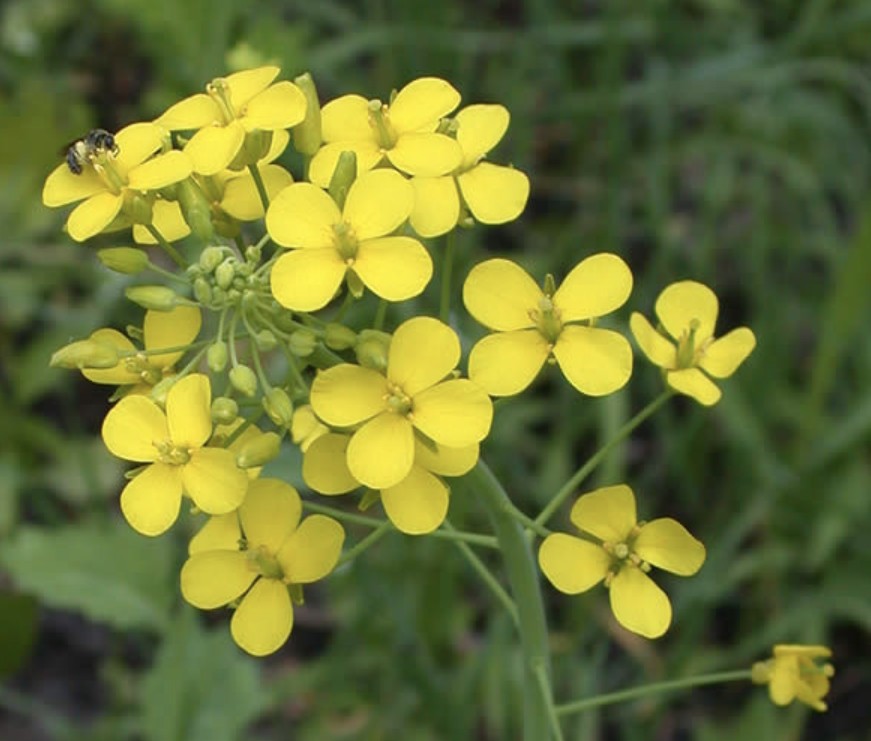
And then this year, God surprised me with another gift. Standing almost five feet high, one stalk of field mustard now grows in my back garden. I didn’t plant it. I’ve not seen that species anywhere in my neighborhood before. It just suddenly appeared. And although farmers tend to consider it a weed, I have learned that one can eat it as mustard greens or make a kind of mustard out of it. I consider its appearance a kind of miracle. Why? Because to me when I look at it, it brings me joy reminding me of mustard, but also past trips, youth formally entrusted to my care but whom I still deeply love, and in no small part, today’s Gospel.
Yet, the Parable of the Mustard Seed is not the only one we hear this morning. In a kind of rapid-fire succession, the lectionary asks us to consider five, very short parables uttered by Jesus. In Jesus’ presentation, one commentary writer, Zina Jacque, compares Jesus to a comedian working the room.[i] Different verbal tidbits are thrown to the crowd hoping that something lands well. The comedian knows that the audience is made of varied people with unique experiences, and so the illustrations used vary to hopefully help different segments of the crowd relate.
Remember, parables can be stories, sayings, or riddles. They might even seem humorous at times. During Jesus’ earthly ministry, parables were used by all kinds of teachers to land a desired lesson…to help their students critically think, learn, and remember. Similarly, Jesus wanted to connect to his original audience and to us.
In detail, Zina Jacque argues this is exactly what Jesus is doing in his teaching and preaching. The repetition is intentional. First, “The mustard seed and the yeast (verses 31–33) speak to those who know the land and the kitchen.”[ii] Meanwhile, “The hidden treasure and the pearl (verses 44–46) speak to those who understand acquisition, risk, and the marketplace.”[iii] Last but not least, “The dragnet full of fish (verses 47–50) speaks to those whose livelihood depends on the sea.”[iv] And I think it is kind of appropriate that this last parable was offered to the Apostles when alone. For as scholars suggest, at least four and up to seven of Jesus’ Apostles were likely fishermen.[v] He tried to connect with them.
Yet despite the variations, she also notes, “no matter which parable grabs your attention, the point remains the same. “The kingdom of heaven is valuable beyond measure, it is at work even when you cannot see it, and it will cost you everything to participate in it fully.”[vi] As humans, we can only get a sense of such wisdom…We taste and but don’t fully see yet what the inbreaking Kingdom has in store.
Still, we might often catch glimpses through the smallest of things…the ordinary…often imperfect things in our eyes. For example, in a central parable of the five, we hear of leaven being worked into flour in order that it might grow, expand, and become the bread that is intended. That, too, is intentional. And, leaven is often used in Matthew as a negative symbol for the teaching of the Pharisees.[vii] “Beware of the leaven,” we are cautioned.
Yet as with last week’s wheat and weeds (Matthew 13:24-30; 36-43), the parable’s leaven is worked into God’s good will for us. Jesus elsewhere says he did not come to abolish the Law but fulfill it. He draws his own teachings from the Law, the Prophets, and the Wisdom literature of Judaism and expands upon it as only God can do. In our Bible study last Wednesday, it struck me that the Jewish image for Wisdom or God’s Spirit was a woman. Perhaps, true wisdom is partly understanding and trusting that all things, even evil things or our own sin, can be used by God in the end to bless us just as Paul argues (Romans 8:28).
Yet always remember that with the Resurrection and ascension of Jesus, the Kingdom is here…not in its fullness yet, still breaking in, but here. In the small neighbor children whom I saw playing with abandon a few nights ago, or through the relationships we might have (particularly perhaps in the Church), and in our gardens or on our daily walks (including our vocational walks), or in the lowly Field Mustard in my backyard…we can witness and learn about the inbreaking of the Kingdom at work within us and around us. Even amidst the leaven, weeds, or any bad, the Kingdom is here and yet still coming. So, we are to watch and wait with expectation and hope.
In Psalm 46, speaking for God, we read, “Be still, and know that I am God.” This use of “still” (raphah) means to stop stiving or let go (“let go and let God”) in Hebrew. It is an invitation to experience God’s sovereignty and love…to witness God’s grace at work. And that is what Jesus is doing with these parables. Stop, contemplate, listen…In modern psychology or other faith traditions, we might say “be mindful.” We who are faithful are to rest and act in a kind of conscious or intentional love. “Abide in my love,” rest in my love, Jesus invited us before he died.
Similarly, in seminary, I was exposed to the writings of Therese of Lisieux. As Therese died from tuberculosis while a young nun, she likened her experience to that of a small butterfly. Even as she did things to help her health, she saw her soul like that time creature entirely dependent on God’s grace to carry her to heaven …the grace now available to us in the Resurrected Christ.
She came to call herself, the Little Flower, as she saw that she was like a hidden wildflower in God’s garden rather than a grand plant. Even from her sickbed, she could serve God through her prayer and faithfulness. Easily overlooked, even in her suffering, she trusted that she mattered to God.
Also, she compared herself and her budding faith to being like a small bird with untried wings looking up at the sun with profound and total confidence. She knew who she belonged to. She would mindfully go through her day looking for signs of God’s Kingdom of love and grace breaking in all around her. She would keep watch and stay awake as Jesus taught.
Today, she is commonly known as the Little Flower, and many people seek to model what she called her “Little Way,” a way of holiness…ultimately Christ’s way. She came to believe that by doing small tasks and performing her duties with great love she was fulfilling her calling within the Kingdom. Heroic feats were not mandatory…are not mandatory. This reminds me of quotes from Mother Therese in Calcutta, but it is also the wisdom shared by Martin Luther. He, too, argued three centuries earlier that in living out our vocations we can make Christ known. He wrote that in the smallest acts done with great love we serve Jesus. Even the diaper changing of a baby when done in love, he suggested, becomes a sacred act…a holy moment.
Thus, the Kingdom of Heaven is not like the human ideas of power, might, nor significance. We are already significant to the God who made us, the Son who died and rose from the dead for us, and the Spirit who lifts our hidden prayers as with groans. In God, we find the fullness of our significance no matter our station or our lot, nor even our ongoing struggles with sin. We cannot be loved more than we already are despite living imperfectly in an imperfect world.
Sadly, since the 1970s at least[viii], the United States Church has been obsessed with growth models related to size, and yet with seventy percent of congregations worshipping at less than 100 people, maybe growth in numbers isn’t the point of our ministry? In the Kingdom’s economy, faithful witness is what matters…no matter the challenges or whatever dangers we face…no matter alone we might seem…even facing our own death. And as Christian denominations and persons tend to struggle and argue over the merits of cultural domination versus cultural accommodation,[ix] maybe we are getting it wrong there, too? That might not be the battle the Kingdom calls us to wage at all.
I like how a former Bible professor of mine, Professor John T. Carroll, summed up the hopeful message that these parables provide us:
“Jesus and the disciples carry out their mission in a world that includes a whole lot of bad. Yet even though God’s reigning presence will not swiftly cancel and eliminate the brutality of Roman armies (to name one example), people of faith can trust the future to the holy justice of God. The parable in 13:47-50 summons readers today to the same courageous trust.”[x]
Now, I could be wrong, but perhaps we who believe are to live more like the humble Field Mustard in my backyard after all. We won’t always be appreciated. We are sometimes forced to live amidst rocky soil or battered by storms. And yet, we each have a purpose that’s special to God. We become a kind of living parable for others to help them understand just a little bit more about the Kingdom of God at work in the world and Jesus’ own call to them in their lives.
Yes, some might see us to be beautifully within this special “mustardy family” we call Church despite our imperfections. That botanical family is a family traditionally known as Cruciferae, which means “cross-bearing” in Latin. For their four petals form a cross when in bloom. This reminds people of Jesus. And through our own crosses born in faith with God’s help, God will surely make us bloom. People can see Jesus in us. And just as Jesus bloomed in his resurrection, we too will fully bloom when his Kingdom comes in its fullness. That’s God’s promise to us. Amen.
[i] Jacque, Z. (July 2026). Commentary on Matthew 13:31-33, 44-52. Working Preacher. As downloaded at https://www.workingpreacher.org/commentaries/revised-common-lectionary/ordinary-17/commentary-on-matthew-1331-33-44-52-7 on July 24, 2026.
[ii] Ibid.
[iii] Ibid.
[iv] Ibid.
[v] Harris, M.D. (March 12, 2025). Why Did Jesus Choose So Many Fishermen to be His Disciples? MD Harris Institute. As downloaded at https://mdharrismd.com/2025/03/12/why-did-jesus-choose-so-many-fishermen-to-be-his-disciples/.
[vi] Jacque, Z. (July 2026). Commentary on Matthew 13:31-33, 44-52.
[vii] Card, M. (2013). Matthew: The Gospel of Identity. Downers Grove, IL: Intervarsity Press. p. 110.
[viii] Holy Post Media (July 22, 2026). Holy Post Podcast: The Idolatry of Church Growth with Andrew Root. Episode 730.
[ix] Bell, J. (July 2, 2026). The End of Christian America: What Actually Killed American Christianity. Livewell. As downloaded at https://jamesbell333289.substack.com/p/the-end-of-christian-america-227?r=6utlc2&utm_medium=ios&triedRedirect=true on July 22, 2026.
[x] Caroll, J.T. (July 2023). Commentary on Matthew 13:1-9, 18-23. Working Preacher. As downloaded at https://www.workingpreacher.org/commentaries/revised-common-lectionary/ordinary-15/commentary-on-matthew-131-9-18-23-6 on July 23, 2026.
Below, please find a video of our worship service. The sermon starts at about the 21:33 minute mark.
© 2026 The Rev. Louis Florio. All content not held under another’s copyright may not be used without permission of the author unless under terms of fair use and properly attributed. Scripture passages when used are from the NRSVue translation unless otherwise indicated.