https://commons.wikimedia.org/w/index.php?curid=24735119
The readings for the 18th Sunday After Pentecost, Yr. A were: Ezekiel 18:1-4, 25-32; Psalm 25:1-9; Philippians 2:1-13; Matthew 20:1-16. This sermon was preached at Grace & Glory Lutheran Church in Palmyra, VA on September 27, 2026.
Long ago in my VMI cadet days, I heard an Army general say that the best soldier is a grumbler. He was sharing an ancient maxim with roots in the Imperial Army of Rome. He explained that grumbling can be an outlet for stress. It might even build some team cohesion through the experience of shared suffering and perseverance. Ultimately, the soldier who grumbles also often proves the soldier who goes on to fulfill his (or now her) duty.
You see, if troops stop complaining to one another, that’s not the norm. Historically, they are likely fully demoralized or planning a mutiny – neither situation good for an army. Centuries later, this maxim proved true during Napolean’s day where his most loyal, elite, and formidable soldiers came to be nicknamed “The Grumblers.” It remains true for today’s US Army. It is better to grumble and do the job at hand then be a “yes man” or woman who does not.
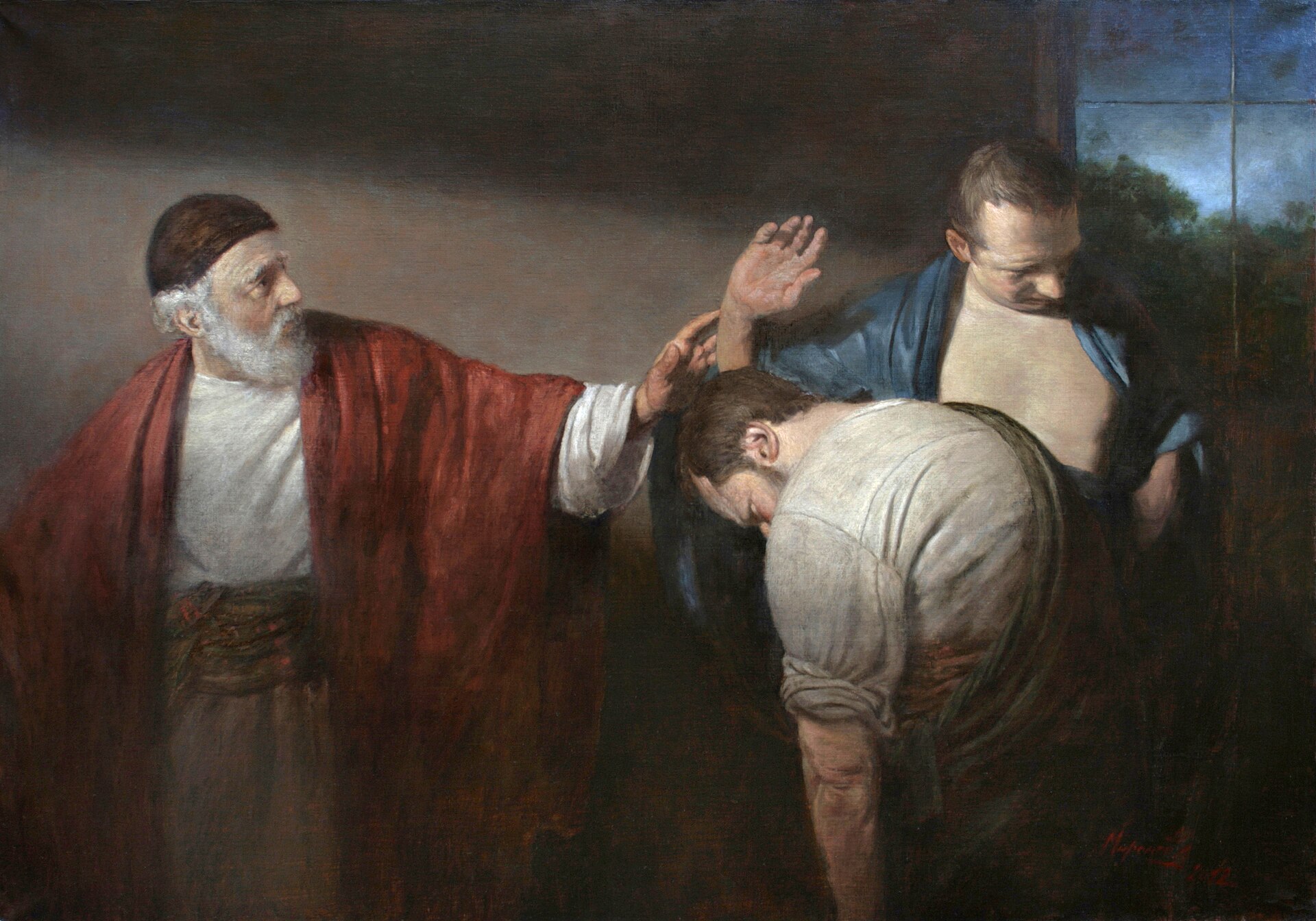
I have often wondered if Jesus was somehow aware of this well-known Roman military maxim when sharing his Parable of the Two Sons. This would be a sad irony, for the Roman Army would eventually execute Jesus. Yet, the parallels seen could just be the recognition of a common cultural and human frailty. We can tend to say yes as humans but then fail to follow through. We can lose our attention on the matter at hand as other things distract us or overcome us. Or maybe we just get stuck in our sin somehow. This human condition is not unrelated to Paul’s observations in Romans 7:15, “I do not understand what I do. For what I want to do, I do not do, but what I hate, I do.”
When Jesus meets the Pharisees today in the Temple, it is after his triumphant entry into Jerusalem on what we now call Palm Sunday. He’s since caused a scene turning over tables of money changers at work in the Temple (see earlier in Mathew 21). He’s already challenged the religious powers-that-be through his teaching with authority (see Matthew 7:29). This resulted in jealousy among some over the large crowds cheering Jesus, but it also caused concern among other religious elites that a riot might happen through the exuberant crowds. This might mean Roman soldiers would oppress the notably rebellious city in response. Then, there are Jesus’ many other challenges to their authority over time. None of that had been received well. Jesus knows this kind of direct confrontation is dangerous, but he also knows that it is also time for him to die.
So, he pokes the bear[i], so to speak. All along, authority has been a key question in this ongoing conflict with religious authorities. Jesus has demonstrated authority to heal, “even at a distance, as recognized by a Gentile” (Mattthew 8:9). He has claimed authority to forgive sins and shared that authority with all his disciples (Matthew 9:8 and 10,1). As one commentary notes, “At the climax of the Gospel he declares that God has given him all authority [emphasis mine], including specifically to teach.”[ii] He has even demonstrated power over creation in feeding large crowds with very little (Matthew 14 and 15) or calming a storm with a few words of rebuke (Matthew 8:26).
Then, knowing the hearts of the chief priests and elders, he sets a rhetorical trap. Remember that as John the Baptist became popular, the religious and political powers came out from Jerusalem to the countryside. They wanted to hear this popular prophet they had been hearing about for themselves. Like today’s political and religious elite, I suppose some wanted to be seen with the popular John the Baptist to capitalize on his fame.
And in pretension and because of conceit, they say yes to John’s message at that time. Yet in their hearts and actions, they reject John’s message. They don’t repent. They still ignore the marginalize and exclude those whom God loves. Now, in answering Jesus’ question, they must confess their failure and sin. If John was from heaven, why did they ignore his supplications? And if they admit they did not believe in John this could anger the very great crowds gathered for the Passover holiday who were still grieving his murder. For what else can one call the execution of an innocent man but murder.
In contrast, the people they judged as unredeemable and junk – prostitutes, tax collectors and others – are the ones who came to John and repented. In turn, they later responded to Jesus. Yet scripture never reports that they became perfect, but they did turn to Jesus (in other words, repent) to embrace true life. They are the ones who continued to ask, seek, and knock. They are the ones who dined with him, listened to him, and tried to follow him. For also unlike the Elders, Scribes, Pharisees and the like, they knew they were sinners and could not save themselves. Jesus had what they hungered for – a new life and freedom. Jesus taught that clinging to him while still imperfect passengers on the stormy seas of life would save them. And so, many of those labeled as the worst of sinners did just that.
Yes, we understand that the parable was an indictment against those religious, power elites opposed to Jesus. (Although, let us not forget that some relative few of the elites did come to follow Jesus.) And the elites were educated enough to understand that this parable was about them. Yet they could not agree to his indictment, and they refused to change. They willfully blinded themselves to the truth that Jesus was of God…was God. And as pressure on them increased to repent – for that’s what Jesus hungered for, their repentance and restoration – they doubled down on their gamble. They would seek to end Jesus’ life. They would help murder him much as John had been.
Yet, it would be too easy for us to just look at the parable and think it is only about those religious elites opposed to Jesus. In doing so, we become like them – judging and hard hearted, ignoring our own humanity and sin. No, Jesus hoped his followers would hear and understand this parable with the help of his Spirit. It is about his disciples, too. This parable was preserved in scripture partly because it is a parable about each of us including all those “saved,” those who trust in Jesus.
Remember that Roman maxim? Jesus, too, knows and understands well that we aren’t perfect. He recognizes that our hearts can easily be divided between the world and following him. Following Jesus can be difficult if not deadly, and this can cause grumbling. And if people ever tell you otherwise, that we can perfectly fulfill the law, that we don’t have the right to lift our struggles and complaints to God faithfully as the Psalmist does, ignore them. That’s right, ignore them. They are offering us the yoke of the Pharisees while Jesus wants to offer us freedom through grace. For, Jesus loves us…loves us enough to die for us.
Daily, not just once, Jesus longs for us to ask, seek, knock and ultimately repent. And repentance from sin can take time, sometimes a lifetime if grievous enough. Sinner-saints at our best, Jesus only asks us to follow while confessing our need and accepting our own crosses whatever they prove to be. As our friends from twelve Step programs might argue, we should rejoice in progress not perfection. And in our want, Jesus promises to send his own Spirit and the people we need to help us on our way.
It can be a frightening thing when we hear threats of our damnation in the Bible…if we are humble enough to believe them. Yet, our choices do matter. That’s what those threats teach. Yet, are we humble enough to also confess our sins and turn to Jesus without fear? “Those who had been saying no to God’s will revealed in the Torah, the tax collectors and prostitutes, changed their mind and accepted John’s message of repentance”[iii]…and now they were beginning to accept Jesus as Lord. The inability of the Elders, Scribes, and the priestly class, all those powerful people to answer Jesus resulted in their self-condemnation. Meanwhile, sinners like the Roman soldier in Matthew 8 came to understand that Jesus can just say the word (give an order) and they can be healed.
This is faith – trust in the promises of Jesus. We trust in what Jesus teaches while seeking to understand it and concretely live it more each day – asking, seeking, knocking, repenting. This helps us become of the same mind with Jesus. This kind of faith, a saying yes with mind, body, and heart (all that we are) is used by God to transforms us…make us new,
No, we will never master the law in our lifetime. No one ever will. Yet we can accept the truth of Christ’s grace. As Paul declares to the Philippians (2:13), “it is God who is at work in you, enabling you both to will and to work for his good pleasure.” It is God who is saving you even now as you sit in that pew or leave here today. Do not be afraid for your salvation. Jesus offers it to us for free. He asks only in response that we say yes and try our best to mean it. Amen.
[i] The bear was a common symbol for raw nature and savagery during the period of the Roman Empire.
[ii] Keck, L.E. (chief editor) The New Interpreter’s Bible Commentary in Twelve Volumes, 1995. (Volume 8).
[iii] Ibid.
Below, please find a video of our worship service. The sermon starts at about the 31:54 minute mark.
© 2026 The Rev. Louis Florio. All content not held under another’s copyright may not be used without permission of the author unless under terms of fair use and properly attributed. Scripture passages when used are from the NRSVue translation unless otherwise indicated.