The readings for All Saints’ Day, Yr. A were: Revelation 7:9-17; Psalm 34:1-10; 1 John 3:1-3; Matthew 5:1-12. This sermon was preached at Grace & Glory Lutheran Church in Palmyra, VA on November 1, 2026.
Many of you who enjoy late night television may remember this name, James Corden. He is a performer and comedian who became a late-night talk show host. You might have heard of him from his Carpool Karaoke with different celebrities still on YouTube and elsewhere. He is from the United Kingdom, and he once shared a story about his difficulty parking a car in the United States. If I remember correctly, this one incident that he brought up was when he was trying to complete the dreaded three-point turn.
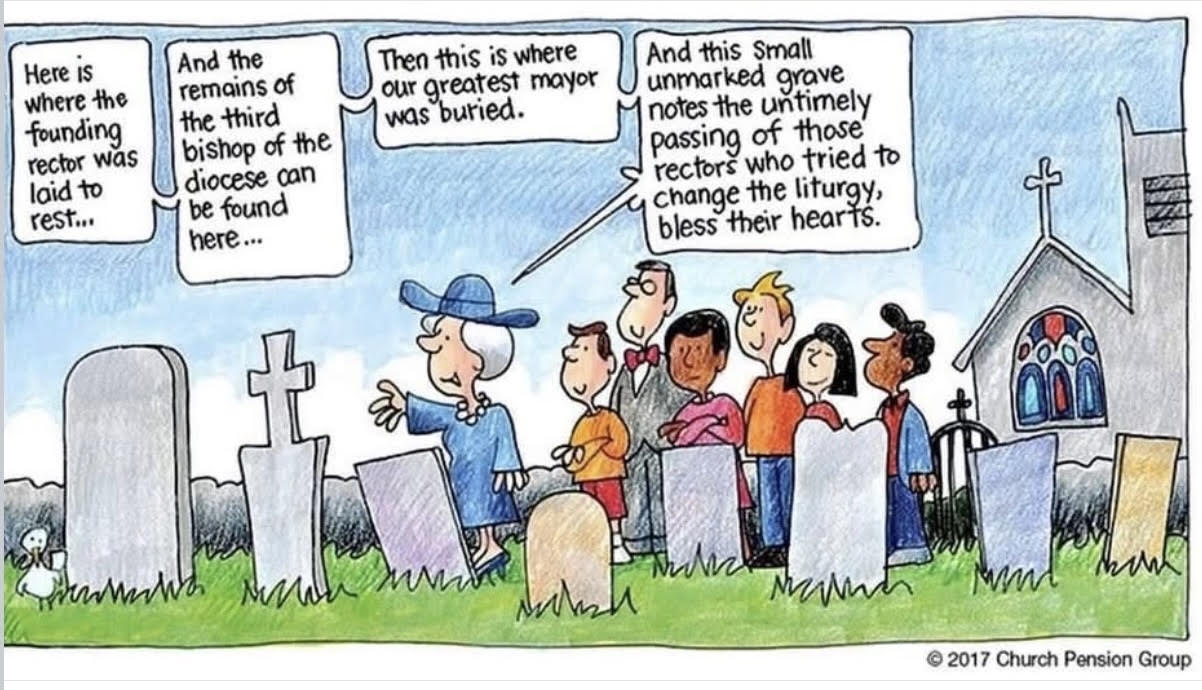
After parking and going into his destination, Corden mentioned this difficulty parking to a Southern woman in the shop. The woman said in response, “Oh, darlin’, bless your heart.” Not familiar with this phrase, being totally new to him, he thought about it for a while and decided, “That’s the nicest expression you could ever have.” He thought it wonderful, but two friends from the South, hearing the story later, had to break it to him, “No, it’s not.”
For any of us who have lived in the South for any length of time, we have probably heard this phrase directed toward us at some point – “Well, bless your heart.” It is sort of a mixed blessing, isn’t it? As someone else noted, “In the South, where politeness reigns among good people, you have to put your judgments somewhere. It’s not polite to speak ill of people if you were raised right.”[i] And so, you might use this phrase…which, true, could be a sign of sincere empathy or blessing…but it is most often not intended in that way. It frequently proves a subtle critique if not a criticism. For example, someone might say, “That was a great sermon, Pastor Lou. Bless your heart.”
So, perhaps we should consider what Jesus means when he tells us that we are blessed: blessed when we are poor in spirit, mourning, meek, or hungry…blessed when we are merciful instead of demanding our rights or retribution…blessed when we are pure in heart or trying to be peacemakers. Even when facing persecution for his sake, Jesus says we are blessed. He’s got to be joking right? This doesn’t sound like much of a blessing to me.
Yet Jesus isn’t trying to fool us. He’s being up front. Conforming and submitting to God’s will often has costs in a very real, harsh and fallen world. Yet we are promised that there’s no better road than the one which leads to heaven[ii]…one that allows us to share in Jesus’ purpose, promise, and mission…one where signs point to God being with us!
Through these succinct phrases, Jesus is providing us with a spiritual attitude and ethics where the rubber can meet the road in the very the real world. Trying to embody these precepts are how we retain our saltiness or reflect the light which Jesus Christ taught about. In Matthew’s mind, today’s Gospel writer, there’s nothing more important than this teaching.
And yet, the Beatitudes are not meant ultimately to be about what we do. These aren’t prescriptive or imperative statements (“if you do this, then you are blessed” or “Thou shall or shall not…”). That’s not what Jesus is getting at here. Jesus uses them to describe. They are declarative representing what God does in the world…His Kingdom values and realities are breaking in. They appear in opposition to what we find in our fallen world.
Thus, the beatitudes have been associated with All Saints Day since the medieval period if not earlier because interpreters saw them as naming both the virtues and the rewards of the holy. These sayings become the lens to view and interpret all that comes after in Matthew’s Gospel. Again, there’s no hidden message here. It isn’t a punishment, a critique, nor a joke. To love God and others in this world can be hard and result in backlash, division, and loss…crosses to bear…sacrifices to make in Jesus’ name. As I said, he will repeat this message throughout the Gospels.
Indeed, as we join Jesus this morning, he has just called his first disciples. This is his first major teaching recorded in Matthew. He has just settled in Capernaum for his base of operations. His teaching and preaching in the region of Galilee is already making a stir among the populace for its authenticity and the promises he shares. It is touching and transforming hearts…blessing them.
And as the crowd grows, he goes up a mountain and sits down. That was a common way that teachers and philosophers of his day taught, and his disciples come to him. And from that mountaintop, almost reminiscent of Moses receiving the Ten Commandments, he speaks to his people. But here, Jesus shares his own sayings…for he is God. Jesus doesn’t receive something as Moses did…there’s no stones to accept as a gift. Jesus is the one giving to his disciples…something to shape and direct their lives as only God could. He is declaring them blessed as they seek to follow him.
To the Hebrews, we read that righteousness is “the fulfillment of all legal and moral obligations. Righteousness is not an abstract notion but rather consists in doing what is just and right in all relationships; ‘…keep justice and do righteousness at all times,’” urge many of the Hebrew scriptures (Ps. 106:3; cf. Isa. 64:4; Jer. 22:3; Ezek. 18:19–27; Ps. 15:2). “Righteous action results in social stability and ultimately in peace: And the work of righteousness shall be peace (Isa. 32:17; cf. Hos. 10:12; Avot 2:7).”[iii] “Righteousness requires not merely abstention from evil, but a constant pursuit of justice and the performance of positive deeds (Deut. 16:20; Jer. 22:3; cf. Prov. 16:17; Gen. R. 30:9; Job. 7:20; Tob. 3:2; Kid. 40a).”[iv]
As no human can be fully righteous, only God can be, and the world is often unfair if not in opposition to our God, the righteous will often be treated unfairly or misunderstood, if not persecuted. And so, those called to be righteous (whether the Jewish nation as a whole or the individual) understood in Jesus’ time that they often might need to wait for their vindication and reward. They might have to wait for the blessing to come in fullness. “For there is not a righteous man upon earth that does good and sins not” (Eccles. 7:20; cf. Ps. 143:2; Job 4:17; 15:14; Dan. 9:18), declares the word of God over and over again. Yet, as a faithful people trusting in the steadfast love of God, the Hebrew people expected and still expect that striving for “righteous action within a righteous society will ultimately help restore peace in the world and will reestablish Jerusalem as the citadel of righteousness.”[v] That’s the context of the people listening to Jesus at the time.
Jesus and his teachings come to us wrapped within this eschatological, or End Time, hope. It is new, but not completely new. It is rooted in other teachings. It is here but not quite yet in fullness. We must wait. Linked to the past, pointing toward the future, reminding us that God is in the midst of the fight now…even as Jesus has won the battle…these phrases stretch us toward new possibilities, if not risks, even as it seeks to comfort those who suffer or wait in the present.
For love in this world is always a choice and a risk. And as much as Jesus has already quoted from scripture, particularly Deuteronomy, a central lens of Jewish faith, he is here drawing further truth out from it. Remember, Deuteronomy calls us to love as God loves. It draws us to reexamine what it means to love God with all that we are and our neighbor as ourselves.
Jesus stretches these previous commands and teachings out, and he reconfigures them. He seeks to unite us more closely with his own heart. We learn of his Kingdom, not of this world. Jesus declares what is breaking into our world with his love and ministry, but it will not become fully evident until he returns once again in victory. Through these blessings, we come to better understand the mystery of what it means to become and live as the Children of God.
Any one of these Beatitudes could prove the seed of a long sermon in its own right. Fortunately, the Beatitudes reflect the reality that we are only human. We need blessing, and although the Beatitudes can be interpreted as Happiness, of Shalom (which means Peace), or even Luck…you will see these translations…blessings from God proves the heart of the matter. They aren’t about our ability to be perfect any more than the Ten Commandments are. They are really about our perfectly loving God who wishes to have his words reside – not on stone tablets – but in our hearts.
In each of our vocations, within our unique nature and call, the Beatitudes open for us a new way to see our world and new possibilities for relationship. An inspiration and role model of mine, Br. Roger of Taizé, formed his ecumenical community in France based primarily on the vision of the Beatitudes.[vi] So, the Beatitudes prove very important to my life, and I think they must remain important to the Church.
In living such a life, many others have been attracted to join in that journey. Thousands…tens of thousands of young people come each year to this little village in France. They come from across denominations and continents to worship God and learn from one another. Some are inspired to stay…to commit their lives concretely to that work. They become brothers.
The community focuses on a radical trust in God’s love, but also commit to a particular work of reconciliation and love of others…no matter the cost. After Br. Roger was murdered during worship by a mentally ill person in 2005, Br. Alois, who I know, the new prior wrote:
Brother Roger often referred to the Beatitudes, and he sometimes said about himself: Je suis un pauvre, “I am a poor man.” He called us, the brothers, not to be spiritual masters but people who listen. He referred to his ministry as prior as being a “poor servant of communion within the community.” He did not hide his vulnerability. Now, our little community feels impelled to continue along the way he opened up. It is a way of trust. For him the word “trust” was not a facile expression. It contains an appeal: to welcome very simply the love that God bears towards everyone, to root our lives in that love, and to take the risks that that implies. To lose that intuition would lead us to impose burdens on those who come seeking the living water. Faith in this love is a wholly simple reality, so simple that everyone can receive it. And this faith can move mountains. Then, even if the world is often torn apart by violence and conflict, the way we look on it can be filled with hope.[vii]
Yes, through the Beatitudes, a door opens for each of us – alone and together in community. Do we dare enter in? Do we risk loving as Christ love us with all that we are…as best as we can? Even as it is simple, it won’t be easy. There will be sad and difficult days. We will be called to die to ourselves, so that God’s will may reign. Still, not one step will be taken, not one tear shed, which will not prove sacred in God’s hands. We will remain blessed. For we will be trying to walk the way of Jesus, and we will never be walking alone. Jesus will meet us on our road to bless us…Through Christ in faith, we share in his victory even now…and that proves the ultimate blessing for each of us who believe. Amen.
[i] Moore, T. (2019). Mel Magazine. Why, “Bless your heart” is the most savage insult in the country. https://melmagazine.com/en-us/story/bless-your-heart
[ii] Chapman, S. C. (1990). No Better Place [Recorded by S. C. Chapman]. On For the Sake of the Call [Album]. Sparrow Records.
[iii] Encyclopaedia Judaica. © 2008 The Gale Group as quoted in “Righteousness,”in the Jewish Virtual Library, at https://www.jewishvirtuallibrary.org/righteousness.
[iv] Ibid.
[v] Ibid.
[vi] Read for example: Cribbin, B. (February 7, 2025). Brother Roger of Taizé. Plough. https://www.plough.com/articles/brother-roger-of-taiz-5d910
[vii] Br. Alois of Taizé. (April 11, 2008). Homage to Brother Roger, as downloaded at https://www.taize.fr/en_article6736.html on January 19, 2023.
Below, please find a video of our worship service. The sermon starts at about the 33:51 minute mark.
© 2026 The Rev. Louis Florio. All content not held under another’s copyright may not be used without permission of the author unless under terms of fair use and properly attributed. Scripture passages when used are from the NRSVue translation unless otherwise indicated.