Tag Archives: spirituality

Rediscovering the Spirit of Halloween

Luther Posting His 95 Theses

Luther Posting His 95 Theses

Each year, we hear debates among Christians regarding Halloween. With all its secular, commercial and bewitching components and hoopla, should Christians celebrate? I argue, “Yes!” If one considers the history of the day and its likely very intentional relationship to the start of the Protestant Reformation, it is impossible to deny the Christian faith’s connection to Halloween. We should celebrate with vigor, yet we should also understand its origins, purpose and potential.

Historically, the word Halloween is a contraction of All Hallows Eve. You might recall that hallow is an Old English word for “to be made holy” (as a verb) or saint (as a noun). Halloween is the evening before the Feast of All Hallows (or in modern English, Saints). Today, we know this religious celebration more commonly as All Saints Day, November 1st.

During All Saints Day, many in the Western church remember with thanksgiving the saints who are now with God. (Orthodox Christians celebrate this feast the Sunday after Pentecost.) Originally, the feast seems to have been celebrated intermittently and not uniformly on May 13th. That’s when Pope Boniface IV consecrated the Pantheon in Rome, a temple formerly dedicated to all gods, in about 609 CE. Thereafter, it became a church dedicated to Mary, the Mother of God and All Martyrs, those who died for their Christian faith. Since the Renaissance period, the building has served as a tomb rather than a church.

This ancient All Saints Day became a time to remember martyrs of the faith and later all canonized saints. During the reign of Pope Gregory III (731-741), the feast day was officially moved to November 1st. Some argue this was done to help combat and suppress the particular pagan Celtic practice of Samhain, a celebration on or about sunset 31 October to sunset 1 November.

Samhain and other similar pagan festivals marked the end of the harvest season and the beginning of winter. It was a time of growing darkness when the Celtic culture and many others – including many early superstitious Christians – believed the lines between our world and the place of the dead became blurred. Stories of hauntings and practicing divination were deeply associated with the pagan holiday.

As with Jewish custom, Christian worship practices recognize the next day begins at sundown. This allowed for a “vigil mass” or service to be held the evening before All Saints Day. This further helped coopt that evening of October 31st into a firmly Christian celebration.

Over the years, the Christian liturgical calendar continued to develop. A Commemoration of All Faithful Departed, not just martyrs or those declared to be saints through canonization, was officially added on November 2nd.[i] In Roman Catholic theology, the belief in purgatory (a place of purging sins to help make one worthy of heaven) had become accepted. This added religious feast day would serve to remember those faithful not yet in heaven and pray for their quick release from purgation. It was intimately associated with the practice of indulgences; pardons earned by works or paid for to free oneself or a loved one from purgatory more quickly.

With the many obvious medieval abuses of this teaching and his own spiritual awakening, Martin Luther began to wrestle with the contemporary practices of the Western church, especially indulgences. A biblical professor and Roman Catholic priest, he wrote 95 points (or theses) he wished to debate regarding how one is saved. Could one buy forgiveness paying for what was called an indulgence? Is it possible to earn your way into heaven or to prove yourself worthy of salvation? These were his ultimate questions.

From studying scripture, the answer had become obvious to Martin Luther. Faith comes down to trusting what Jesus did for us on the cross and through his resurrection. Jesus’ holy work was enough to cover all our sins – past, present and future – just as Jesus promised in scripture, “So if the Son makes you free, you will be free indeed.”[ii]

Although I personally have not yet found any writings explicitly connecting Luther’s posting of his 95 Theses on 31 October 1517  to Halloween, it seems exceedingly likely. Luther would expect large crowds to be present at church for the feast days ahead. Further, this educated man probably recognized the propriety of discerning about indulgences and purgatory as the Western church prepared to celebrate All Hallows Eve or Halloween, the Feast of All Saints, and the Commemoration of All the Faithfully Departed (now commonly known as All Souls Day). His 95 Theses specifically addressed beliefs, practices and excesses associated with these celebrations.

Understanding that we are saved by grace through faith in Jesus Christ, Lutherans no longer recognize purgatory or All Souls Day, but Halloween as well as All Saints Day remain on many of our personal and religious calendars. (For Roman Catholics and some others, many still look at the three days of October 31st through November 2nd as intimately connected and call it “the triduum of Hallowmas.”)

As a Protestant Christian, Halloween need not be a time where we find ourselves over focusing on evil, commercialism, violence or anything else. It can become a time of worship and spiritual formation. Despite its origins and relationship with pagan practices, it can now serve as the perfect time to remember what ignited the Protestant Reformation and particularly the saving work of Jesus Christ. We can celebrate both the love and memories of the faithfully departed as well as share in family fun – yes, trick-or-treating, trunk-or-treating or parties included. Like all things in life, our Halloween celebrations can be whatever we choose to make of them including something appropriate for all Christ’s sinner-saints[iii] still here on earth. How we celebrate can witness to our shared faith in Jesus and love for one another.

Some practices you might like to consider:

  • Visit grave sites of loved ones to place flowers, candles or luminaria (as allowed by regulation or law). Pray with thanksgiving for how God shared love with you through their lives.
  • In your faith community, share the names of those who have died over the last year perhaps ringing a bell for each one. You might allow for a special wreath where flowers can be added to symbolically represent those God used to shape your life and faith. Pray for all those who continue to mourn.

all saints sunday

  • Talk about your ancestors and family history together. Share stories of faith. How did your family communicate and pass down their faith in Jesus? Where do you see God’s steadfast love at work in the stories of the past or in your present lives?
  • Have a Reformation Day party or reenact Martin Luther’s posting of the 95 Theses.
  • Instead of dressing up as a ghost or goblin, consider positive role models such as faith-filled saints of the past or inspiring heroes of the present.
  • Share in a bonfire and hymn sing with friends and family or attend a fall festival.
  • For something different, carve pumpkins with religious or Reformation themes.

We need not grieve like the rest of humanity over those who have died. Sin, death and the Devil no longer have a hold over us thanks be to Jesus Christ, so there is no cause to be afraid. As the children of God, we have a multitude of reasons to celebrate for all eternity. So, why not celebrate Halloween?


[i] Recognitions similar to All Souls Day seem to have been a practice from early Christianity, but they varied greatly in timing and scope. CatholicCulture.org reports this about the origin of All Souls Day: “Masses for the dead are found in the fifth century. But it was St. Odilo [c.962 – c.1048], fourth abbot of Cluny, who was responsible for the institution of the general commemoration of all the faithful departed; he instituted it and fixed its celebration on November 2, the day after All Saints. The practice spread to the rest of Christendom.” (Others claim the three day celebration stems from an order by Pope Gregory IV in the 8th century.) Indulgences are still attached to All Souls Day in the Roman Catholic Church. Learn more at: http://bit.ly/Hstmm5

[ii] John 8:36

[iii] Luther came to argue that Christians remain simultaneously sinners (still struggling with sin) yet saved (through faith in Jesus Christ). We should strive to follow Christ, but we must accept our constant need for grace. Jesus is the only source of our salvation, not our works.

Unless otherwise indicated, all scripture quotations for this article are from the New Revised Standard Version (NRSV) translation.

© 2013 The Rev. Louis Florio. All content not held under another’s copyright may not be used without permission of the author.

The image “pumpkin of Luther posting his 95 Theses” used above with this post is believed not to be copyrighted. If I am in error, please contact me, and I will remove it or provide proper attribution as desired. Efforts were made to identify its source but unsuccessfully.

Leave a comment

Filed under Church History, Liturgical Year, saints, Theology

Giving Thanks is Hard Work

Rejoice always, pray without ceasing, give thanks in all circumstances; for this is the will of God in Christ Jesus for you. (1 Thess. 5:16-18)

How can we properly give thanks to God? According to Paul’s letter to the community of faith in Thessalonica (Thessaloníki), it isn’t just by our words alone. As his letter comes to a close, Paul reminds the local congregation that Jesus is coming. We don’t know when, but we are asked to be prepared to welcome him. We are to remain sober, “putting on faith and love as a breastplate, and the hope of salvation as a helmet,” and all the while trusting that he will remain true to all his promises.

In other words, yes, wHard Work Aheade will share in Christ’s ultimate victory through faith, but we aren’t to be lazy while we wait for it. Our salvation isn’t just about our needs and our feelings. We are part of a much bigger, cosmic battle and purpose where we are to live – and yes, in some ways die – for one another: “encourage one another and build each other up”; “acknowledge those who work hard among you,” loving them and respecting their call to leadership; “warn those who are idle and disruptive, encourage the disheartened, help the weak, be patient with everyone.” It might require putting our needs behind the needs of others. We might need to forgive someone who hurt us or be gentle in our reproach. Ultimately, we are to humbly love and serve one another and all those entrusted to our care. That can be hard!

Yet actively discerning our call from Christ, we are empowered to go forward in confidence. Victory is assured. We respond in thanksgiving by seeking to follow his Holy Spirit wherever it leads, no matter the risk or cost. Our Christian lives prove to be a great and noble effort based solely upon the love of our God and never our own legacy. We give thanks by being more than “country club” church members. We are to live actively as Christ’s disciples and saints, for by grace through faith that is exactly who we are.

So, yes I give thanks in prayer for all that we have shared and accomplished these past five years together at Messiah. I give thanks for our wonderful shared legacy of forty-five years serving Mechanicsville, Hanover County, and beyond. I remain thankful for all the saints in my own time and before who continue to inspire me. Yet most of all, I rejoice with you in our call to shared life and ministry; one that might prove hard at times but always consists of a future full of hope. It is together as church where we find the abundant life that Jesus promised us, and I am grateful for living as church with you.

This life of discipleship is Christ’s way, leading us and all the saints to the eternal feast of thanksgiving yet to come. To help celebrate, I invite all of us to reflect upon how we can live out Messiah’s mission more fully, “To share the good news of Jesus Christ and to invite all to join us in faith, worship, and service,” for there always remains room at Christ’s table.

Christ’s peace be with you always. I send you my prayers for a blessed Thanksgiving. Please pray for Kristine and me as well.

Your brother in Christ,
Pastor Lou


Unless otherwise indicated, all scripture quotations for this article are from the New Revised Standard Version (NRSV) translation.

© 2013 The Rev. Louis Florio. All content not held under another’s copyright may not be used without permission of the author.

1 Comment

Filed under Community Life, Ministry, Pastoral Letter, saints, social justice

Needy? Our Cup Overflows

Messiah Lutheran.group shot

Messiah Lutheran Church Members & Friends,
8 September 2013

We want you to know, brothers and sisters, about the grace of God that has been granted to the churches of Macedonia; for during a severe ordeal of affliction, their abundant joy and their extreme poverty have overflowed in a wealth of generosity on their part. (2 Cor. 8:1-2)

Reading the above passage, I began to reflect upon our life together at Messiah Lutheran. Seeking assistance for a mission, Paul was encouraging the larger, more affluent congregation in Corinth to look toward the example of the struggling Christian community in Macedonia. I began to see a parallel. How has our little church faced with so many historic and current problems been used to encourage others?

Once a person mentioned to me in passing that it seemed our community is made of a “disproportionate number of people in need” and perhaps we would always remain small. This indeed might be true (only God knows the plans in store for us), yet I embrace that description. After all, Jesus came for the “least of these”: the hungry, the naked, the homeless and marginalized, even prisoners. Therefore at Messiah, we have intentionally forged strong relationships with those having intellectual, physical and mental disabilities. We have actively sought to support members of our community with food, clothing, and housing. Hospitality and authentic welcome are recognized marks of our ministry regardless of social, economic, political or other differences. Some of our members and neighbors have been helped to lift themselves out of domestic abuse, addiction, and even jail. We are truly trying to live as Christ’s disciples in mission, no longer Gentile or Jew, male or female, but all one in Christ. If two or three gather in his name, Christ is there, so our size doesn’t really matter either. Our congregation is exactly the kind of beloved community spoken about in scripture!

Despite our needs (or perhaps because of them), we have come together to rebuild and strengthen this congregation’s ministry, not perfectly but as best we can, and this has made a difference worth celebrating. Although we are still small and at times people might leave, worship attendance has increased over 35% since 2006. Giving has gone up about 10% per year no matter the ebb and flow of our national economy. We still struggle financially (sometimes wondering how we will pay our bills), but we have closed a $35,000 deficit while supporting others – fully funding our tithe to the greater church, ranking several years in the top 20 for donations to the Virginia Synod’s United Lutheran Appeal, starting new ministries in support of Lutheran Family Services, serving as a covenant congregation with Hanover Habitat, reinvigorating the shared, ecumenical food, clothing and benevolence ministry which is MCEF, and much, much more. Our outreach has dramatically increased and a number of long-time members have suggested our community is more spiritually oriented than ever before.

Thanks to the grace of God working through our lives together, we have all contributed to our “success.” A Thrivent loan officer remarked, “We have seen congregations ten times your size not do as much.” It is often why when I am at area events that people remark, “I hear things are going great at Messiah,” or “Your that church that is so active in the community.” In our welcoming of All Souls Episcopal to share our worship space, I have had three different Evangelical pastors comment at the great and unusual witness to Christian love being made manifest here. When we attended the Virginia Synod Assembly, other congregations have asked for appointments to discuss why and how things are “going so well” at Messiah for two years running. We are further affirmed as a community by the reality that 46% of our membership comes from outside of Mechanicsville. These people are willing to make drives of 30 minutes to an hour because they recognize that this community is indeed “different.”

Are we challenged as an institution in property and programs? Do we dine with people who are marginalized, hurting, sinful and alone? Do we struggle as individuals? You bet! We are real people with real problems, but we are a saved people all the more. Thanks be to Christ, we are the church! We seek to live as disciples more than as “members”; striving to concretely love God and neighbor. We are invited to walk on in a living hope of what is promised us in Christ’s victory, not based upon what we get or experience here and now.

In the end, we are ultimately a family of faith not defined by geography, finances, numbers or programs, and especially not our aging building. Instead, love, abundant joy and generosity – a response to what God has already offered us – describes us well. We are being recognized locally and beyond because as Jesus has promised, “By this everyone will know that you are my disciples, if you have love for one another.”

As we continue to celebrate our 45 years in ministry, I want to say that I am always proud and grateful to serve you as well as alongside you in mission. If you are a visitor or have been away, I invite you to come join our celebration; not an event but our shared life in Christ Jesus.

Peace,
Pastor Lou

Everyone makes a difference at
Messiah Lutheran!

To see pictures from our God’s Work – Our Hands Day, click here.  

Unless otherwise indicated, all scripture quotations for this article are from the New Revised Standard Version (NRSV) translation.

© 2013 The Rev. Louis Florio. All content not held under another’s copyright may not be used without permission of the author.

1 Comment

Filed under Community Life, Grace, Ministry, Pastoral Letter, saints

Be a clown!

Be a clownA cheerful heart is a good medicine, but a downcast spirit dries up the bones. (Proverbs 17:22)

I have been called many things in my life, but this past month I was called a clown. To be more precise, I was called to be a clown as part of our Vacation Bible School. Through skit and song, crafts and games, I was blessed to share a journey with forty youth and almost as many adults into deeper friendship with God and one another.

I find that relationships are most easily formed through joyful encounters and positive attitudes, and it isn’t much different for our relationship with Christ and his church. Our happy fellowship, laughter, and even a caring smile can serve as a witness to our faith and help sustain others, but I believe it also serves to encourage us in our work and shape our own futures.

What kind of joy is this? I am talking about much more than a positive attitude (although that helps). In fact, it ultimately isn’t about us at all. Trusting that no matter what happens we will always be cared for by Christ frees us to smile, to laugh, to risk relationship and love no matter the cost. We can be rejected, and yet our healthy self-esteem can continue unharmed because we are loved by God. We can seem to fail in our efforts and yet not worry; we share in Christ’s victory. Even as we struggle with sin or illness or tears, or anything else one can think of, we can trust with Julian of Norwich, “All shall be well, and all shall be well, and all manner of things shall be well.” God will use whatever happens for our good.

“Faith is a living, daring confidence in God’s grace, so sure and certain that a man could stake his life on it a thousand times,” declared Martin Luther. Yes, faith is God’s punch line to our world’s fallen reality. Faith surprises and empowers us. Even amidst difficulties or tears, it manifests itself through the fruit of the Spirit: love, joy, peace, forbearance, kindness, goodness, faithfulness, gentleness and self-control. It keeps us going in the face of great obstacles, and in answer to death, it births an abundant life.

Long ago, Francis of Assisi and his followers encountered Christ’s love in their midst through active fellowship, service and worship together. This radical communal lifestyle raised the eyebrows of many who called them “Fools for Christ,” yet that way of life brought Francis, his friends and those they served an abundance of joy – not sour, pious faces, rigorous religiosity, or burdensome obligations. Perhaps, they had the last laugh by adopting the name meant to deride them.

That is the kind of clown I hope I can be…that I believe Christ intends us to be together as church. Please help us together discover the gift of such joy this fall as we celebrate 45 years of ministry at Messiah. No kidding, it might just change the world.

May Christ’s peace and joy always reign in your life,

Pastor Lou

Unless otherwise indicated, all scripture quotations for this article are from the New Revised Standard Version (NRSV) translation.

© 2013 The Rev. Louis Florio. All content not held under another’s copyright may not be used without permission of the author.

Leave a comment

Filed under Community Life, Grace, Ministry, Pastoral Letter, Uncategorized

How shall our garden grow?

Vegetable-Garden-Layout1

“Other seed fell into good soil and brought forth grain, growing up and increasing and yielding thirty and sixty and a hundredfold.” (Mark 4:8)

Summer is a season of growth. Planting is done, but there is much watering, weeding and tending left to do before the harvest. Sure, we can plant seed in the best soil available, then walk away and hope things grow by the grace of God. Yet, our plot probably won’t bear as much fruit, vegetables or flowers without our active, attentive, intentional involvement. Life might never sprout at all.

We, too, grow by the grace of God. The seed of faith has been planted in our hearts, and our history, surroundings and dispositions affect us much like soil. Worse, life can be hot and dry or too stormy; threatening to wither us, outside of our control. So like the local fields, we need tending. Our summer travels can be part of that, refreshing and renewing us, yet we can’t ever think rest alone is enough to make us yield thirty, sixty or a hundredfold. God has to be in the mix, for only God makes things grow and become greater (1 Cor. 3:7).

To help with this, Messiah is offering a number of opportunities to encourage individual growth, as well as the growth of our congregation and greater community. We’ll have a series of unified services with special offerings from visitors wishing to minister to us – including their use of liturgical music and performing arts. We’ll celebrate our full communion and shared ministry with All Souls Episcopal in worship together and pulpit exchanges. We will minister to others through our Lutheran Family Services Picnic for adopted and foster care families, the summer program at our school, our popular vacation bible school, and more. These efforts will certainly bless our neighbors this summer, but volunteers time and again report the multiplied blessings they have encountered through building relationship with others and in serving together. Yet, that’s not all. Opportunities continue for bible study, contemplative prayer, Christian formation, and active service including with our many partnering non-profits. We’ll also have youth and adults attending Caroline Furnace Lutheran Camp, mission trips, and other retreats for all ages. God will be active here. Why not you?

Growth requires balance – daily rest and work centered on and fed by the love of God. Yes, near or far, at rest or active in service, we remain the church. We have nothing to fear from darkness, storm or death, for eternal life will be ours through faith. Still, our shared hope remains as in Paul’s long ago prayer; that all of us together may lead lives worthy of the Lord, fully pleasing to him, as we bear fruit in every good work and as we grow in the knowledge of God (Col. 1:10).

No matter our circumstance, we find ourselves always in a mission field. Jesus has come so that we might have life, and have it abundantly (John 10:10) while in that field and beyond. On vacation or not, no matter the season, let us heed Christ’s invitation, cooperate with the grace offered us, and intentionally strive to nurture his life in our hearts and the hearts of others.

Peace,
Pastor Lou


The above pastoral letter was originally published in Messiah Lutheran Church and School’s newsletter, The Messenger (July 2013 edition). To view the entire issue of The Messenger or to see the full calendar of events, visit: http://www.mlcas.org

Unless otherwise indicated, all scripture quotations for this article are from the New Revised Standard Version (NRSV) translation.

© 2013 The Rev. Louis Florio. All content not held under another’s copyright may not be used without permission of the author.

Leave a comment

June 29, 2013 · 11:28 pm

Time to Live

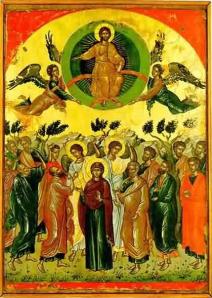
ascension

The Ascension of Jesus

So let us not grow weary in doing what is right, for we will reap at harvest time, if we do not give up. So then, whenever we have an opportunity, let us work for the good of all, and especially for those of the family of faith. (Galatians 6: 9-10)

I am tired: tired of wars and rumors of war; tired of terrorism; tired of illness and trials; tired of death.[i] I know I am not alone. Our nation and world has experienced much too much suffering these last few weeks. Just watching the news was emotionally draining, and many still feel alone and isolated. Others grieve or remain afraid.

Yet if we overly focus on this very real suffering and evil, is it any wonder we grow tired? It seems too much for us, because it is! We are not God, able to work healing, life-giving miracles at our whim. As frail, fallible humans, we are not able to stand alone. So what can we do?

At such difficult times, I don’t give up. I find comfort, strength and motivation in a promise – something not yet a reality, but definitely coming. We are told there will be a day with no more death, mourning, crying or pain. All will be made new.[ii]

Oh, that day’s not here yet, but Christ’s ascension into heaven[iii] foreshadows his certain return.[iv] Although Jesus isn’t with us in body, it is Jesus himself who promises us, “I am with you always.”[v] Granted much stands against us, yet our God is for us and standing with us. We are already conquerors sharing in Christ’s victory over sin, death and the Devil no matter how we might feel about it.[vi]

This promise is our inheritance and claims us as Christ’s people – a people of living faith, hope and love.[vii] It turns our eyes to look beyond our own suffering and fears toward how we are called to help answer such pain and injustice in the world.[viii] Indeed, in Jesus’ physical absence, we serve as his body.[ix] Our feet are those which bring his good news to dark places.[x] Our hands are those that bring his healing.[xi] Our shared ministries are used to create miracles and give life in his name.[xii]

This is no time to run and hide. It isn’t time to be caught asleep or medicating ourselves with escapist, self-indulgence. Instead, Jesus invites us to truly live saying, “Don’t be afraid. Follow me.” Jesus is coming, and we have much left to do in preparation.

No, we still aren’t God, but we are God’s people. At home or away, at work, school or vacation, even in places of emergency, we remain his church – together with Jesus and never alone. When people look to the hills for help[xiii], it might just be us whom Jesus has sent to be his living answer to their cries for help.

So, let us rest when needed, mourn if we must, support one another, pray and wait with patience, but never give up. There will be a day when there will be no more broken hearts. Until then, Jesus asks us as his body to surrender our hearts to his own – trusting in his promises; fulfilling his Father’s will; freed to love God and our neighbor as his Spirit leads us with all that we are, wherever we might be, whatever might happen. In the face of death, it is time to live.

Just as Jesus came when the time was right[xiv], he sends us now to a world in need of his love – a world where we will meet the Risen Christ on our way already waiting to sustain us with his joy and peace.

At a time of terror or indeed any time, it proves a blessing to take up our cross and seek to do what is right. All will be well, for we always belong to Christ.[xv] Jesus never grows tired, and he will never give up on us.

As I posted this pastoral letter, I recalled this song by Stephen Curtis Chapman. Inspired by the Book of Acts, it often comforted me as a police officer and since. I believe it echoes the above message shared with my community:


[i] Read Jesus’ teaching on such signs in Matthew 24.

[ii] For example, see Revelation 21:1-8.

[iii] Read about Jesus’ physical ascension into heaven here.

[iv] Read for example Matthew 24:30-31 and 1 Thessalonians 4:13-18. Although some biblical scholars argue these passages are metaphorical or symbolic of his return, orthodox Christians maintain Jesus will somehow return to earth for the final resurrection and judgment – whether we understand the details of how or not.

[vi] Read Romans 8.

[viii] See for example, Micah 6:8.

[ix] Church is not a physical building or meeting place, but believers united together in and with Christ, the Head of the Body. We are the church. Sometimes called the catholic (with the small “c” meaning universal) church, we extend beyond time and place. Some passages to explore: Romans 12:3-5; 1 Corinthians 10:31-33; 1 Corinthians 12:12-26; Ephesians 1:18-23; Ephesians 2:19-22; Ephesians 5:25-32; Colossians 1:17-20; Colossians 3:14-16; and 1 Peter 2:9-10.

[xi] Consider these passages in the context of your own life: 1 John 1:1; 1 Thessalonians 4:10-12; James 4:8

[xii] See for example, John 12:26.

[xv] “All shall be well, and all shall be well, and all manner of things shall be well.” Julian of Norwich

The above pastoral letter is adapted from one originally published in Messiah Lutheran Church and School’s newsletter, The Messenger (May 2013 edition). To view the entire issue of The Messenger or to see the full calendar of events, visit: http://www.mlcas.org

Unless otherwise indicated, all scripture quotations for this article are from the Today’s New International Version translation.

© 2013 The Rev. Louis Florio. All content not held under another’s copyright may not be used without permission of the author.

1 Comment

Filed under Community Life, Grace, Pastoral Letter, saints, Uncategorized

Jesus is Risen! Now what?

empty_tomb

We welcome Easter morn with shouts of “Jesus is risen. He is risen indeed!” As they echo through our sanctuary, I wonder if that truth will continue to resonate through our lives. Jesus is risen, we proclaim. His resurrection is to be a new, ongoing reality for us; one that changes our actions and very being. This is present tense, touching our here and now; in our lives, our world, and his holy universal church.

Yet like those first disciples surprised by the empty tomb, we can instead get lost in that past moment of time. The resurrection tends to serve as a historical marker rather than a living sign for our present reality. We remain stuck in our shock and fear trying to make sense of things. What can such a resurrection mean? Perhaps more so, what can it mean for me?

Soon after that first Easter morning, Peter preached that Jesus was not abandoned to the realm of the dead, nor did his body see decay. Paul explains to us in many of his letters that through faith the power of that resurrection makes us a new being, a child of God, and we will be heirs to Christ’s victory to share in that resurrection forever.

This is all true, yet neither great Apostle came to understand the resurrection as a singular past event or one all about our far off future with Christ. Instead, the Risen Christ and the Holy Spirit woke them from their initial shock. It was revealed that they were to share in the living resurrection for eternity – starting now. Christ’s light is to shine through us as we walk with him and talk with him, but unlike that old Gospel song (In the Garden), we cannot tarry there.

Jesus instead tells us, “I have come that you may have life, and have it abundantly.” This resurrected life isn’t one found by standing alone; mute and in shock. It isn’t a life solely about what Jesus can do for us as individuals or a community. It calls us to action.

The resurrected life that we are invited to share is one of living relationship. It is one of service, fellowship, and corporate worship. It is one where we seek to follow Jesus each day and introduce him to others. It is one where we might even be called to share in the sting of Christ’s sacrifice and cross out of love.

Let’s not just stand here pondering. Let’s live like we believe in the resurrection. As the Father has sent him, he sends us now. Among the greatest miracles, Jesus has chosen to make the resurrection universal and eternal through our own unworthy love and lives. We must now go and share that miracle with others, for Jesus is truly risen in us. We are to live as his risen body, a resurrected people, forever – starting now.

Christ’s peace be with you always,
Pastor Lou

Unless otherwise indicated, all scripture quotations for this article are from the New Revised Standard Version (NRSV) translation.

© 2013 The Rev. Louis Florio. All content not held under another’s copyright may not be used without permission of the author.

2 Comments

Filed under Church History, Lectionary, Liturgical Year, Pastoral Letter

Where in the world was Jesus on Holy Saturday?

Harrowing of Hell
Harrowing of Hell

As the Passion ends, we leave with Jesus laid in the tomb. Was he asleep? No, scripture clearly strives to prove and proclaim that Jesus truly died on that cross. Did he go to heaven? Actually, scripture leads us to believe that Jesus was somehow still miraculously at work but not in heaven.

Our Lutheran confessions state that “we believe simply that the entire person, God and human being, descended to Hell after his burial, conquered the devil, destroyed the power of Hell, and took from the devil all his power.” (See Solid Declaration, Art. IX.) Luther seems to have believed it an ultimate mystery that Jesus descended. Nothing tells us if he did so in “humiliation” or in glory, but we should just believe the faith in which we baptize (see the Apotles’ Creed: Jesus descended into  sheol – in Hebrew the place of the dead, sometimes called hades).

Early Christianity believed this and scripture alludes to it in such passages as 1 Peter 3:18-20: For Christ also suffered for sins once for all, the righteous for the unrighteous, in order to bring you to God. He was put to death in the flesh, but made alive in the spirit, in which also he went and made a proclamation to the spirits in prison, who in former times did not obey, when God waited patiently in the days of Noah, during the building of the ark, in which a few, that is, eight people, were saved through water.”

In the Old English, harrowing was the term used to describe Christ’s descent. Ancient icons often show Jesus amidst previous saints of the Jewish Testament, standing on the gates of sheol now opened. The gates are often an “X” or Chi in Greek, reminding us that Jesus is Χριστός, or Christ – the Annointed One and our Messiah come to save us from sin, death and the Devil.

Christians may debate whether Jesus entered triumphantly or suffered more indignities, but mainstream Christianity looks to both scriptures and the faith handed down to us. Jesus’ entrance into the grave was not the last of his journies for us. With sundown, his burial was complete. The Jewish sabbath had begun, and Jesus went to work. The Saturday of our Holy Week is indeed good (holy), and we rightly rejoice even as we wait for the Day of Resurrection. Jesus has come to save all his people.

Unless otherwise indicated, all scripture quotations for this article are from the New Revised Standard Version (NRSV) translation.

© 2013 The Rev. Louis Florio. All content not held under another’s copyright may not be used without permission of the author.

Leave a comment

Filed under Lectionary, Liturgical Year, saints

There is no shame in humility

Italy Vatican PopeA response to “Pope’s foot-wash a final straw for traditionalists” as reported by the AP

Within an ancient culture that didn’t count women during the government census or necessarily notice or respect them in the home, it is not a real shocker the bible doesn’t often mention women.

Despite this, it remains most probable that women were an important part of Jesus immediate community and present at his final Passover Feast. Matthew reports that at the feeding of the 5,000, the count did not include women and children.[i] Or later, Matthew shares that women who “had followed Jesus from Galilee to care for his needs” watched as he died.[ii] (Was this perhaps after preparing and sharing in his last Passover Feast?). There are other attestations from other Gospel writers as well which some see as supporting that women were among his disciples and active in his ministry.

Whether you agree or not, or think women had their feet washed by Jesus or not, Jesus’ greatest intention on Maundy Thursday was to teach us to love and serve everyone (“one another”) as he had us. After all, Maundy comes from the Latin word mandatum (meaning “commandment”), and it was used in the early Latin Vulgate translation of John 13:34: “I give you a new commandment, that you love one another. Just as I have loved you, you also should love one another.” Using scripture to interpret scripture and seeing Christ’s own example, it is hard to argue that this command to love only covered Christians. Christ longs for his family to grow.

Yes, this final teaching echoed Jesus’ earlier ones. What’s the greatest commandment?[iii] Who is our neighbor?[iv] Jesus reached out to all those marginalized by society whether Jewish or not. We are not to become their stumbling block.[v] We are to let “the children” come to Jesus.[vi] Indeed, we are to love whoever might be thought as “the least of these” – perhaps children, inmates, the poor, women (in many cultures still), anyone we tend to label as “sinners”, and non-Christians. Matthew is said to have been the most Jewish of the Gospel writers; at least his writings reflected many Jewish teachings and responded to many Jewish biases about their being the chosen ones of God. Yet, he shows Jesus to be incredibly open and loving to all. Jesus longs for relationship!

Despite this, some traditionalist Roman Catholics have become more and more vexed by Pope Francis’ election and recent behaviors. He has cast aside signs of regalism. He has acted in ways lifting up the priesthood of all believers. He has expressed openness to Protestants, Orthodox Christians, and people of other faiths entirely. As in Argentina when a Cardinal, Pope Francis seeks simplicity, and he lives that way. Not the least of their issues with him, many traditionalist have expressed “the horror” (not my word, but often found in their tweets and posts) that the Pope would wash not only the feet of a juvenile women who happened also to be a prisoner, but in one case was Islamic. “He cultivates a militant humility, but can prove humiliating for the church,”[vii] Fr. Bouchacourt, head of the traditionalist, schismatic St. Pius X Society, said. I have seen similar less than charitable comments by other traditionalists, even from some of those who haven’t broken from the Roman Catholic hierarchy but instead claim to love and obey it. Some even suggest Pope Francis’ behaviors are just a show in violation of scripture.[viii]

If signs of humility are embarrassing to the Roman Catholic Church, then I bluntly but in love suggest these folks take a look at Jesus’ own behavior. Jesus often intentionally exemplified his teachings through public behaviors. That’s what teachers and leaders need to do. Jesus prayed in public at times not for his own sake and not for a show, but so that others could be comforted and learn of God’s love.[ix] He purposefully embodied earlier prophesies to help reveal his identity, such as by riding a young donkey into Jerusalem.[x] (Certainly, Palm Sunday was quite a spectacle.) Some of the same conservatives – those who were so protective in promoting the sanctity of the conclave and agressively argued that the election process was in the Spirit’s presence and following God’s will – turned on Pope Francis that first night.

Even as a Lutheran, I would agree that the Spirit is involved in leading the Roman Catholic Church, but I would also argue the Spirit seeks to guide all other denominations as well. Institutions made of fallible humans can err (a very Lutheran attitude to be sure), but we still remain Christ’s church. Despite the historic divisions of the universal church, Pope Francis holds one of (if not the most) prominent positions of Christianity. To be ashamed of such humble, public actions that so many “of the least” will take notice of seems the real shame to me.

This Lutheran says, “Good for Pope Francis!” Perhaps I shouldn’t care so much, but I (like countless other Christians) hope and pray for the coming reality of Christ’s own prayer that we live as one.[xi] We are the church together, not our denominations, through the grace of our shared faith and baptism. I humbly support my brother Francis in his efforts to make Christ’s love known in the entire world.

After all, Jesus asked us to love and support one another. He never said with our human minds, hearts and ways that we always would agree on everything.

Postscript: Vatican responds to complaints: http://bit.ly/Z02evs


[i] See for example Matthew 14:13-21.

[ii] See for example Matthew 27:55-57.

[iv] In response, Jesus taught about the Good Samaritan. See Luke 10:29-37.

[v] Read Matthew 18.

[vi] See for example, Matthew 19:14.

[viii] See for example Matthew 6.

[xi] See John 17.


Unless otherwise indicated, all scripture quotations for this article are from the New Revised Standard Version (NRSV) translation.

© 2013 The Rev. Louis Florio. All content not held under another’s copyright may not be used without permission of the author.

2 Comments

Filed under Community Life, Lectionary, Liturgical Year, Theology, Uncategorized

Of Saints and Winners

Frances perkins, winner of the 2013 Golden Halo

Frances Perkins, winner of the 2013 Golden Halo

And the winner is…Frances Perkins? Who?

Until Lent Madness, a Lenten devotion sponsored by Forward Movement (an outreach of the Episcopal Church), I had never heard of her or her Christian witness.

According to one commentating participant of Lent Madness 2013, “For the people who comprise the parish of St. Monica and St. James Episcopal, Frances Perkins is not just a New Deal bureaucrat, but is a living, breathing saint who worshipped with their predecessors and put the incarnational theology of their Anglo-Catholic liturgy into concrete social action.”[i]

Yes, it was often in their rooms and sanctuary that she stayed, prayed and made plans to champion a social safety net for the elderly, eliminate child labor, fix a minimum wage, create the Civilian Conservation Corps (CCC), provide disability for those hurt on the job, create unemployment insurance, a shorter work week, and worker safety regulations. She was an important person of her time, and her actions still help shape our nation. For some, these programs remain a lifeline.

Frances believed faith “served as a bedrock and a way to seek meaning in life when so much seemed inexplicable.”[ii] In her young adult life, she attended Mount Holyoke College, whose founder, Mary Lyon said, “Mount Holyoke women should live for God and do something.” A Baptist turned Congregationalist, she also is known to have advised, “When you choose your fields of labor go where nobody else is willing to go.” She knew the needs of the world.

Within that legacy, one of Frances’ teachers took her to look at the hard realities found in the nearby textile mills and factories.[iii] From affluence herself, Frances discovered a vocation to do something for the poor, the immigrant, and all others in need. Like today, many young women had come to the United States for promised jobs, but instead, they were forced into prostitution. Working with police and other institutions, Frances fought against this plight, the frequent drug and alcohol addiction, and the abusers of others.

Having been a cop in such communities, I know this to be no small task. Indeed, it is frightening in our seeming powerlessness over such issues as well as to stand in the face of real and potential violence. Thanks to her faith, Frances wasn’t afraid to enter relationship with the poor or anyone in need. She went where too few are willing to go.

Nominated as the first woman cabinet member as Secretary of Labor under Franklin D. Roosevelt, she continued to care about “the least of these”[iv] among us. She actively sought to protect Jewish and other refugees facing persecution in Europe under the Nazis. Until 1940, the Labor Department controlled the Immigration Service. She never got the quotas she desired, but a number of our Jewish neighbors owe their lives partly to her efforts, as do the famous Von Trapp family of Sound of Music fame.[v]

Writing this during this Passover holiday, I am reminded how Frances sought to echo God’s own love as reported in Deuteronomy 10, “For the Lord your God is God of gods and Lord of lords, the great God, mighty and awesome, who is not partial and takes no bribe, who executes justice for the orphan and the widow, and who loves the strangers, providing them food and clothing. You shall also love the stranger, for you were strangers in the land of Egypt.”[vi] Reflecting previous teachings of the prophets, Jesus, the Son of God, called us to concretely live out Deuteronomy 6, to love God with all that we our and our neighbor as ourselves.[vii] Frances heard and understood rightly that our neighbor includes all those around us. We are created and called to be God’s ambassadors to the world.[viii]

Most certainly, Frances Perkins lived within the concrete reality of amazing grace. Once when asked “Don’t you think it’s wrong for people to get things they don’t pay for?” “Why no,” Frances Perkins responded. “I find I get so much more than I pay for. Don’t you?”[ix] She understood that assisting the poor wasn’t just the work of government, and so she enlisted the help of church communities from across the United States to help respond to the upheavals of the Great Depression. She served the poor and needy directly as well, despite her station, throughout her life.

In a fallen world with fallen people, some today take advantage of such “grace,” do not appreciate it, or even intentionally abuse it. As humans, that’s the way it has always been. Even though the poor and undeserving will always be with us, we are to feed, clothe, train, and love them anyway. People will die, but we are to seek their healing and comfort. We are a people of hope and grace, and not ultimately one of reason. In fact, as Philp Yancey professes in his book What’s so amazing about grace (2002), life isn’t fair but neither is grace. God utilizes a totally different scale of justice than we do where love overflows.

Still, some might have very sound political and economic reasons to disagree with how Florence concretely tried to share God’s love, the system that has came about in more recent time, or even aspects of her theology. Yet speaking from a Lutheran perspective, we don’t expect perfection in God’s saints or require mystical miracles. Among the greatest mystery is that love can be found at all in a world that rejected the love of Christ and often still does. Even more so, we imperfect people are the means God has chosen to make love known since Jesus ascended.[x]

With Frances’ win of the Golden Halo, some will likely gnash their teeth at the “political correctness” of it all. If her last competitor, the evangelist Luke, had won, some others would have likely bristled at the patriarchal or mythical aspects of his victory. (I was happy either way for this matchup is at its corps just a silly way to promote Christian formation, and all saints share in the most import thing – Christ’s victory.) The truth remains that both saints remind us of our own call to be saints in our own context. We are to use the gifts that God gave us to the best of our ability – for God’s glory and not our own.

Some may never know our doubts and darkness, seeing only our public “mythic” face. Some may disagree with our attempts to love or even aspects of our faith and theology. Most of us will never be recognized or lauded for loving others. Still, I firmly believe that we are saints nonetheless; part of a great cloud of witnesses[xi], and God will make our love matter.

If we are indeed Christ’s saints (and we are through faith), we can’t just sit here as if faith without works is ok. A living faith infers we need to love – always imperfect even at our best, but love nonetheless; prudently certainly, but not with so much prudence that we are frozen to inaction from fear of error or consequences.

As Jesus said approaching his own suffering and death, the poor will be with us always, but in saying this, he alluded to Deuteronomy 15, “Give generously to [those in need] and do so without a grudging heart; then because of this the Lord your God will bless you in all your work and in everything you put your hand to. There will always be poor people in the land. Therefore I command you to be openhanded toward your fellow Israelites who are poor and needy in your land.”

Br. Roger of Taizé used to remind those of us in discernment for vocations there or in other parts of the church that Jesus is awaiting us in that dark chasm of our future. We must go forward to him with trust. We must seek to love, for Christ will meet us then and there. You see, God will use all things (even our failures and sin) for the good of those who love him.[xii]

As a theological descendent of Martin Luther’s Doctrine of the Two Kingdoms, I do indeed trust, understand, and demand that government has to be part of the solution to address poverty and other social ills. Yet, I acknowledge that we have to be smarter and demand more accountability and care. Government is a bureaucracy after all. People are imperfect. I also sometimes wonder if some of us rely on government as a solution to social ills way too much or (worse?) would rather pay taxes to support such programs than be in relationship with the poor. (As I often teach, a personal relationship with Jesus infers a relationship with others, including those in his church and without; those who have plenty and those who lack.) Too often, we attack one another rather than wrestle with the problem at hand. We get angry at the possibility of change or what we percieve as an attack on our precious viewpoints.

Now is the acceptable time…a time to be truly charitable – seeking to serve all those suffering, listening with respect and patience to one another, forging new relationships to seek God’s will and do it, forgiving error when it occurs. (And it certainly will come!) In humility, we must also remain aware that the worst error might prove to be our own, known or unknown.

True, Frances Perkins isn’t yet on our Lutheran (ELCA) Liturgical Calendar, but perhaps she should be – and not just because the ELCA has a full communion agreement with the Episcopal Church. We believe we are saved by grace through faith in Jesus Christ (by trusting in what he has done for our sake) – not our own works. In Frances’ historic context, she was remarkable and helped shaped our modern nation. More importantly, her witness was a faithful one. She has inspired many others to loving service at Mount Holyoke and elsewhere, yet she was never perfect nor are we. She could yet serve to inspire others to serve and hold discussions to evaluate how we could love our neighbor most effectively through government, church, and as individuals.

Maybe that’s a great miracle we should always trust in and act upon. We are truly Christ’s saints – all of us who believe even if with doubts – and we need to seek to live as his saints, his body in the world. Perhaps it is a happy coincidence that Frances Perkins won the Golden Halo on this Maundy Thursday (from the Latin mandatum, meaning command). Her imperfect but faithful life reminds us of the command Jesus left us as our inheritance during his Last Supper. The Gospel of John (13:34) reports that Jesus said, “A new commandment I give unto you, that we love one another; as I have loved you.”

Without fear, without hesitation, without our preconceived political notions or human expectations, may we heed Christ’s great command to love God and one another. Whether we view ourselves more left or right or anywhere in the middle, we shaare the family name of Christian. May Christ help us live as his saints each day in our own context – using our time, treasure and talent to the best of our ability.

Heaven knows, this real world needs all the saints it can get. We will never love perfectly. Our work will seem to never end, but do not be afraid. As Frances believed and scripture promises, Christ “will wipe every tear from their eyes. Death will be no more; mourning and crying and pain will be no more…”[xiii] Thanks to Jesus, inspite of and because of our sin, we will share in a victory beyond our hopes and dreams.

Jesus will do what we cannot. All things will be made perfect and new. His justice and love will reign fully at last.

To read of Lent Madness and the awarding of the 2013 Lent Madness Golden Halo visit:
http://www.lentmadness.org

This year, Mount Holyoke, a women’s college in Massachusetts and alma Marta of Frances Perkins, celebrates its 175th anniversary. (There alumni, staff and students caused a large spike in  turnout for Frances each round, thanks to use of social media.) Congrats to them! (If only VMI had done the same for Jonathan Daniels!) You might like to visit their special anniversary website celebrating women of influence:
https://www.mtholyoke.edu/175/celebrating-175-years-women-influence

The United States Labor Department is also celebrating their 100th anniversary. Learn more here:
http://www.dol.gov/100/

You can learn more of Francies Perkins by visiting the Frances Perkins Center on the internet or in person:
http://francesperkinscenter.org/


Watch this short excerpt of “You may call me her Madam Secretary”

From the Washington Post, March 28, 2013 edition, you can read about Frances’ win and the reaction in the Labor Department. I hope and pray all government employees view their service as a sacred vocation, loving their neighbor, as she did:  http://wapo.st/165chTZ


[iii] “You may call me her Madam Secretary” (1987). Vineyard Video Productions.

[iv] See for example, Matthew 25: 31-46

[vii] See for example, Matthew 22:36-40.

[xiii] See Revelation 21:1-6


Unless otherwise indicated, all scripture quotations for this article are from the New Revised Standard Version (NRSV) translation.

© 2013 The Rev. Louis Florio. All content not held under another’s copyright may not be used without permission of the author.

Leave a comment

Filed under Lent Madness, Liturgical Year, saints, social justice, Theology, Uncategorized