On coming to the house, they saw the child with his mother Mary, and they bowed down and worshiped him. Then they opened their treasures and presented him with gifts of gold, frankincense and myrrh.” (Matthew 2:11)
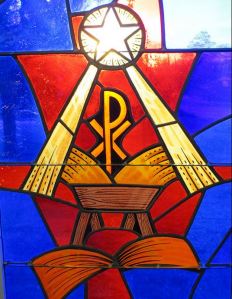
Have you ever taken a good look around our sanctuary? Our stained glass windows are beautiful and educational. Long before the average person could read, people attempted to capture and share the wonder of God’s love for us through the art of stained glass.
At this time of year, my thoughts are always drawn to meditate upon the meaning behind our nativity window. It shows the star of Bethlehem shining above a manger. In the manger is the ancient “Chi Rho” symbol. This symbol is the first two letters of “Christ” in Greek joined together. Early Christians used this mark to represent Jesus. The window reminds us that Jesus, the Christ, came to us in human form at Christmas. Such news becomes even more wondrous when one considers that he comes to us throughout time. He is the Alpha and Omega, the beginning and the end – present before history began and will be after it ends – because Jesus always was, is and will be our God who is with us and for us.
Luther once wrote that the Bible is like the manger where we can meet, know and worship Jesus the Christ over and over again. This, too, is true, but it also doesn’t quite capture this special relationship – the intimacy spoken of goes well beyond “knowing” Jesus with only our intellect. Our holy texts assure us that Jesus has come to live with us in our hearts. Jesus wants to abide in us. He longs to be an intimate part of every aspect of our lives. This joyful mystery cannot be captured fully in written word or by any other human art, yet my thoughts came back to an old 18th Century Danish hymn which focuses upon the joining of our human hearts with the divine heart though the incarnation and gift of faith. It is one of my favorite pieces of Christmas music.
Written by a Danish Lutheran pastor and later bishop, Hans Adolph Brorson, Mitt Hjerte Alltid Vanker (in English, sometimes entitled “My Heart Always Wanders” or “My Heart Remains in Wonder”) movingly grasps at the surprise and mystery of the incarnation. Soundly pietist, the reflection remains more oriented toward his feelings and heart rather than any intellectual exploration. The lyrics reflect relationship and intimacy, as well as grace and gratitude. Contemplating this miracle, God coming to us as a vulnerable newborn in a stable, Brorson’s own mind and heart wanders and enters a blissful wonderment as he thinks about his current saving, relationship with Christ.
O come, my Lord, I pray Thee!
And be my honour’d guest,
I will in love array Thee
A home within my breast.
That home can be no stranger
You bought it all yourself.
Thou will surely stay here
Swaddled in my heart.
We will never be able to fully appreciate, capture, or understand the miracle of love offered to us through Jesus Christ. Yet because it is not just an historical event, each and every day we may strive to cooperate with grace and make room for the Christ child in our hearts above all other things. His birth should move us to reflect upon the ultimate, ongoing Christmas miracle which comes to us through Christian faith, worship, fellowship and service. Christ’s Spirit continues to shape us and sanctify us into the gift God first intended with our own creation. We become part of God’s greatest gift to the world, where in Jesus’ name, we will love others. Through grace, we concretely become the Christ’s body, here and now.
Throughout your holiday wanderings and celebrations, I pray that you, your family and friends stop and ponder the nativity. Continue to wonder about and experience this joyful mystery and invitation in your life. Rejoice, for a child has been born for us! His name is Jesus, and we will never be alone or unloved. In response, let us seek to rightly worship him, opening our hearts and offering all that we are to him in thanksgiving.
—————————–
Many variants of the song exist in English due to the difficulty of translation. Along with the above video, here are English lyrics for this wonderful Christmas song:
My Heart Remains in Wonder/My Heart Always Wanders
My heart remains in wonder (or better translation: My heart always wanders)
Before that lowly bed
Within the stable yonder
Where Christ, my Lord, was laid. (or: was born)
My faith finds there its treasure,
My soul its pure delight,
Its joy beyond all measure,
The Lord of Christmas night.
But Oh! my heart is riven
With grief and sore dismay
To see the Lord of heaven
Must rest on straw and hay,
That He whom angels offer
Their worship and acclaim
From sinful man must suffer
Such scorn, neglect and shame.
Why should not castles royal
Before Him open stand,
And kings, as servants loyal,
Obey His least command?
Why came He not in splendor
Arrayed in robes of light
And called the world to render
Its homage to His might?
The sparrow finds a gable
Where it may build its nest,
The oxen know a stable
For shelter, food and rest;
Must then my Lord and Savior
A homeless stranger be,
Denied the simplest favor
His lowly creatures see.
O come, my Lord, I pray Thee,
And be my honored guest.
I will in love array Thee
A home within my breast.
It cannot be a stranger
To Thee, who made it free.
Thou shalt find there a manger (or: Thou will surely stay there)
Warmed by my love to Thee.[i](or: swaddled in my heart)
In English, it is difficult to find a flowing, direct translation of the traditional final stanza in Danish or Norwegian, but it means roughly:
I’ll willingly spread branches Of palms around your bed. For you and you alone I will live and I will die. Come, let my soul find bliss In this moment of delight: To see you born right here, Deep inside my heart’s abyss. (or: loving heart)[ii]
[ii] Translation merging multiple sources, primarily the above video and pust.org
The above piece was adapted from one shared in Messiah’s newsletter, The Messenger, in November 2009. Unless otherwise indicated, all scripture quotations for this article are from the New Revised Standard Version (NRSV) translation.
A comet that gained an earthly following because of its bright tail visible from space was initially declared dead after essentially grazing the sun. Now, there is a sliver of hope that Comet ISON may have survived. (Source: AP, 11/19/13)
“For surely I know the plans I have for you,” says the Lord, “plans for your welfare and not for harm, to give you a future with hope.”(Jeremiah 29:11)
In Jeremiah’s letter to the Jewish people in exile, we hear God speak profound words of hope in the face of their doubt and darkness. God had not abandoned them. God did not stop loving them. The world seemed to be crashing down around them, and many were tempted to give up on forgiveness, salvation and new life. Yet, God would never give up on them. Rather than assimilating to the “realistic” outlook and ways of the world, they were invited to look to the Lord, have faith, and truly live.
No matter the generation, it is no different for us who dare to believe in God amidst our own struggles. Abraham hoped against hope; trusting that he would become “the father of many nations”[1] just because God had promised. We are told not to be jealous or measure ourselves against others. “Surely there is a future, and your hope will not be cut off,” Proverbs assures us.[2] In the face of many trials and losses, Moses and his people were still shown the way to freedom. They just had to trust, seek to follow God, and walk on.
Jesus himself tells us, “Do not worry about tomorrow.”[3] Instead, he only asks us to trust in him, follow his light, and reflect his love. He is our star of hope which no darkness – including our sin – can ever overcome. No matter our challenges, our lives are free to glorify God and rejoice, because of the hope laid up for us in heaven.[4]
Discussion question: How can living as a people of hope shape our lives?
The above reflection was originally published in Messiah Lutheran Church and School’s worship bulletin for the Fourth Sunday of Advent, 2013. It is meant to complement Creative Communications’ Bright Star of Bethlehem series for Advent and Christmas.
Unless otherwise indicated, all scripture quotations for this article are from the New Revised Standard Version (NRSV) translation.
An image of a ‘light echo’ produced by the glare from a star that was, for one brief shining moment, the brightest star in the night sky – V838 Monocerotis (Source: Daily Mail)
“And I, when I am lifted up from the earth, will draw all people to myself.” (John 12:32)
Through the fall, the world suffered what seemed to be irreparable separation from God. Instead, the rest of scripture reveals God’s ultimate plan, the reconciliation and unity that occur through Jesus Christ.
In the Jewish scriptures, God promises time and again to use the Jewish people as a means to bless all nations. In the Gospels, we see Jesus preach, teach and do miracles in ways that heal the world and draw people together in his love. As the church begins, we learn from the Spirit that there is no longer gentile or Jew, male or female. Economic and political differences, ethnicity and language are moot points when it comes to the reach of God’s love.
In the end of time, all promises will be fulfilled. Jesus will come again as “the bright morning star” announcing:
“The Spirit and the bride say, ‘Come.’
And let everyone who hears say, ‘Come.’
And let everyone who is thirsty come.
Let anyone who wishes take the water of life as a gift.” (Rev. 22:17)
Until that day, we have been called together to be his one body, the church. On his behalf and with his authority, we have the honor and duty to share the water of life and invite all we meet, “Come, follow Jesus. Be one with us in his love.”
Discussion questions:
What gets in your way of a deeper relationship with Jesus? How do you live as one with his church? How can you invite others into such a relationship?
The above reflection was originally published in Messiah Lutheran Church and School’s worship bulletin for the Second Sunday of Advent, 2013. It is meant to complement Creative Communications’ Bright Star of Bethlehem series for Advent and Christmas.
Unless otherwise indicated, all scripture quotations for this article are from the New Revised Standard Version (NRSV) translation.
This Hubble photo is but a small portion of one of the largest seen star-birth regions in the galaxy, the Carina Nebula.
Luther observed, “Our Lord has written the promise of resurrection, not in books alone, but in every leaf in springtime.” God is, was, and always will be part of the creation that surrounds us.
Yet in a fallen world, that wasn’t good enough. The works of sin, death, and the Devil enslave our lives, separating us from God and one another.
Instead, God longs for relationship and intimacy; to replace our hearts of stone with hearts of flesh. Through the prophets, God promised to make his home with us, not in some new stone temple, but in those same hearts so prone to wander and fail.
Into the world, God sent his only Son to fulfill this promise. Jesus would take on flesh for our sake. He would live for us, work for us, suffer for us, and die for us. From his resurrection, our own eternal life springs forth.
Through the mysteries of our shared faith and baptism, we now become a new creation, freed from our flesh and the limits of this world to be the children of God. We are saved to be his body which proclaims the Good News: Jesus has come into the world to offer new life to all.
Discussion questions: As part of God’s creation, the promise of resurrection is written in each of us, as we are now. How does your life signify or serve as a promise of the resurrection? How could you “shine more brightly” to better give God glory and point others toward Christ?
The above reflection was originally published in Messiah Lutheran Church and School’s worship bulletin for the First Sunday of Advent, 2013. It is meant to complement Creative Communications‘ Bright Star of Bethlehem series for Advent and Christmas.
Unless otherwise indicated, all scripture quotations for this article are from the New Revised Standard Version (NRSV) translation.
In case you come across this article by Thomas Cahill as I have being reposted and misused by some Roman Catholic brothers and sisters (along with some rather un-Christian remarks), be assured the author misses the mark somewhat when it comes to Luther’s psychology and theology. His take is too simplistic.
Luther’s efforts to reform the church (especially at the start) weren’t about ego alone, but about the Word of God being adhered to without mental gymnastics to make them fit corrupt and superstitious practices of the day. He was a pastor caring for his people, and a teacher seeking truth. His intent was not to be independent, revolutionary, or famous.
Unlike the short quote within the article, Luther’s words at Worms were more nuanced [please note the points I emphasize]:
“Unless I am refuted and convicted by testimonies of the Scriptures or by clear arguments (since I believe neither the Pope nor the Councils alone; it being evident that they have often erred and contradicted themselves), I am conquered by the Holy Scriptures quoted by me, and my conscience is bound in the word of God: I can not and will not recant any thing, since it is unsafe and dangerous to do any thing against the conscience.” (History of the Christian Church, vol. VII, ch. 3, sec. 55).
Martin Luther was posting an academic disputation – a common practice of his day – and wrote later writings to be discussed in community. He wasn’t looking for a fight nor a break with the church catholic, and his efforts were shaped by much more than just a matter of an individual’s ego.
True, self-interpretation of scripture has its weaknesses and excesses, but Luther wasn’t guilty there either. His focus remained on the assembly (the church) in relationship with one another and Christ. (This is made quit clear in his Large Catechism and other theological writings.) The church guided by the Spirit and tested by the divine revelation of scripture is the corrective for us all when it comes to interpretation, for Luther knew we all can err as much as popes and councils. We need to open scripture, listening for the Spirit and to one another.
As the debates rolled on and intensified, Luther failed to do that at times himself. Much like those posting anti-Lutheran insults and commentary, he let his anger and disappointment (and perhaps later his mental illness) govern some of his responses. After all, many people wanted to see him dead and weren’t exactly charitable either.
Martin Luther was human, and he realized it. In reviewing much of his writings, you will see him hesitate to state things definitively rather than to risk error. He critiques himself and his lack of ability. You will see calls for discernment rather than name calling over theological issues. He turns toward grace to light his way forward and not some internal power of his own.
I think such an attitude represents a very human, Christian humility and maturity rather than egocentricity. Adapted beyond theology discussions to a way of life, such an attitude will likely prove the best answer to what gridlocks us in our politics and divides our culture today.
As St. Paul reminded Luther and reminds us all, “And do not grieve the Holy Spirit of God, with which you were marked with a seal for the day of redemption. Put away from you all bitterness and wrath and anger and wrangling and slander, together with all malice, and be kind to one another, tenderhearted, forgiving one another, as God in Christ has forgiven you.” (Eph. 4:30-32). Even amidst important theological or other disputes, we are to remain one family of faith, the holy people of God.
Unless otherwise indicated, all scripture quotations for this article are from the New Revised Standard Version.
So let us not grow weary in doing what is right, for we will reap at harvest time, if we do not give up. So then, whenever we have an opportunity, let us work for the good of all, and especially for those of the family of faith. (Galatians 6: 9-10)
I am tired: tired of wars and rumors of war; tired of terrorism; tired of illness and trials; tired of death.[i] I know I am not alone. Our nation and world has experienced much too much suffering these last few weeks. Just watching the news was emotionally draining, and many still feel alone and isolated. Others grieve or remain afraid.
Yet if we overly focus on this very real suffering and evil, is it any wonder we grow tired? It seems too much for us, because it is! We are not God, able to work healing, life-giving miracles at our whim. As frail, fallible humans, we are not able to stand alone. So what can we do?
At such difficult times, I don’t give up. I find comfort, strength and motivation in a promise – something not yet a reality, but definitely coming. We are told there will be a day with no more death, mourning, crying or pain. All will be made new.[ii]
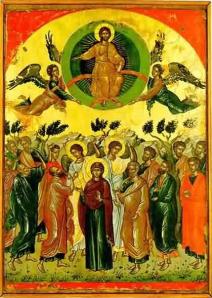
Oh, that day’s not here yet, but Christ’s ascension into heaven[iii] foreshadows his certain return.[iv] Although Jesus isn’t with us in body, it is Jesus himself who promises us, “I am with you always.”[v] Granted much stands against us, yet our God is for us and standing with us. We are already conquerors sharing in Christ’s victory over sin, death and the Devil no matter how we might feel about it.[vi]
This promise is our inheritance and claims us as Christ’s people – a people of living faith, hope and love.[vii] It turns our eyes to look beyond our own suffering and fears toward how we are called to help answer such pain and injustice in the world.[viii] Indeed, in Jesus’ physical absence, we serve as his body.[ix] Our feet are those which bring his good news to dark places.[x] Our hands are those that bring his healing.[xi] Our shared ministries are used to create miracles and give life in his name.[xii]
This is no time to run and hide. It isn’t time to be caught asleep or medicating ourselves with escapist, self-indulgence. Instead, Jesus invites us to truly live saying, “Don’t be afraid. Follow me.” Jesus is coming, and we have much left to do in preparation.
No, we still aren’t God, but we are God’s people. At home or away, at work, school or vacation, even in places of emergency, we remain his church – together with Jesus and never alone. When people look to the hills for help[xiii], it might just be us whom Jesus has sent to be his living answer to their cries for help.
So, let us rest when needed, mourn if we must, support one another, pray and wait with patience, but never give up. There will be a day when there will be no more broken hearts. Until then, Jesus asks us as his body to surrender our hearts to his own – trusting in his promises; fulfilling his Father’s will; freed to love God and our neighbor as his Spirit leads us with all that we are, wherever we might be, whatever might happen. In the face of death, it is time to live.
Just as Jesus came when the time was right[xiv], he sends us now to a world in need of his love – a world where we will meet the Risen Christ on our way already waiting to sustain us with his joy and peace.
At a time of terror or indeed any time, it proves a blessing to take up our cross and seek to do what is right. All will be well, for we always belong to Christ.[xv] Jesus never grows tired, and he will never give up on us.
As I posted this pastoral letter, I recalled this song by Stephen Curtis Chapman. Inspired by the Book of Acts, it often comforted me as a police officer and since. I believe it echoes the above message shared with my community:
[i] Read Jesus’ teaching on such signs in Matthew 24.
[iii] Read about Jesus’ physical ascension into heaven here.
[iv] Read for example Matthew 24:30-31 and 1 Thessalonians 4:13-18. Although some biblical scholars argue these passages are metaphorical or symbolic of his return, orthodox Christians maintain Jesus will somehow return to earth for the final resurrection and judgment – whether we understand the details of how or not.
[xv] “All shall be well, and all shall be well, and all manner of things shall be well.” Julian of Norwich
The above pastoral letter is adapted from one originally published in Messiah Lutheran Church and School’s newsletter, The Messenger (May 2013 edition). To view the entire issue of The Messenger or to see the full calendar of events, visit: http://www.mlcas.org
Unless otherwise indicated, all scripture quotations for this article are from the Today’s New International Version translation.
We welcome Easter morn with shouts of “Jesus is risen. He is risen indeed!” As they echo through our sanctuary, I wonder if that truth will continue to resonate through our lives. Jesus is risen, we proclaim. His resurrection is to be a new, ongoing reality for us; one that changes our actions and very being. This is present tense, touching our here and now; in our lives, our world, and his holy universal church.
Yet like those first disciples surprised by the empty tomb, we can instead get lost in that past moment of time. The resurrection tends to serve as a historical marker rather than a living sign for our present reality. We remain stuck in our shock and fear trying to make sense of things. What can such a resurrection mean? Perhaps more so, what can it mean for me?
Soon after that first Easter morning, Peter preached that Jesus was not abandoned to the realm of the dead, nor did his body see decay. Paul explains to us in many of his letters that through faith the power of that resurrection makes us a new being, a child of God, and we will be heirs to Christ’s victory to share in that resurrection forever.
This is all true, yet neither great Apostle came to understand the resurrection as a singular past event or one all about our far off future with Christ. Instead, the Risen Christ and the Holy Spirit woke them from their initial shock. It was revealed that they were to share in the living resurrection for eternity – starting now. Christ’s light is to shine through us as we walk with him and talk with him, but unlike that old Gospel song (In the Garden), we cannot tarry there.
Jesus instead tells us, “I have come that you may have life, and have it abundantly.” This resurrected life isn’t one found by standing alone; mute and in shock. It isn’t a life solely about what Jesus can do for us as individuals or a community. It calls us to action.
The resurrected life that we are invited to share is one of living relationship. It is one of service, fellowship, and corporate worship. It is one where we seek to follow Jesus each day and introduce him to others. It is one where we might even be called to share in the sting of Christ’s sacrifice and cross out of love.
Let’s not just stand here pondering. Let’s live like we believe in the resurrection. As the Father has sent him, he sends us now. Among the greatest miracles, Jesus has chosen to make the resurrection universal and eternal through our own unworthy love and lives. We must now go and share that miracle with others, for Jesus is truly risen in us. We are to live as his risen body, a resurrected people, forever – starting now.
Christ’s peace be with you always,
Pastor Lou
Unless otherwise indicated, all scripture quotations for this article are from the New Revised Standard Version (NRSV) translation.
As the Passion ends, we leave with Jesus laid in the tomb. Was he asleep? No, scripture clearly strives to prove and proclaim that Jesus truly died on that cross. Did he go to heaven? Actually, scripture leads us to believe that Jesus was somehow still miraculously at work but not in heaven.
Our Lutheran confessions state that “we believe simply that the entire person, God and human being, descended to Hell after his burial, conquered the devil, destroyed the power of Hell, and took from the devil all his power.” (See Solid Declaration, Art. IX.) Luther seems to have believed it an ultimate mystery that Jesus descended. Nothing tells us if he did so in “humiliation” or in glory, but we should just believe the faith in which we baptize (see the Apotles’ Creed: Jesus descended into sheol – in Hebrew the place of the dead, sometimes called hades).
Early Christianity believed this and scripture alludes to it in such passages as 1 Peter 3:18-20: For Christ also suffered for sins once for all, the righteous for the unrighteous, in order to bring you to God. He was put to death in the flesh, but made alive in the spirit, in which also he went and made a proclamation to the spirits in prison, who in former times did not obey, when God waited patiently in the days of Noah, during the building of the ark, in which a few, that is, eight people, were saved through water.”
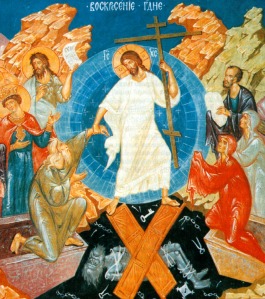
In the Old English, harrowing was the term used to describe Christ’s descent. Ancient icons often show Jesus amidst previous saints of the Jewish Testament, standing on the gates of sheol now opened. The gates are often an “X” or Chi in Greek, reminding us that Jesus is Χριστός, or Christ – the Annointed One and our Messiah come to save us from sin, death and the Devil.
Christians may debate whether Jesus entered triumphantly or suffered more indignities, but mainstream Christianity looks to both scriptures and the faith handed down to us. Jesus’ entrance into the grave was not the last of his journies for us. With sundown, his burial was complete. The Jewish sabbath had begun, and Jesus went to work. The Saturday of our Holy Week is indeed good (holy), and we rightly rejoice even as we wait for the Day of Resurrection. Jesus has come to save all his people.
Unless otherwise indicated, all scripture quotations for this article are from the New Revised Standard Version (NRSV) translation.
Within an ancient culture that didn’t count women during the government census or necessarily notice or respect them in the home, it is not a real shocker the bible doesn’t often mention women.
Despite this, it remains most probable that women were an important part of Jesus immediate community and present at his final Passover Feast. Matthew reports that at the feeding of the 5,000, the count did not include women and children.[i] Or later, Matthew shares that women who “had followed Jesus from Galilee to care for his needs” watched as he died.[ii] (Was this perhaps after preparing and sharing in his last Passover Feast?). There are other attestations from other Gospel writers as well which some see as supporting that women were among his disciples and active in his ministry.
Whether you agree or not, or think women had their feet washed by Jesus or not, Jesus’ greatest intention on Maundy Thursday was to teach us to love and serve everyone (“one another”) as he had us. After all, Maundy comes from the Latin word mandatum (meaning “commandment”), and it was used in the early Latin Vulgate translation of John 13:34: “I give you a new commandment, that you love one another. Just as I have loved you, you also should love one another.” Using scripture to interpret scripture and seeing Christ’s own example, it is hard to argue that this command to love only covered Christians. Christ longs for his family to grow.
Yes, this final teaching echoed Jesus’ earlier ones. What’s the greatest commandment?[iii] Who is our neighbor?[iv] Jesus reached out to all those marginalized by society whether Jewish or not. We are not to become their stumbling block.[v] We are to let “the children” come to Jesus.[vi] Indeed, we are to love whoever might be thought as “the least of these” – perhaps children, inmates, the poor, women (in many cultures still), anyone we tend to label as “sinners”, and non-Christians. Matthew is said to have been the most Jewish of the Gospel writers; at least his writings reflected many Jewish teachings and responded to many Jewish biases about their being the chosen ones of God. Yet, he shows Jesus to be incredibly open and loving to all. Jesus longs for relationship!
Despite this, some traditionalist Roman Catholics have become more and more vexed by Pope Francis’ election and recent behaviors. He has cast aside signs of regalism. He has acted in ways lifting up the priesthood of all believers. He has expressed openness to Protestants, Orthodox Christians, and people of other faiths entirely. As in Argentina when a Cardinal, Pope Francis seeks simplicity, and he lives that way. Not the least of their issues with him, many traditionalist have expressed “the horror” (not my word, but often found in their tweets and posts) that the Pope would wash not only the feet of a juvenile women who happened also to be a prisoner, but in one case was Islamic. “He cultivates a militant humility, but can prove humiliating for the church,”[vii] Fr. Bouchacourt, head of the traditionalist, schismatic St. Pius X Society, said. I have seen similar less than charitable comments by other traditionalists, even from some of those who haven’t broken from the Roman Catholic hierarchy but instead claim to love and obey it. Some even suggest Pope Francis’ behaviors are just a show in violation of scripture.[viii]
If signs of humility are embarrassing to the Roman Catholic Church, then I bluntly but in love suggest these folks take a look at Jesus’ own behavior. Jesus often intentionally exemplified his teachings through public behaviors. That’s what teachers and leaders need to do. Jesus prayed in public at times not for his own sake and not for a show, but so that others could be comforted and learn of God’s love.[ix] He purposefully embodied earlier prophesies to help reveal his identity, such as by riding a young donkey into Jerusalem.[x] (Certainly, Palm Sunday was quite a spectacle.) Some of the same conservatives – those who were so protective in promoting the sanctity of the conclave and agressively argued that the election process was in the Spirit’s presence and following God’s will – turned on Pope Francis that first night.
Even as a Lutheran, I would agree that the Spirit is involved in leading the Roman Catholic Church, but I would also argue the Spirit seeks to guide all other denominations as well. Institutions made of fallible humans can err (a very Lutheran attitude to be sure), but we still remain Christ’s church. Despite the historic divisions of the universal church, Pope Francis holds one of (if not the most) prominent positions of Christianity. To be ashamed of such humble, public actions that so many “of the least” will take notice of seems the real shame to me.
This Lutheran says, “Good for Pope Francis!” Perhaps I shouldn’t care so much, but I (like countless other Christians) hope and pray for the coming reality of Christ’s own prayer that we live as one.[xi] We are the church together, not our denominations, through the grace of our shared faith and baptism. I humbly support my brother Francis in his efforts to make Christ’s love known in the entire world.
After all, Jesus asked us to love and support one another. He never said with our human minds, hearts and ways that we always would agree on everything.
According to one commentating participant of Lent Madness 2013, “For the people who comprise the parish of St. Monica and St. James Episcopal, Frances Perkins is not just a New Deal bureaucrat, but is a living, breathing saint who worshipped with their predecessors and put the incarnational theology of their Anglo-Catholic liturgy into concrete social action.”[i]
Yes, it was often in their rooms and sanctuary that she stayed, prayed and made plans to champion a social safety net for the elderly, eliminate child labor, fix a minimum wage, create the Civilian Conservation Corps (CCC), provide disability for those hurt on the job, create unemployment insurance, a shorter work week, and worker safety regulations. She was an important person of her time, and her actions still help shape our nation. For some, these programs remain a lifeline.
Frances believed faith “served as a bedrock and a way to seek meaning in life when so much seemed inexplicable.”[ii] In her young adult life, she attended Mount Holyoke College, whose founder, Mary Lyon said, “Mount Holyoke women should live for God and do something.” A Baptist turned Congregationalist, she also is known to have advised, “When you choose your fields of labor go where nobody else is willing to go.” She knew the needs of the world.
Within that legacy, one of Frances’ teachers took her to look at the hard realities found in the nearby textile mills and factories.[iii] From affluence herself, Frances discovered a vocation to do something for the poor, the immigrant, and all others in need. Like today, many young women had come to the United States for promised jobs, but instead, they were forced into prostitution. Working with police and other institutions, Frances fought against this plight, the frequent drug and alcohol addiction, and the abusers of others.
Having been a cop in such communities, I know this to be no small task. Indeed, it is frightening in our seeming powerlessness over such issues as well as to stand in the face of real and potential violence. Thanks to her faith, Frances wasn’t afraid to enter relationship with the poor or anyone in need. She went where too few are willing to go.
Nominated as the first woman cabinet member as Secretary of Labor under Franklin D. Roosevelt, she continued to care about “the least of these”[iv] among us. She actively sought to protect Jewish and other refugees facing persecution in Europe under the Nazis. Until 1940, the Labor Department controlled the Immigration Service. She never got the quotas she desired, but a number of our Jewish neighbors owe their lives partly to her efforts, as do the famous Von Trapp family of Sound of Music fame.[v]
Writing this during this Passover holiday, I am reminded how Frances sought to echo God’s own love as reported in Deuteronomy 10, “For the Lord your God is God of gods and Lord of lords, the great God, mighty and awesome, who is not partial and takes no bribe, who executes justice for the orphan and the widow, and who loves the strangers, providing them food and clothing. You shall also love the stranger, for you were strangers in the land of Egypt.”[vi] Reflecting previous teachings of the prophets, Jesus, the Son of God, called us to concretely live out Deuteronomy 6, to love God with all that we our and our neighbor as ourselves.[vii] Frances heard and understood rightly that our neighbor includes all those around us. We are created and called to be God’s ambassadors to the world.[viii]
Most certainly, Frances Perkins lived within the concrete reality of amazing grace. Once when asked “Don’t you think it’s wrong for people to get things they don’t pay for?” “Why no,” Frances Perkins responded. “I find I get so much more than I pay for. Don’t you?”[ix] She understood that assisting the poor wasn’t just the work of government, and so she enlisted the help of church communities from across the United States to help respond to the upheavals of the Great Depression. She served the poor and needy directly as well, despite her station, throughout her life.
In a fallen world with fallen people, some today take advantage of such “grace,” do not appreciate it, or even intentionally abuse it. As humans, that’s the way it has always been. Even though the poor and undeserving will always be with us, we are to feed, clothe, train, and love them anyway. People will die, but we are to seek their healing and comfort. We are a people of hope and grace, and not ultimately one of reason. In fact, as Philp Yancey professes in his book What’s so amazing about grace (2002), life isn’t fair but neither is grace. God utilizes a totally different scale of justice than we do where love overflows.
Still, some might have very sound political and economic reasons to disagree with how Florence concretely tried to share God’s love, the system that has came about in more recent time, or even aspects of her theology. Yet speaking from a Lutheran perspective, we don’t expect perfection in God’s saints or require mystical miracles. Among the greatest mystery is that love can be found at all in a world that rejected the love of Christ and often still does. Even more so, we imperfect people are the means God has chosen to make love known since Jesus ascended.[x]
With Frances’ win of the Golden Halo, some will likely gnash their teeth at the “political correctness” of it all. If her last competitor, the evangelist Luke, had won, some others would have likely bristled at the patriarchal or mythical aspects of his victory. (I was happy either way for this matchup is at its corps just a silly way to promote Christian formation, and all saints share in the most import thing – Christ’s victory.) The truth remains that both saints remind us of our own call to be saints in our own context. We are to use the gifts that God gave us to the best of our ability – for God’s glory and not our own.
Some may never know our doubts and darkness, seeing only our public “mythic” face. Some may disagree with our attempts to love or even aspects of our faith and theology. Most of us will never be recognized or lauded for loving others. Still, I firmly believe that we are saints nonetheless; part of a great cloud of witnesses[xi], and God will make our love matter.
If we are indeed Christ’s saints (and we are through faith), we can’t just sit here as if faith without works is ok. A living faith infers we need to love – always imperfect even at our best, but love nonetheless; prudently certainly, but not with so much prudence that we are frozen to inaction from fear of error or consequences.
As Jesus said approaching his own suffering and death, the poor will be with us always, but in saying this, he alluded to Deuteronomy 15, “Give generously to [those in need] and do so without a grudging heart; then because of this the Lord your God will bless you in all your work and in everything you put your hand to. There will always be poor people in the land. Therefore I command you to be openhanded toward your fellow Israelites who are poor and needy in your land.”
Br. Roger of Taizé used to remind those of us in discernment for vocations there or in other parts of the church that Jesus is awaiting us in that dark chasm of our future. We must go forward to him with trust. We must seek to love, for Christ will meet us then and there. You see, God will use all things (even our failures and sin) for the good of those who love him.[xii]
As a theological descendent of Martin Luther’s Doctrine of the Two Kingdoms, I do indeed trust, understand, and demand that government has to be part of the solution to address poverty and other social ills. Yet, I acknowledge that we have to be smarter and demand more accountability and care. Government is a bureaucracy after all. People are imperfect. I also sometimes wonder if some of us rely on government as a solution to social ills way too much or (worse?) would rather pay taxes to support such programs than be in relationship with the poor. (As I often teach, a personal relationship with Jesus infers a relationship with others, including those in his church and without; those who have plenty and those who lack.) Too often, we attack one another rather than wrestle with the problem at hand. We get angry at the possibility of change or what we percieve as an attack on our precious viewpoints.
Now is the acceptable time…a time to be truly charitable – seeking to serve all those suffering, listening with respect and patience to one another, forging new relationships to seek God’s will and do it, forgiving error when it occurs. (And it certainly will come!) In humility, we must also remain aware that the worst error might prove to be our own, known or unknown.
True, Frances Perkins isn’t yet on our Lutheran (ELCA) Liturgical Calendar, but perhaps she should be – and not just because the ELCA has a full communion agreement with the Episcopal Church. We believe we are saved by grace through faith in Jesus Christ (by trusting in what he has done for our sake) – not our own works. In Frances’ historic context, she was remarkable and helped shaped our modern nation. More importantly, her witness was a faithful one. She has inspired many others to loving service at Mount Holyoke and elsewhere, yet she was never perfect nor are we. She could yet serve to inspire others to serve and hold discussions to evaluate how we could love our neighbor most effectively through government, church, and as individuals.
Maybe that’s a great miracle we should always trust in and act upon. We are truly Christ’s saints – all of us who believe even if with doubts – and we need to seek to live as his saints, his body in the world. Perhaps it is a happy coincidence that Frances Perkins won the Golden Halo on this Maundy Thursday (from the Latin mandatum, meaning command). Her imperfect but faithful life reminds us of the command Jesus left us as our inheritance during his Last Supper. The Gospel of John (13:34) reports that Jesus said, “A new commandment I give unto you, that we love one another; as I have loved you.”
Without fear, without hesitation, without our preconceived political notions or human expectations, may we heed Christ’s great command to love God and one another. Whether we view ourselves more left or right or anywhere in the middle, we shaare the family name of Christian. May Christ help us live as his saints each day in our own context – using our time, treasure and talent to the best of our ability.
Heaven knows, this real world needs all the saints it can get. We will never love perfectly. Our work will seem to never end, but do not be afraid. As Frances believed and scripture promises, Christ “will wipe every tear from their eyes. Death will be no more; mourning and crying and pain will be no more…”[xiii] Thanks to Jesus, inspite of and because of our sin, we will share in a victory beyond our hopes and dreams.
Jesus will do what we cannot. All things will be made perfect and new. His justice and love will reign fully at last.
To read of Lent Madness and the awarding of the 2013 Lent Madness Golden Halo visit: http://www.lentmadness.org
This year, Mount Holyoke, a women’s college in Massachusetts and alma Marta of Frances Perkins, celebrates its 175th anniversary. (There alumni, staff and students caused a large spike in turnout for Frances each round, thanks to use of social media.) Congrats to them! (If only VMI had done the same for Jonathan Daniels!) You might like to visit their special anniversary website celebrating women of influence: https://www.mtholyoke.edu/175/celebrating-175-years-women-influence
The United States Labor Department is also celebrating their 100th anniversary. Learn more here: http://www.dol.gov/100/
You can learn more of Francies Perkins by visiting the Frances Perkins Center on the internet or in person: http://francesperkinscenter.org/
Watch this short excerpt of “You may call me her Madam Secretary”
From the Washington Post, March 28, 2013 edition, you can read about Frances’ win and the reaction in the Labor Department. I hope and pray all government employees view their service as a sacred vocation, loving their neighbor, as she did: http://wapo.st/165chTZ
Husband, Pastor, Law Enforcement Chaplain, and member of the Clerical Errors (aka "The Three Priests"), I'm sharing my two cents with anyone who cares...
You can also find me on social media as Loudluthrn (Lou-d-Luthrn or Lou the Lutheran). It is a moniker given me while attending a Presbyterian Seminary, but I'm a loud and proud Lutheran too (just not too loud and proud, mind you).

 On coming to the house, they saw the child with his mother Mary, and they bowed down and worshiped him. Then they opened their treasures and presented him with gifts of gold, frankincense and myrrh.” (Matthew 2:11)
  Written by a Danish Lutheran pastor and later bishop, Hans Adolph Brorson, Mitt Hjerte Alltid Vanker (in English, sometimes entitled “My Heart Always Wanders” or “My Heart Remains in Wonder”) movingly grasps at the surprise and mystery of the incarnation. Soundly pietist, the reflection remains more oriented toward his feelings and heart rather than any intellectual exploration. The lyrics reflect relationship and intimacy, as well as grace and gratitude. Contemplating this miracle, God coming to us as a vulnerable newborn in a stable, Brorson’s own mind and heart wanders and enters a blissful wonderment as he thinks about his current saving, relationship with Christ.








 2pennyblog