Join us for our second of two special services celebrating our Christian Unity, Sunday July 14th, 9:30 am. All Souls Episcopal Church and Messiah Lutheran Church will share in the Episcopal liturgy for communion with Pastor Lou presiding. More information is in the pastoral letter below:
Dear Messiah members and friends, and to all our brothers and sisters in Christ:
On July 3-7, Lutherans and Anglicans in Canada gathered in a joint assembly in Ottawa for worship, fellowship and to make important decisions about ministering together as Christians. In anticipation of the assembly, leaders of the Evangelical Lutheran Church in Canada, The Anglican Church of Canada, The Episcopal Church and the Evangelical Lutheran Church in America (ELCA) shared in a letter how members of the four denominations have come “closely together in service of the gospel.” (You can read it here: http://bit.ly/1aeSwNR )
For twelve years, Lutherans of the ELCA and Episcopalians have shared “full communion.” As the our denomination’s website states, “Full communion is when two churches develop a relationship based on a common confessing of the Christian faith and a mutual recognition of baptism and sharing of the Lord’s Supper. This does not mean that two churches merge; rather, in reaching agreements, churches also respect differences. These denominations likewise jointly worship, may exchange clergy, and also share a commitment to evangelism, witness and service in the world.”
This journey is as old as Christ’s own prayer that his disciples live as one. It has been a continued hope since the Augsburg Confession called for unity amidst serious differences between Roman Catholics and those who would later be called “Protestant.” Following the world wars of the last century, Christians searched to understand how Christians could visit such atrocities upon one another, and a new openness arose to ecumenism as evident by Vatican II and many new ecumenical bodies and efforts being formed. Since then, ministry has been joined globally, nationally and locally to be sure. In fact, Lutherans seeking unity would help create the ELCA out of several Lutheran faith traditions 25 years ago. Eventually, this was followed by full communion agreements between the ELCA and a number of other denominations. (To learn more about that, visit: http://bit.ly/Z1bXY1 )
In our case, All Souls Episcopal and Messiah Lutheran members remain individual congregations, but share our building and much ministry. We have helped each other to meet crucial, practical needs. We have shared in outreach to our community and world. Recently, both pastors have spent time learning about each other’s liturgy. This facilitates pulpit exchanges, and now, each pastor will seek to aid the other church whenever an absence or emergency need arises without the added cost of a supply pastor. On a practical level, this is all good stewardship. On a spiritual level, it helps expose us all to the fullness, depth and breadth of Christ’s church and its varied theological riches.
There is no one model for living out our shared faith and call. Some Episcopal-Lutheran congregations (such as in Galax, VA) have fully merged or formally yoked together for the sake of the Gospel. Others like us, share our lives openly without any formal expectations or agreements. Others might join together as needs and opportunities for ministry arise. In each unique context, we must prayerfully find the path Christ has prepared for us and go. Christ prayed for our togetherness long ago, but in many ways, our journey together as Episcopalians and Lutherans has just begun.
Whether we continue to share the same building or not, we are, will be, and should be the church together. Messiah and All Souls members intend to labor together and along with other area congregations for the sake of sharing the Good News of Jesus Christ. It leads us toward the fulfillment of Christ’s prayer and calls us to the same future.
This Sunday, July 14th, the congregations of Messiah and All Souls will come together as part of the catholic (universal) church and celebrate our unity in one service at 9:30 am. We’ll share in worship and break bread at our Lord’s Table. Our prayer and fellowship together will fortify us for the work ahead, such as: our combined Vacation Bible School, our ongoing ministry to those suffering hunger and homelessness, our youth’s combined mission trip in July, our seeking to be good stewards of everything God has given us. The service will also powerfully witness to us and others of God’s grace and love. Jesus said, “I give you a new commandment, that you love one another. Just as I have loved you, you also should love one another. By this everyone will know that you are my disciples, if you have love for one another.” (John 13:34-35)
God is doing something special here in and through our small but mutually growing congregations. I invite everyone to come and celebrate our unity in Jesus, not just at worship this Sunday, but as we leave to go out into the mission fields together as brothers and sisters in Christ.
Peace,
Pastor Lou Florio
Unless otherwise indicated, all scripture quotations for this article are from the New Revised Standard Version (NRSV) translation.
So let us not grow weary in doing what is right, for we will reap at harvest time, if we do not give up. So then, whenever we have an opportunity, let us work for the good of all, and especially for those of the family of faith. (Galatians 6: 9-10)
I am tired: tired of wars and rumors of war; tired of terrorism; tired of illness and trials; tired of death.[i] I know I am not alone. Our nation and world has experienced much too much suffering these last few weeks. Just watching the news was emotionally draining, and many still feel alone and isolated. Others grieve or remain afraid.
Yet if we overly focus on this very real suffering and evil, is it any wonder we grow tired? It seems too much for us, because it is! We are not God, able to work healing, life-giving miracles at our whim. As frail, fallible humans, we are not able to stand alone. So what can we do?
At such difficult times, I don’t give up. I find comfort, strength and motivation in a promise – something not yet a reality, but definitely coming. We are told there will be a day with no more death, mourning, crying or pain. All will be made new.[ii]
Oh, that day’s not here yet, but Christ’s ascension into heaven[iii] foreshadows his certain return.[iv] Although Jesus isn’t with us in body, it is Jesus himself who promises us, “I am with you always.”[v] Granted much stands against us, yet our God is for us and standing with us. We are already conquerors sharing in Christ’s victory over sin, death and the Devil no matter how we might feel about it.[vi]
This promise is our inheritance and claims us as Christ’s people – a people of living faith, hope and love.[vii] It turns our eyes to look beyond our own suffering and fears toward how we are called to help answer such pain and injustice in the world.[viii] Indeed, in Jesus’ physical absence, we serve as his body.[ix] Our feet are those which bring his good news to dark places.[x] Our hands are those that bring his healing.[xi] Our shared ministries are used to create miracles and give life in his name.[xii]
This is no time to run and hide. It isn’t time to be caught asleep or medicating ourselves with escapist, self-indulgence. Instead, Jesus invites us to truly live saying, “Don’t be afraid. Follow me.” Jesus is coming, and we have much left to do in preparation.
No, we still aren’t God, but we are God’s people. At home or away, at work, school or vacation, even in places of emergency, we remain his church – together with Jesus and never alone. When people look to the hills for help[xiii], it might just be us whom Jesus has sent to be his living answer to their cries for help.
So, let us rest when needed, mourn if we must, support one another, pray and wait with patience, but never give up. There will be a day when there will be no more broken hearts. Until then, Jesus asks us as his body to surrender our hearts to his own – trusting in his promises; fulfilling his Father’s will; freed to love God and our neighbor as his Spirit leads us with all that we are, wherever we might be, whatever might happen. In the face of death, it is time to live.
Just as Jesus came when the time was right[xiv], he sends us now to a world in need of his love – a world where we will meet the Risen Christ on our way already waiting to sustain us with his joy and peace.
At a time of terror or indeed any time, it proves a blessing to take up our cross and seek to do what is right. All will be well, for we always belong to Christ.[xv] Jesus never grows tired, and he will never give up on us.
As I posted this pastoral letter, I recalled this song by Stephen Curtis Chapman. Inspired by the Book of Acts, it often comforted me as a police officer and since. I believe it echoes the above message shared with my community:
[i] Read Jesus’ teaching on such signs in Matthew 24.
[iii] Read about Jesus’ physical ascension into heaven here.
[iv] Read for example Matthew 24:30-31 and 1 Thessalonians 4:13-18. Although some biblical scholars argue these passages are metaphorical or symbolic of his return, orthodox Christians maintain Jesus will somehow return to earth for the final resurrection and judgment – whether we understand the details of how or not.
[xv] “All shall be well, and all shall be well, and all manner of things shall be well.” Julian of Norwich
The above pastoral letter is adapted from one originally published in Messiah Lutheran Church and School’s newsletter, The Messenger (May 2013 edition). To view the entire issue of The Messenger or to see the full calendar of events, visit: http://www.mlcas.org
Unless otherwise indicated, all scripture quotations for this article are from the Today’s New International Version translation.
Although not traditional first responders, pastors and other ministry leaders prove an integral part of the response to any emergency. What they choose to do or not do impacts the entire community as people seek to deal with the physical, mental, emotional and spiritual aftermath. I hope pastors, other ministers and church leaders might consider and discuss the following points for their benefit and the benefit of those they serve.
When it comes to facing evil, sin and death, I don’t think anyone can ever be an expert. The context of any situation and the needs of those affected vary. Our own resiliency and competencies change. I don’t think there can be a single, perfect response when we and our world are so imperfect.
The following comments are not meant to reflect expertise or suggest a perfect response, but they do reflect some things I have learned along my way as a former police officer and hospice chaplain. Currently, I serve as a volunteer law enforcement chaplain,[i] yet I am still learning. At the same time, I desire to learn from your comments and feedback based upon your own experiences and training. Please share them privately with me or in the comments section below.
Regarding unexpected emergencies and disasters:
1. Stay calm and listen: Listen to local media for instructions from emergency officials. As you listen, recognize that there exists a great deal of confusion. As the media and individual politicians seek to get information out quickly, the result is often many false reports and much bad information. Not unlike gossip, avoid passing this on or instinctually reacting to it as if true. Wait for official statements of first responders, disaster organizations, and government officials actually in charge of rescue operations and response. Even though these too can err, they remain your best sources for information to inform your own response and pass on. Try to listen to or watch any and all official press conferences. Prior to emergencies, consider following your local first responders, aid organizations, and local government, state and federal entities (especially departments of emergency management at the county and state level) on Twitter and Facebook. If they offer texts in emergencies, sign up for that service.
2. Observe and report: Before, during, and after an unexpected emergency don’t call 911 unless an emergency. Store your local first responder’s non-emergency numbers in your cell phone and address books prior to your need for them. These can be used in cases where there is no immediate or confirmed threat, leaving emergency lines open for those who really need them. Report all suspicious activity, as any info can be helpful. Let those in charge decide what is important. If community truly is a response to a common call, we must all seek to serve and protect those entrusted to us, our neighbors.
3. Avoid phone use in and to affected areas. Don’t overload the system with needless calls. No matter how concerned you are for a loved one, your call may inhibit first responder’s response to those in need and their use of communication assets. (In Boston, the media suggested officials had turned off cell service. It is more likely local service was overwhelmed as with past terrorist activity.) Remember also, cellular signals can inadvertently cause detonations of explosive devices and fumes. If you are in the immediate area of the emergency, follow the directions of emergency personal. Wait on calls until in a safe place or longer if possible. Even once in a safe place, Twitter and Facebook might be the best way to communicate. You might reach many more people at once.
After a recent earthquake, people could not reach our preschool as phone systems were overwhelmed. Through Twitter (including an automatic feed to our website) and Facebook, we were able to advise that everyone was safe, thus removing the need for calls to our location. After a hurricane, we were able to easily pass on information about emergency services and resources (such as ice, food and water) to those without regular phone service or power. Most people were still connected to the internet and social media through charging mobile phones in their cars.
4. Stay in a safe place. Don’t clog roads with needless travel or get in way of first responders. If they or aid agencies need help, they will ask for it. They will direct you to a staging area or advise of materials needed and collection points. Even in weather emergencies, don’t assume because you can get to your church people should be on the roads. Emergency responders and utilities will be slowed and unnecessarily taxed by accidents resulting from people thinking the roads are safe when they aren’t. Signals out at intersections can be as dangerous as downed trees, power lines and flooding. PLEASE follow the directives of your local and state governments. If they ask people to stay off the roads, don’t hold services or events. More traffic means more risk for emergency responders, transportation employees, and utility workers. Traffic related accidents is among the biggest killer for these publiuc servants. Sadly, businesses tend to ignore such directives, but I think they do so selfishly. Faith communities should and can do better.
5. Pray, comment and act wisely. As leaders in the community, the concept of being a non-anxious presence remains valid. While recognizing your own emotions and limits, it will not be the best time to share them openly and unfiltered on Facebook, Twitter or in person. Again, don’t add to the gossip and sharing of bad information. People will react to your own modeling of behaviors and attitudes, so seek to be prudent, loving and faithful.
If responding to an act of violence or terror, it is biblically sound to speak of the need to avoid scapegoating. Yet in speaking of love, peace, reconcilliation and forgiveness, let’s not forget the great challenges of those who might be called to a vocation where they must manage and use violence. They do so in order to serve and protect others. At their best, they are seeking to establish Christ’s justice and peace in the world, defend and protect the week, and love their neighbor – even their enemies at times. Choose your words wisely.
Unless you consider the Christian call one of pure pacifism, or you feel pacisifism a higher call, I would argue theirs can and should be deemed a holy vocation. Speaking solely of turning the other cheek and ignoring the real needs of police and others tasked to defend us serves to isolate them and can add to their immediate and long-term burden. As well, families and friends of victims might not be able to see past their anger yet, and anger can indeed be a justified, healthy response as long as we don’t get stuck in it or sin in our anger. Inadvertently, our words can wound their spirit and have long term, unintended consequnces upon recovery. I suggest that as we pray for love and forgiveness we might also pray for God’s justice and peace be achieved by those called to that task in our fallen world[ii]. We all need guidance in how to respond to and deal with such events. Let’s not forget the military, first responders, and victim families and the emotional, ethical turmoil they face.
Running down to the place of the emergency might be your gut instinct, but consider that you might get in the way or put yourself needlessly at risk. As you were likely urged a sa child, “Walk, don’t run.” You might not know all the threats and hurried responses can turn into accidents and error. Try to contact those in charge of a response before you act and seek their direction. (This might require your patience until things are under better control.)
In seeking to respond to the emergency, not everyone need put themselves in danger. Those outside the immediate area affected need ministry too. As Martin Luther suggested in Whether one may flee from a deadly plague (1527)[iii], don’t be too quick to become a martyr (or, I would add, a person in need of rescue). Considering individual gifts and the availability of others should impact any decision about who and how many should respond to any event. Again, listen to local authorities. Making preparations beforehand through emergency responders, relief agencies, and local ministeriums will prove helpful. As a volunteer fire-fighter (and pastor) told me, don’t be a hero. Instead, seek to work as a team rather than as a lone wolf. It will tend to make everyone safer.
6. Seek to be prepared. Before any emergency, I suggest you receive training and familiarize yourself with assets and their procedures beforehand. Volunteer for citizen police academies. Participate in emergency drills offered by fire and rescue. Train all staff in first aid and CPR. Connect with and get training from nonprofits and government entities that respond to emergencies before incidents happen. Join the other faith communities in FEMA’s National Preparedness Coalition: http://www.ready.gov. Make emergency plans for your institution. Examples are widely available from government and non-government entitities on the web. Along with joining FEMA’s National Preparedness Coalition, some churches and faith-based organizations might benefit from contacting the FEMA Voluntary Agency and Donations Coordination Section. Let others know about the American Red Cross’ Safe and Well Program and other nonprofit or government offerings to help prepare for and deal with disasters.
7. Do not be afraid. Yes, fear is a normal, God-given human response to help preserve life, but we shouldn’t let it be the primary control of our response no more than anger. Despite fear, sometimes we are called to act in love.
The world can be a dangerous place and people can prove frightening. As a police officer, I learned the hard way that despite all the evil I saw in person and in the often disproportionate media reporting, God was, is and will be still at work for our welfare – often through ordinary people with little fanfare. I needed to keep my eyes and heart open to those signs of hope, or I would become what I hated. Even during emergencies, striving for self-care to the best of your abilities will help us be open to the work of God before us and around us. Be honest about our limitations. Admit if you need help. Such behaviors will help us love others better in the long run and see God and the world more clearly.
When God seems hidden, it is all the more reason to hold on to Christ’s promises. He is there in the chaos! Let us cast all our cares upon Christ[iv] and seek to do whatever we as individuals and a community are called to do. Jesus is with us, and we might be in this place, time and circumstance so that he can be glorified through us. His body, the church, needs to be present at exactly such scary, dangerous times. As I headed out each night for duty, I chose to intentionally remember the promises of Romans 8; nothing not even death will separate us from the love of God[v]. More than comfort, it strengthened me for the shift ahead.
In the face of evil, sin and death, we need only seek to respond in faith, hope and love to the best of our imperfect abilities. Beyond that, Jesus has our back. So as Elliott Ness said in The Untouchables, “Alright now, let’s do some good.”[vi] No matter the odds against us, love will win the day. Do not be afraid. Act wisely in faith, hope and love.
In Virginia, consider following these agencies on Twitter, find them on Facebook and the web:
Federal Emergency Management Administration (FEMA) @fema
Centers for Disease Control @CDCemergency, @CDCgov and more
Virginia Department of Emergency Management @VDEM
Your local Red Cross, for example @RedCrossRVA
Virginia Department of Health @MyVDH
Virginia Department of Transportation @VaDOT
Official local, state, and federal exective branch leadership & agencies
Local, state, and federal law enforcement serving your area
Public utilities serving your area
Your denominational or other faith tradition resources for disaster response
[ii] You might like to read Martin Luther’s pamphlet, On whether soldiers too can be saved? As a police officer, I found it helpful in dealing with the evil I faced and shaping how I should respond.
Within an ancient culture that didn’t count women during the government census or necessarily notice or respect them in the home, it is not a real shocker the bible doesn’t often mention women.
Despite this, it remains most probable that women were an important part of Jesus immediate community and present at his final Passover Feast. Matthew reports that at the feeding of the 5,000, the count did not include women and children.[i] Or later, Matthew shares that women who “had followed Jesus from Galilee to care for his needs” watched as he died.[ii] (Was this perhaps after preparing and sharing in his last Passover Feast?). There are other attestations from other Gospel writers as well which some see as supporting that women were among his disciples and active in his ministry.
Whether you agree or not, or think women had their feet washed by Jesus or not, Jesus’ greatest intention on Maundy Thursday was to teach us to love and serve everyone (“one another”) as he had us. After all, Maundy comes from the Latin word mandatum (meaning “commandment”), and it was used in the early Latin Vulgate translation of John 13:34: “I give you a new commandment, that you love one another. Just as I have loved you, you also should love one another.” Using scripture to interpret scripture and seeing Christ’s own example, it is hard to argue that this command to love only covered Christians. Christ longs for his family to grow.
Yes, this final teaching echoed Jesus’ earlier ones. What’s the greatest commandment?[iii] Who is our neighbor?[iv] Jesus reached out to all those marginalized by society whether Jewish or not. We are not to become their stumbling block.[v] We are to let “the children” come to Jesus.[vi] Indeed, we are to love whoever might be thought as “the least of these” – perhaps children, inmates, the poor, women (in many cultures still), anyone we tend to label as “sinners”, and non-Christians. Matthew is said to have been the most Jewish of the Gospel writers; at least his writings reflected many Jewish teachings and responded to many Jewish biases about their being the chosen ones of God. Yet, he shows Jesus to be incredibly open and loving to all. Jesus longs for relationship!
Despite this, some traditionalist Roman Catholics have become more and more vexed by Pope Francis’ election and recent behaviors. He has cast aside signs of regalism. He has acted in ways lifting up the priesthood of all believers. He has expressed openness to Protestants, Orthodox Christians, and people of other faiths entirely. As in Argentina when a Cardinal, Pope Francis seeks simplicity, and he lives that way. Not the least of their issues with him, many traditionalist have expressed “the horror” (not my word, but often found in their tweets and posts) that the Pope would wash not only the feet of a juvenile women who happened also to be a prisoner, but in one case was Islamic. “He cultivates a militant humility, but can prove humiliating for the church,”[vii] Fr. Bouchacourt, head of the traditionalist, schismatic St. Pius X Society, said. I have seen similar less than charitable comments by other traditionalists, even from some of those who haven’t broken from the Roman Catholic hierarchy but instead claim to love and obey it. Some even suggest Pope Francis’ behaviors are just a show in violation of scripture.[viii]
If signs of humility are embarrassing to the Roman Catholic Church, then I bluntly but in love suggest these folks take a look at Jesus’ own behavior. Jesus often intentionally exemplified his teachings through public behaviors. That’s what teachers and leaders need to do. Jesus prayed in public at times not for his own sake and not for a show, but so that others could be comforted and learn of God’s love.[ix] He purposefully embodied earlier prophesies to help reveal his identity, such as by riding a young donkey into Jerusalem.[x] (Certainly, Palm Sunday was quite a spectacle.) Some of the same conservatives – those who were so protective in promoting the sanctity of the conclave and agressively argued that the election process was in the Spirit’s presence and following God’s will – turned on Pope Francis that first night.
Even as a Lutheran, I would agree that the Spirit is involved in leading the Roman Catholic Church, but I would also argue the Spirit seeks to guide all other denominations as well. Institutions made of fallible humans can err (a very Lutheran attitude to be sure), but we still remain Christ’s church. Despite the historic divisions of the universal church, Pope Francis holds one of (if not the most) prominent positions of Christianity. To be ashamed of such humble, public actions that so many “of the least” will take notice of seems the real shame to me.
This Lutheran says, “Good for Pope Francis!” Perhaps I shouldn’t care so much, but I (like countless other Christians) hope and pray for the coming reality of Christ’s own prayer that we live as one.[xi] We are the church together, not our denominations, through the grace of our shared faith and baptism. I humbly support my brother Francis in his efforts to make Christ’s love known in the entire world.
After all, Jesus asked us to love and support one another. He never said with our human minds, hearts and ways that we always would agree on everything.
According to one commentating participant of Lent Madness 2013, “For the people who comprise the parish of St. Monica and St. James Episcopal, Frances Perkins is not just a New Deal bureaucrat, but is a living, breathing saint who worshipped with their predecessors and put the incarnational theology of their Anglo-Catholic liturgy into concrete social action.”[i]
Yes, it was often in their rooms and sanctuary that she stayed, prayed and made plans to champion a social safety net for the elderly, eliminate child labor, fix a minimum wage, create the Civilian Conservation Corps (CCC), provide disability for those hurt on the job, create unemployment insurance, a shorter work week, and worker safety regulations. She was an important person of her time, and her actions still help shape our nation. For some, these programs remain a lifeline.
Frances believed faith “served as a bedrock and a way to seek meaning in life when so much seemed inexplicable.”[ii] In her young adult life, she attended Mount Holyoke College, whose founder, Mary Lyon said, “Mount Holyoke women should live for God and do something.” A Baptist turned Congregationalist, she also is known to have advised, “When you choose your fields of labor go where nobody else is willing to go.” She knew the needs of the world.
Within that legacy, one of Frances’ teachers took her to look at the hard realities found in the nearby textile mills and factories.[iii] From affluence herself, Frances discovered a vocation to do something for the poor, the immigrant, and all others in need. Like today, many young women had come to the United States for promised jobs, but instead, they were forced into prostitution. Working with police and other institutions, Frances fought against this plight, the frequent drug and alcohol addiction, and the abusers of others.
Having been a cop in such communities, I know this to be no small task. Indeed, it is frightening in our seeming powerlessness over such issues as well as to stand in the face of real and potential violence. Thanks to her faith, Frances wasn’t afraid to enter relationship with the poor or anyone in need. She went where too few are willing to go.
Nominated as the first woman cabinet member as Secretary of Labor under Franklin D. Roosevelt, she continued to care about “the least of these”[iv] among us. She actively sought to protect Jewish and other refugees facing persecution in Europe under the Nazis. Until 1940, the Labor Department controlled the Immigration Service. She never got the quotas she desired, but a number of our Jewish neighbors owe their lives partly to her efforts, as do the famous Von Trapp family of Sound of Music fame.[v]
Writing this during this Passover holiday, I am reminded how Frances sought to echo God’s own love as reported in Deuteronomy 10, “For the Lord your God is God of gods and Lord of lords, the great God, mighty and awesome, who is not partial and takes no bribe, who executes justice for the orphan and the widow, and who loves the strangers, providing them food and clothing. You shall also love the stranger, for you were strangers in the land of Egypt.”[vi] Reflecting previous teachings of the prophets, Jesus, the Son of God, called us to concretely live out Deuteronomy 6, to love God with all that we our and our neighbor as ourselves.[vii] Frances heard and understood rightly that our neighbor includes all those around us. We are created and called to be God’s ambassadors to the world.[viii]
Most certainly, Frances Perkins lived within the concrete reality of amazing grace. Once when asked “Don’t you think it’s wrong for people to get things they don’t pay for?” “Why no,” Frances Perkins responded. “I find I get so much more than I pay for. Don’t you?”[ix] She understood that assisting the poor wasn’t just the work of government, and so she enlisted the help of church communities from across the United States to help respond to the upheavals of the Great Depression. She served the poor and needy directly as well, despite her station, throughout her life.
In a fallen world with fallen people, some today take advantage of such “grace,” do not appreciate it, or even intentionally abuse it. As humans, that’s the way it has always been. Even though the poor and undeserving will always be with us, we are to feed, clothe, train, and love them anyway. People will die, but we are to seek their healing and comfort. We are a people of hope and grace, and not ultimately one of reason. In fact, as Philp Yancey professes in his book What’s so amazing about grace (2002), life isn’t fair but neither is grace. God utilizes a totally different scale of justice than we do where love overflows.
Still, some might have very sound political and economic reasons to disagree with how Florence concretely tried to share God’s love, the system that has came about in more recent time, or even aspects of her theology. Yet speaking from a Lutheran perspective, we don’t expect perfection in God’s saints or require mystical miracles. Among the greatest mystery is that love can be found at all in a world that rejected the love of Christ and often still does. Even more so, we imperfect people are the means God has chosen to make love known since Jesus ascended.[x]
With Frances’ win of the Golden Halo, some will likely gnash their teeth at the “political correctness” of it all. If her last competitor, the evangelist Luke, had won, some others would have likely bristled at the patriarchal or mythical aspects of his victory. (I was happy either way for this matchup is at its corps just a silly way to promote Christian formation, and all saints share in the most import thing – Christ’s victory.) The truth remains that both saints remind us of our own call to be saints in our own context. We are to use the gifts that God gave us to the best of our ability – for God’s glory and not our own.
Some may never know our doubts and darkness, seeing only our public “mythic” face. Some may disagree with our attempts to love or even aspects of our faith and theology. Most of us will never be recognized or lauded for loving others. Still, I firmly believe that we are saints nonetheless; part of a great cloud of witnesses[xi], and God will make our love matter.
If we are indeed Christ’s saints (and we are through faith), we can’t just sit here as if faith without works is ok. A living faith infers we need to love – always imperfect even at our best, but love nonetheless; prudently certainly, but not with so much prudence that we are frozen to inaction from fear of error or consequences.
As Jesus said approaching his own suffering and death, the poor will be with us always, but in saying this, he alluded to Deuteronomy 15, “Give generously to [those in need] and do so without a grudging heart; then because of this the Lord your God will bless you in all your work and in everything you put your hand to. There will always be poor people in the land. Therefore I command you to be openhanded toward your fellow Israelites who are poor and needy in your land.”
Br. Roger of Taizé used to remind those of us in discernment for vocations there or in other parts of the church that Jesus is awaiting us in that dark chasm of our future. We must go forward to him with trust. We must seek to love, for Christ will meet us then and there. You see, God will use all things (even our failures and sin) for the good of those who love him.[xii]
As a theological descendent of Martin Luther’s Doctrine of the Two Kingdoms, I do indeed trust, understand, and demand that government has to be part of the solution to address poverty and other social ills. Yet, I acknowledge that we have to be smarter and demand more accountability and care. Government is a bureaucracy after all. People are imperfect. I also sometimes wonder if some of us rely on government as a solution to social ills way too much or (worse?) would rather pay taxes to support such programs than be in relationship with the poor. (As I often teach, a personal relationship with Jesus infers a relationship with others, including those in his church and without; those who have plenty and those who lack.) Too often, we attack one another rather than wrestle with the problem at hand. We get angry at the possibility of change or what we percieve as an attack on our precious viewpoints.
Now is the acceptable time…a time to be truly charitable – seeking to serve all those suffering, listening with respect and patience to one another, forging new relationships to seek God’s will and do it, forgiving error when it occurs. (And it certainly will come!) In humility, we must also remain aware that the worst error might prove to be our own, known or unknown.
True, Frances Perkins isn’t yet on our Lutheran (ELCA) Liturgical Calendar, but perhaps she should be – and not just because the ELCA has a full communion agreement with the Episcopal Church. We believe we are saved by grace through faith in Jesus Christ (by trusting in what he has done for our sake) – not our own works. In Frances’ historic context, she was remarkable and helped shaped our modern nation. More importantly, her witness was a faithful one. She has inspired many others to loving service at Mount Holyoke and elsewhere, yet she was never perfect nor are we. She could yet serve to inspire others to serve and hold discussions to evaluate how we could love our neighbor most effectively through government, church, and as individuals.
Maybe that’s a great miracle we should always trust in and act upon. We are truly Christ’s saints – all of us who believe even if with doubts – and we need to seek to live as his saints, his body in the world. Perhaps it is a happy coincidence that Frances Perkins won the Golden Halo on this Maundy Thursday (from the Latin mandatum, meaning command). Her imperfect but faithful life reminds us of the command Jesus left us as our inheritance during his Last Supper. The Gospel of John (13:34) reports that Jesus said, “A new commandment I give unto you, that we love one another; as I have loved you.”
Without fear, without hesitation, without our preconceived political notions or human expectations, may we heed Christ’s great command to love God and one another. Whether we view ourselves more left or right or anywhere in the middle, we shaare the family name of Christian. May Christ help us live as his saints each day in our own context – using our time, treasure and talent to the best of our ability.
Heaven knows, this real world needs all the saints it can get. We will never love perfectly. Our work will seem to never end, but do not be afraid. As Frances believed and scripture promises, Christ “will wipe every tear from their eyes. Death will be no more; mourning and crying and pain will be no more…”[xiii] Thanks to Jesus, inspite of and because of our sin, we will share in a victory beyond our hopes and dreams.
Jesus will do what we cannot. All things will be made perfect and new. His justice and love will reign fully at last.
To read of Lent Madness and the awarding of the 2013 Lent Madness Golden Halo visit: http://www.lentmadness.org
This year, Mount Holyoke, a women’s college in Massachusetts and alma Marta of Frances Perkins, celebrates its 175th anniversary. (There alumni, staff and students caused a large spike in turnout for Frances each round, thanks to use of social media.) Congrats to them! (If only VMI had done the same for Jonathan Daniels!) You might like to visit their special anniversary website celebrating women of influence: https://www.mtholyoke.edu/175/celebrating-175-years-women-influence
The United States Labor Department is also celebrating their 100th anniversary. Learn more here: http://www.dol.gov/100/
You can learn more of Francies Perkins by visiting the Frances Perkins Center on the internet or in person: http://francesperkinscenter.org/
Watch this short excerpt of “You may call me her Madam Secretary”
From the Washington Post, March 28, 2013 edition, you can read about Frances’ win and the reaction in the Labor Department. I hope and pray all government employees view their service as a sacred vocation, loving their neighbor, as she did: http://wapo.st/165chTZ
For those that have looked at my Heroes and Sheroes page, you might recognize that today is a special day for me. March 25th is the traditional commemoration date of Saint Dismas on a number of Christian liturgical calendars, and I bear his name.
Widely known as the “Good Thief” or the “Penitent Thief”, Dismas was crucified beside Jesus. The name Dismas was later adapted from a Greek word meaning “sunset” or “death.” His real name is unknown. Most likely, he was not a thief, but instead, some kind of rebel or raider deserving the death penalty under Roman law.
Dismas’ lesser feast day or commemoration derived from a tradition believing that March 25th was the actual calendar date of Christ’s crucifixion, although the Passover and Easter celebrations move due to their following a lunar calendar. The Feast of the Annunciation is the primary, modern celebration on our Lutheran calendars today (except when March 25th falls during Holy Week), but I still stop to remember St. Dismas annually on this day.
Although Dismas was never officially canonized by the Roman Catholic Church, he is declared so in scripture by Jesus himself. We hear in Luke that Dismas defended Jesus from the abuse of the other condemned man, commonly named Gestas (but also unknown). Hearing Jesus preach, teach and pray from the cross, Dismas began to look to Jesus with trust. He asked, “Jesus remember me when you come into your kingdom.” Jesus declared, “Truly I tell you, today you will be with me in Paradise.” (See Luke 23:39-43)
Years ago in a home with many challenges, I came to see the world in black and white terms. I secretly believed myself unlovable and defective even at a young age. As I write elsewhere, I am sure I heard the story of Dismas often in church growing up, but it first really impacted me while watching The Greatest Story Ever Told on television with my father in about eighth grade. At that time, I had been going through confirmation classes at St. Pius X Roman Catholic Church. Prior to confirmation (viewd as a sacrament in the Roman Catholic faith tradition), we were asked to think of a confirmation name, one to symbolize our coming to adulthood in faith and hopefully be a saint who inspired us.
In the Roman Catholic tradition, St. Dismas is the patron saint of condemned prisoners, reformed thieves, undertakers, funeral directors, penitent sinners, and prisoners. Indeed, some Lutheran and other prison ministries are named after him. When confirmed in the Catholic tradition, I decided to take his name. This seems ironic perhaps for one who would become a police officer, yet I always remembered how my heart was deeply touched by his story. In the depths of my being, I hoped I could be so loved.
Later as a young adult, I left active life in the church. I believed in God at some level, but I made bad choices at times, experienced losses that often come with life, and experienced much too much evil as a police officer. In short, I gave up on God. I became empty and cynical. I came to feel that not even Christ’s cross was enough to save me. I had much to repent over, for I was very wrong.
Yet when my life seemed darkest after another profound loss, two dear Christian friends from my past redirected my gaze toward the cross and its certain grace. On March 7, 1992, I had what I call my “re-conversion experience” – for I understand now that since my baptism and before, God has always been active in my life. My faith was small and deformed, but it made a difference in my life. God loved me before I ever realized it, even on Christ’s cross long ago. I truly experienced amazing grace, and my life changed.
Through this renewed experience with grace, I came to understand and more importantly finally trust that I was indeed loved and forgiven. I began to dig into scripture as never before. I hungered for the Word of life, and I found it alive in and through Christ’s church. With the church, I sought to share the grace I knew to be true with others in both word and deed. My police work became a sacred vocation. Later, God would invite me to take his love on the road through mission. Overtime, I discovered a home in the Lutheran family of faith. Still a sinner, I trust that I am also a saint. Christ declares this through his death and resurrection for our sake, and I do trust him for he never lies. His sacrifice atoned for our sin – past, present and future. His death remains enough to save us all.
Each year since my “re-conversion” and return to the church, I think of Dismas and rejoice. I celebrate the opportunities found in Lent and Christ’s forgiveness. I trust that with others who believe (and even those who don’t yet) I was, am and will be remembered. Dismas’ story is our own.
Yes, Jesus remembered us all as he died on that cross. He died, so that we could truly live…starting today.
Psalm 32 – The Joy of Forgiveness 1 Happy are those whose transgression is forgiven,
whose sin is covered. 2 Happy are those to whom the Lord imputes no iniquity,
and in whose spirit there is no deceit. 3 While I kept silence, my body wasted away
through my groaning all day long. 4 For day and night your hand was heavy upon me;
my strength was dried up as by the heat of summer. Selah
5 Then I acknowledged my sin to you,
and I did not hide my iniquity;
I said, ‘I will confess my transgressions to the Lord’,
and you forgave the guilt of my sin. Selah
6 Therefore let all who are faithful
offer prayer to you;
at a time of distress, the rush of mighty waters
shall not reach them. 7 You are a hiding-place for me;
you preserve me from trouble;
you surround me with glad cries of deliverance. Selah
8 I will instruct you and teach you the way you should go;
I will counsel you with my eye upon you. 9 Do not be like a horse or a mule, without understanding,
whose temper must be curbed with bit and bridle,
else it will not stay near you. 10 Many are the torments of the wicked,
but steadfast love surrounds those who trust in the Lord. 11 Be glad in the Lord and rejoice, O righteous,
and shout for joy, all you upright in heart.
Prayer:
Gracious Lord, even as you died on your cross, you looked upon Dismas and saw our human need, shared suffering, and sin. You looked upon him with love before his repentence. His simple trust in you opened a way of communion with your heart’s mercy and forgiveness even as the centurion’s spear sought to tear your heart asunder. Your death and resurrection saves me. His trust in you inspires me. Bless your entire church; that together we remember your cross with confidence, persevere in faith through times of trial, and experience the resurrection of our lives today. Empower us to remember and serve the outcast, sinner, and all who suffer; sharing your grace, mercy and love, as you have so abundantly shared it with us. Amen.[i]
[i] This prayer is inspired by a Roman Catholic prayer.
Unless otherwise indicated, all scripture quotations for this article are from the New Revised Standard Version (NRSV) translation.
The Judean desert from Jerusalem the Movie (expected in 2013)
“From early Biblical times to the Middle Ages to the Present, the rugged, isolated beauty of the Judean Desert (Midbar Yehuda) has long attracted those seeking refuge, solitude or spiritual inspiration. According to the Bible, the prophet, Elijah, King David, John the Baptist, and Jesus all spent time here. Herod the Great built two fortresses here, Herodium and Massada, and during the Byzantine period (6th century A.D.), magnificent monasteries were built into its cliffs and rock crevices. Bordered by the Judean Mountains to the West and the Dead Sea to the East, the Desert’s 1,500 km landscape features canyons up to 500 meters deep and cliffs up to 300 meters high. Arid hills and valleys are contrasted with ancient springs that create oases such as Nahal Arugot, Nahal Prat, and Nahal David. It’s no wonder that this breathtaking, harsh and often surprising place has held the attention of so many for so long.” – as posted by Jerusalem the Movie on Facebook, March 8, 2013
Coming across the above picture of the Judean desert got me thinking…
As we walk these forty days of Lent, we remember the forty years that the Jewish people wandered in the desert due to their wandering hearts, as well as Jesus’ own forty days there fasting. As the note with this striking picture attests, the desert has often been a fruitful place for the people of God. Sadly, we need not travel far to find desert times in our lives. This can be so even when we practice “proper disciplines” and actively seek out God. Even in France, Br. Roger often compared the beautiful community, ministry and village of Taize’ to a desert, for no matter where we are, we can feel at times parched and long for the water of God.
I entered such a time once again this past week. Already tired from a new ailment recently diagnosed, I had two members of my congregation die within two days. During that same time, my mother called in tears to let me know my aunt had died. My mother’s melancholy increased as she came to realize she is the last of her generation in our family. My own grief grew as I realized that I couldn’t respond to New England to support her and my cousins due to my illness. Just when I thought I had had enough, I heard more tragic news – a member of my former police department had been shot during a traffic stop.
I remember well how such incidents tear at the heart of the entire police community. In fact while already grieving the present, I found myself thrust back in time to attend to other wounds now reopened. My soul cried out for my friends and the entire agency. I wondered, “Is it someone I knew?” I grieved anew the losses I remembered while serving with the Alexandria Police Department and elsewehere. I felt sad. I felt physically sick. I felt terribly and utterly alone in those moments.
Throughout the day, I prayed. I watched and wandered through my day. Yet, God seemed far away. Words of friends and family didn’t (couldn’t?) fully console me, and I longed for my hidden God. Yet all the while, many long past experiences reminded me of God’s faithfulness. Amidst the darkness, I clung to the light and love experienced in those times and the written promise of the steadfast love of God in scripture like a life preserver.
As the Bible assures us and Martin Luther reminded us, don’t trust our eyes, reason, or feelings. Trust Jesus. Hold onto him trusting that he will prove true to his promise that he holds on to us, guides us, and love us – always. As one of my favorite fictional crime fighters, Cadfael (a medieval monk and Sherlock Holmes rolled into one), was prone to say, “Sleep well, for God is awake.” Yes, even when we haven’t the strength to raise our heads, God looks kindly upon us. Life may still prove hard at times, but God’s love proves everlasting.
Since that day, I have been thinking a lot about my wandering, human heart. I am grateful that the officer shot is recovering. I am grateful for the spouse, family, friends, and congregation that joined me in prayer and waiting. I am thankful for the God who once again reminded me during a time of desert that our wanderings will come to an end, and healing will be ours.
Yet, another officer has been shot in Virginia and died; this time a Virginia State Trooper. Others in my congregation have faced new losses, and because I love them, I suffer with them. Still I hold on and wait, for to whom else can I go? Why should I hide? Instead, I’ll seek to serve, and worship, and love while I wander, for I’m called to live. I will find life within Christ’s community the church. I’ll seek to share hope and life outside of it. This desert time will end, for Jesus has already spoken the words of eternal life. Amidst the savage beauty of our desert wilderness, I trust we’ll discover the wonderous truth that Jesus never lies.
Through Isaiah, we hear God promise that our desert time can only lead to new life. Let’s, together, seek to remember these words as we walk on:
“The poor and needy search for water, but there is none;
their tongues are parched with thirst.
But I the Lord will answer them;
I, the God of Israel, will not forsake them.
I will make rivers flow on barren heights, and springs within the valleys.
I will turn the desert into pools of water, and the parched ground into springs.
I will put in the desert the cedar and the acacia, the myrtle and the olive.
I will set junipers in the wasteland, the fir and the cypress together,
so that people may see and know, may consider and understand,
that the hand of the Lord has done this,
that the Holy One of Israel has created it.” (from Isaiah 41)
Indeed, and the Holy One has created us as well. His hands will never let us go.
This is a trying time for all those in Virginia’s law enforcement community. Please keep all of them and their families in your prayers. If you would like to learn how you can better support law enforcement in your community during times of death and beyond, consider visiting and supporting: Concerns of Police Survivors National Law Enforcement Memorial Fund International Conference of Police Chaplains or, contact your local police agency to volunteer.
If you would like to help the Laboy family, you can drop off a donation at the Alexandria Police Department, 3600 Wheeler Avenue Alexandria, VA 22304 or send a donation to: Alexandria Police Association c/o Peter Laboy P.O. Box 1228 Alexandria, VA 22313
The Alexandria Police Association has also established a PayPal account for those who wish to give by debit or credit card.
Thanks to Jerusalem the Movie for allowing me to use their photo. They remain in sole control of its use. The movie is due for worldwide release in 2013. Visit their website, follow them on Twitter or Facebook, and be sure to see it when released!
Unless otherwise indicated, all scripture quotations for this article are from the New Revised Standard Version (NRSV) translation.
As a proud (but not too proud) Lutheran, I am thankful to be part of the somewhat dysfunctional family fun known as Lent Madness. As we reach the cataclysmic matchup of Martin Luther v. Martin Luther King, Jr. on Monday, February 25th, I humbly submit these 95 theses (not the original 95 Theses by a long shot) to all those who love Lent Madness.
I have been told that some Anglicans don’t consider themselves Protestant. Others don’t honor Martin Luther with a day of commemoration. Yet if Episcopalian, you are in full communion with your Evangelical Lutheran Church in America (ELCA) brothers and sisters. So, how about throwing us a bone?
If Roman Catholic, how about a vote in the spirit of reconciliation? Was the Reformation really so bad? Don’t you know our faith traditions are in talks to heal the wounds and divisions of the past, even (maybe someday) share communion. Follow the example of Pope Benedict. Be a uniter, and not a divider. Vote for Luther!
If you, dear reader, are of another faith tradition, get to know Martin Luther. To know him is to love him. “This is most certainly true” (as Martin Luther used to say…a lot). Many of his writings are as informative and entertaining as when they were first penned.
I know some in Lent Mandess tend to prefer martyrs. Luther wasn’t one, but he received constant threats of imprisonment and death, struggled to make ends meet, and suffered long seperations from his beloved family. His health likely suffered as well due to his long hours in service to others. Perhaps most compelling, Martin Luther King’s family apparently had a thing for Martin Luther’s legacy. (You’ll want to read #55 below.)
Others would prefer modern people wear the Golden Halo. Well, reading these Ninety-Five Lent Madness Theses might convince you that Martin Luther is as relevant today as in the 16th Century.
For those that can’t seem to forgive the sometimes admittedly cranky, rude, and anti-semetic Luther, I hope you will try ot look at him in context before you vote. He held many biased and sometimes repulsive views of his time – appropriately called Dark Ages – to be sure, but he also showed evidence of increasing mental illness as he aged. This is most clearly noted by comparing his canon of work and his biography, not by taking things piecemeal out of context. This isn’t an excuse, but it might help you forgive and look at the bigger picture of his life.
Despite his clear failings, God used him to achieve great things. Roman Catholics, Protestants, and all kinds of Anabaptists benefited directly and indirectly from the Reformation long-term. It has fostered democracy and education. It even influenced the arts. Luther was a big part of the movement forward, a progressive for his time, and many of his contemporaries (including some adverseries) give him credit for his positive influence. His efforts didn’t just help change the United States (no small thing to be sure), but it helped transform the world and is still helping to do so. We have come a long way in the almost 500 years since the posting of his 95 Theses at Wittenberg.
Please give Martin Luther your most compassionate consideration. Vote for him while holding your nose if you must. (Just clean your hands before touching your keyboard again please. It is flu season.) He understood himself as a saved sinner, so maybe you can vote for a sinner after all as Rev. Janine Schenone suggested regarding Seabury.
As Luther died, he wrote, “We are beggars. This is true.” He was speaking about grace, but it might just work for Lent Madness too. I beg you (or at least ask politely); vote Martin Luther on February 25th. If you are like me, you can do no other. VOTE MARTIN LUTHER ON MONDAY FEBRUARY 25TH!
Look up #BigLutheran #hereIvote #vote4Luther #MartinLuther #Luther #LutheranConspiracy #embracethejerk #LentMadness on Twitter to see how things go.
Disputation of the Rev. Louis A. Florio, Jr. (aka lou-d-luthrn or @loudluthrn) on the Goodness and Efficacy of voting for Dr. Martin Luther (2013)
Out of love for the truth and from desire to elucidate it, the Reverend Louis Florio, Master of Divinity, and ordinary pastor therein at Messiah Lutheran Church (Mechanicsville, VA), intends to defend the following statements and invoke your vote for the Rev. Dr. Martin Luther during Lent Madness.
Luther loved God. He forcefully argued over and over again that the Ten Commandments and all of scripture wrapped into those first three commandments (as Lutherans count them) to honor and love God. Loving neighbor served to help fulfill that call, and served as sort of twin commandments. To me, it sounds a lot like Jesus.
Luther was a spiritual trend setter. When the system came out against him, he continued to seek the truth through faith, scripture and reason despite the costs – and for him, there were many. He faced death threats and suffering throughout his career as a Reformer. Word Alone – Faith Alone – Grace Alone; that was enough for Luther. He steadfastly argued we are saved by grace though faith in Jesus Christ alone.
Luther loved his wife, Katharina, despite her perhaps smelling a bit like herring when they first met. Luther in some ways (not all) ended up ahead of his time for women’s rights. They shared in their family’s economic and social life as relative equals. She, a former nun, was a close advisor and coworker in the Reformation and his letters speak lovingly of her. She was called the Morning Star of Wittenberg, and she became almost a model that a woman could do anything. When Luther died, he left his entire estate under her control against the practice of society at the time. He looked upon marriage as an equal calling to celibacy. Marriage helped fulfill God’s command in Genesis to go forth and multiply, but it also echoed and modeled the love which is God active in our lives (with or without children). Not a shrinking violet when it comes to talk of sex, he encouraged husbands to attend to all their wife’s needs. Read more in Luther on Women by Susan Karant-Nunn.
Katharina von Bora Luther, the love of Martin Luther’s life. Click here to watch “The Morning Star of Wittenberg.”
While always busy with the Reformation, Luther and Katie loved children and family life. They had six: Hans – June 1526; Elizabeth – 10 December 1527, who died within a few months; Magdalene – 1529, who died in Luther’s arms in 1542; Martin – 1531; Paul – January 1533; and Margaret – 1534. Although a man of his times in many respects regarding child rearing, Martin Luther spoke out against parents being overbearing and their responsibility to demonstrate Christian love at all times.
Luther loved his neighbor and was compassionate towards them. For example, he argued that those who committed suicide should be shown love and mercy. They should be allowed to rest in hallowed grounds – not the practice of his day – for the darkness of this world had simply overcome them. Their salvation wasn’t resting on their own strength but the strength of Christ’s cross. (This is not unlike Hildegard of Bingen.) He was ahead of his time, perhaps since Luther himself seems to have suffered from depression himself. In his exposition of “Thou shall not murder,” Luther included ignoring your neighbor’s needs as a kind of murder. His faith was relational – toward God, toward neighbor, lived out together as church.
Luther understood isolation and loneliness. Much like John of the Cross’ dark night of the soul, Luther wrote about Anfechtungen, the German word that Luther used to describe the overwhelming spiritual trial, terror, despair, and religious crisis that he experienced at times throughout his life. In such times, one must trust in the “hidden God” who is at work fulfilling all the promises of scripture (and more) with steadfast love. Luther often reminded himself of God’s promises in Baptism, simply reminding himself when afraid or filled with doubt, “I am baptized. I am Christ’s”
Luther loved animals and was bitterly opposed to hunting for sport. His beloved dog Tölpel (which means something like dunderhead) is mentioned affectionately again and again by Luther, and Luther expected animals to have a place in heaven thanks to our loving God. “Be thou comforted, little dog, Thou too in Resurrection shall have a little golden tail.” (Laurie B., if Old Marty starts to tank in the vote, get some of those cute pandas ready for him. He would love that, I am sure.)
Luther was extremely social. He loved gathering with friends and visitors to talk over current events, theology, and more while sharing a meal and a beer or two. (Hey, he was German, don’t forget.) His family frequently rested on the verge of poverty hosting so many people. Some of his most candid comments are found in a collection called Table Talk.
Luther liked music, and he wrote many hymns. He is said to have sometimes taken common, popular music and attached Christian lyrics. The rumor is that A Mighty Fortress is Our God was from a popular pub song. He also believed if you couldn’t sing, sing loud anyway. It would scare away the Devil and bring you good cheer.
Luther liked beer and even made it. No wonder the pope assumed he was just some “drunk German monk.” His favorite was said to be Einbeck beer, said to be the most famous beer of the Middle Ages, available everywhere in Germany and shipped as far as Jerusalem. Learn more about the beers of Martin Luther at Cyberbrethren.com.
Luther is your Homeboy. He was appreciated by contemporaries and later people for his down to earth language and theological approaches. Although, some (especially today) complain about these earthy characteristics and his bathroom language as well. Of course, who ever said saints are perfect?
His theological descendants are your friends and neighbors. There are over 70.5 million Lutherans in the world. Visit the Lutheran World Federation (LWF) to learn more.
How many Lent Madness participants have rap songs written for them?
Do you like reading or hearing scriptures in your own language? Well then, vote for Luther! Like Wycliffe and Hus, Luther advocated for it, and he created the first Bible in the German tongue. Bibles in the vernacular were still opposed by the Roman Catholic Church at the time – including in England.
Do you like receiving both the body and the blood of Christ during the celebration of the Eucharist? Well then, vote for Luther! Again like Wycliffe and Huss, he advocated for it, and it became a reality. (In his day, only the body was commonly shared with the congregation during the Roman Catholic mass.)
Do you enjoy and find benefit from the liturgy in your own language? Well then, vote for Luther! He helped make it happen.
Luther believed in the real presence – not transubstantiation or consubstantiation which are Aristotelian, metaphysical constructs. He didn’t want to even try to explain the mystery and risk being unbiblical, never mind use philosophy to do so. Instead, he suggested trusting that it was the real body and blood of Christ in, under and through the bread. Jesus said it. It is most certainly true. (We could perhaps avoid a lot of arguments with this simple approach.)
Luther did not desire to break up the church only reform it, and he explicitely didn’t want a religion named after him. (Of course, you don’t always get what you want.) About ninety percent of all Lutherans still believe that there is one universal (i.e. catholic with a small c) church despite theological divisions, and they live their lives quite ecumenically. Our confessions, the Book of Concord, are held to be true as far as they are proven consistent with scripture. Thus, denominations like the ELCA feel free to work and worship with other denominations. The other 10%, called confessional Lutherans, hold the confessions to be equal to scripture. If you don’t agree with the confessions as written, you are deemed deficient if not heretical. I think the 90% are correct. Why not show them your support and vote Luther! While you are at it, read about The Catholicity of the Reformation or other Lutheran related books.
The pastor’s cat is a Lutheran cat.
In an attempt to be biblical, Luther reviewed what should be considered a sacrament. The seven sacraments were settled upon in about the 12th or 13th century. The 16th Century Luther preserved what had been the seven sacraments as ministries of the church, but only two remained as sacraments – Baptism and the Lord’s Supper. Why? Simply put, Jesus commanded these actions, and God’s Word is joined with physical things to become means of grace through faith. Confession almost made the cut, but it has no physical sign attached to it. Lutherans still practice corporate and private confession which Luther called a “healing medicine,” but it isn’t mandated. See, we Lutherans aren’t so different after all…
How many Lent Madness participants have polkas made for them? (And seriously, who doesn’t like a good polka? #guiltypleasure)
Luther was very human and certainly could be hot headed at times. The Lutheran Insulter is a fun tool to get your frustrations out.
Imperfect as he knew he was, Luther held on to the grace of God even more. He viewed all Christians as simultaneously sinners and saints. When someone was struggling with sin, he advised, “sin boldly, but believe more boldly still.” This is all based upon his concept of justification by faith alone.
Luther believed Jesus never lied. Jesus died for us and spoke forgiveness to us. He died for our past sins, current sinfulness, and even future sins. We should trust him! To do otherwise is to laugh at or discount his cross. We would believe in our sin more than Christ. (…Not such a good thing, and something I had to learn.)
Luther said, “Although the Christian is thus free from all works, he ought in his liberty to empty himself, take upon himself the form of a servant, be made in the likeness of men, be found in human form, and to serve, help, and in every way deal with his neighbor as he sees that God through Christ has dealt and still deals with him. This he should do freely, having regard for nothing but divine approval.” Loving neighbor was a gift in itself to us, even as it is pleasing to God. We should give ourselves to “Christ in our neighbor” just as Christ gave himself to us. When he had a sick friend write of an illness, Martin Luther heard Christ’s own call to be helped – the living Christ in his friend. Like Christ, we too must carry our crosses – service to others or our own sufferings – with faith. He developed a Theology of the Cross in opposition to a Theology of Glory. There would be no prosperity gospel for Luther. Life is hard, but God is good…always.
Luther taught that we bear the name of Christ because Christ truly dwells in us, and we in his body the church. He argued we should trust in this reality and live like we believe it is true at all times.
Luther wasn’t against Christian works; only that they didn’t save. Our works and sufferings are used by God to help faith grow in us and others, and it is used by God to establish the Kingdom of Heaven. We cannot sanctify ourselves. No cheap grace for him, as the Lutheran martyr Dietrich Bonhoeffer later expands upon in The Cost of Discipleship and elsewhere. If you appreciate Bonhoeffer’s writings or Jürgen Moltmann’s The Crucified God: The Cross of Christ as the Foundation and Criticism of Christian Theology, you really should vote for Luther.
Although Luther was against the mass as a sacrifice or something that gets one extra credit for heaven, he valued and argued to maintain the liturgy when others wanted to punt it. In some Lutheran countries the Lutheran service is still called a mass. Click the picture below to learn about Lutheran worship, “a foundation of faith to everything we do.”
Luther believed in the priesthood of all believers. “All Christians are truly of the spiritual estate.” You are not defined by any vocation. We are all equally and eternally children of God with important tasks to do on Christ’s behalf.
Luther tried to empower families to be a little church within the greater church. His Small Catechism was for home use.
Luther believed if God could speak through an ass against a prophet, God could use any person as a pastor. His Large Catechism was originally written for pastors, but today, it is widely read by people of all kinds of vocations. He argued for an educated pastorate for good order, but pastors are human like everyone else. Your pastoral call is temporary, but you call as a child of God is eternal.
Vote for Luther! He has his own bobble head. If he wasn’t important, would he have a bobble head?
If you prefer, show your support with a cute Luther windup toy, then go vote. (Yes, there is a Katie version too.)
What man doesn’t like to read in the bathroom? That’s a great use of time, and Luther is said to have some of his best ideas come to him there. (This might not be true, but I like to think so…)
Luther believed in Two Kingdoms. This helped lead to a separation of church and state, a modern polity in the church, as well as our modern democracy.
Luther believed believers should be actively engaged in civil life, not separated or hidden away. Christians need to be involved in the community and its politics.
In his Smalcald Articles, he described the saints as currently residing “in their graves and in heaven.” Luther maintained that it was not false doctrine to believe that a Christian’s soul sleeps after it is separated from the body in death, but he also didn’t condemn those who believed in immediate life after death. The bible isn’t clear. In addition, he hated to declare who would be saved and who would not in detail. To do so risked being unbiblical. He trusted those who believed in Jesus would be saved, but beyond that, it is up to God to discern. With our limited intellect and failings, we risk error to do otherwise and dangerously play at being God. He was for people discerning their beliefs based upon scripture, but he didn’t dictate his own beliefs as dogma. Pretty darn nice of him, I think.
If you haven’t already noticed, Luther hated being unbiblical, sometimes to his detriment –consider the bigamy issue. (See #90.)
Luther wrote often about the Jewish people, but his attitudes reflected a wrong-headed theological and cultural tradition which saw them as a rejected people guilty of the murder of Christ. At the same time as early as 1516, Luther wrote, “…[M]any people are proud with marvelous stupidity when they call the Jews dogs, evildoers, or whatever they like, while they too, and equally, do not realize who or what they are in the sight of God.” In writings, Luther sometimes advised kindness toward the Jews in that Jesus Christ was born a Jew, but his aim was often converting Jewish believers to Christianity. When Jewish people resisted conversion, he got more and more hard hearted about it. He couldn’t believe with the Reformation that they didn’t see the light of Christ. In short, he was often wrong (aka human) in his offenses. Sad but true, and I hope that this later errors doesn’t stop you from voting for him. He was a man of his time (the Dark Ages to be sure), likely suffering mental illness at the time of his most offensive writings, and no saint is perfect. He did a lot of good too. Can you forgive him this error? I hope so.
Yes, he was a complicated, sinful person like the rest of us. On one hand, he wrote with promise toward his Jewish neighbors, hopeful they would see the light of the “true faith” lifted up in the Reformation. As he got older, suffered the death of his daughter, and most likely continued bouts of depression and perhaps even had mental issues due to urine poisoning (after a fierce case of urinary track blockage), he wasn’t so kind. He was a product of his time and circumstances to be sure, yet there’s no excuse good enough, and modern Lutherans have issued formal apologies. Too late perhaps for some people, but perhaps it can count for something when evaluating Luther’s legacy (and voting in Lent Madness).
Printed images of Luther that emphasized his monumental size were crucial to the spread of Protestantism – a large, portly size with double chin indicated he was a common guy, not some frail Catholic saint removed from the real world. Indeed, he was quite popular with the common folk.
Although not seen as a traditional systematic theologian, his theological writings are quite numerous. He wrote and wrote in response to questions and debates as they came up. His works translated into English are in more than 55 volumes, and they don’t hold everything he wrote! (Try the cd-rom or buy the set.) The Weimar edition of his works began in 1883 and were completed in 2009 with 121 volumes in quarto format (around 80,000 pages). “For Luther theology was not a detached academic pursuit circumscribed by the walls, procedures, customs, and language of the university, but a matter of life and death. He took God seriously. Nothing is more important in man’s life than his relationship to God. The chief function of theology (and of the theologian), then, is not to speculate about God or even to systematize man’s knowledge of God. Rather its function is to lead men to and strengthen them in faith. For Luther faith meant specifically trust in God through Jesus Christ. Inevitably Luther’s classroom extended far beyond the university and the circle of educated students to whom he lectured there” (Luther’s Works, Vol. 42, x).
The more he tried to do for God, it seemed, the more aware he became of his sinfulness. When he was young, God seemed not love but hatred. Johann von Staupitz, his spiritual director, advised him to study the mystics, following their path of surrender to the love of God. This helped lead him to Reformation understandings. Who doesn’t like a good conversion story?
Luther’s “evangelical breakthrough” did not come all at once, but unfolded within the context of his teaching and pastoral responsibilities. However, a turning point came in 1515, when he was lecturing on Romans, in particular the passage on the “righteousness of God” (1:17). If Paul’s Letter to the Romans touches your heart, you’ll probably like Luther and should vote for him. By the way, it is likely fiction that it came to him in a bathroom, but who really knows. Psychologist Eric Erikson took a German phrase uttered by Luther and interpreted it literally to mean Luther was in the bathroom when he had his evangelical breakthrough. Other’s suggest it meant his enlightenment came during a time of melancholy.
Luther sought to steer a middle way between papists to the right and political radicals and Anabaptists to the left. Thomas Müntzer (1488-1525) taunted Luther as “Dr. Easychair and Dr. Pussyfoot” but names never hurt old Luther. (He certainly hurled them back at times. See #23.) Despite Luther’s own occasional blustering against opponents, he hoped for ultimate reconciliation and unity. I argue that a vote for Luther is a vote for unity.
Luther wasn’t always certain about what should be done. In the Peasant Rebellion, he saw the need for much change, but he also hated the excesses of violence and unrest. As the revolt broke the peace, Luther ultimately supported the authorities which led to many deaths. Again, do you really expect or want a perfect saint? It is hard being Christian in the real world. Show your forgiveness and vote for Luther.
Luther’s 1534 Bible translation inspired William Tyndale, who spent time with Martin Luther in Wittenberg. Tyndale’s translation was foundational for the King James Bible. Thus, Luther’s work influenced the King James Version of the Bible, still the most popular English language translation. If you like it, say thank you by voting for Luther!
Martin Luther had his own PBS documentary, The Reluctant Revolutionary. Could PBS be wrong about Luther being a cool guy? Check it out at PBS or watch an episode here, then vote for Luther.
He has number of movies about him too, such as the 2003 version with Joseph Fiennes as Luther and Peter Ustinov as Frederick the Wise.
The Moravians love Luther, and they commonly use his Large Catechism. They also make tasty cookies.
John Calvin often spoke of his debt to Luther. If you are of the Reformed tradition, you owe Martin Luther to vote for him. (Just saying…)
Martin Luther King liked Martin Luther too. In fact, he respected the #BigLutheran so much, he had his own name and the name of his son legally changed from Michael King. We now know his son as Martin Luther King, Jr. in honor of the #BigLutheran. Reformers themselves, I wouldn’t be surprised if they would vote for Martin Luther in Lent Madness (if they could).
Although sharing some similarities in life and faith, Martin Luther and Martin Luther King shouldn’t be confused. Check out this test called “Who said what.” If you like Martin Luther King, Jr., you might just like Martin Luther enough to vote for him during Lent Madness.
Martin Luther was quite practical. He preached a Sermon on How to Prepare to Die, including both spiritual and practical advice on caring for your loved ones left behind. In another writing dealing with the plague, he urged people to use their heads. Christian mercy required pastors to tend to their flock, but only those needed should risk their lives. If one would do, one should go. We don’t need to needlessly rush into martyrdom.
Martin Luther understood we lived in a fallen world and there exists a tension between valid use of force and pacifism within Christian ethics. I suggest you read his short piece, Can a soldier too be saved. If you’re a veteran or a police officer, you’ll probably agree with the general thesis of this work. “What men write about war, saying that it is a great plague, is all true. But they should also consider how great the plague is that war prevents.”
Martin Luther taught a great deal about Christian vocation in the widest of terms. If you are a ditch digger or king, be a Christian in how you live those calls out. Read about Luther on vocation. Your work is sacred when done in love – even if changing diapers – according to Martin Luther.
His teachings helped lead to spiritual renewal, pietism (a heart centered, lived faith), and indirectly the German revivals and Great Awakenings.
At the same time, his teachings helped lead to a love of liturgy and orthodoxy (which are not always known for the traits listed in #60.)
His Luther Rose or Seal is both stylish and theological! Click the seal to learn how.
Martin Luther was an avid supporter of public education. The Reformation helped lead to more public schools and libraries.
He was actually humble, often insulting himself and not just others for foibles and failings.
I humbly and subtly try to encourage a fair and unbiased vote from the congregation during Lent madness.
Luther worked for his keep. He worked as a carpenter, made and sold some beer, and grew food for sale. He was apparently known for his wonderful lettuce, beans, melons and cucumbers. Of course, he also was a professor and pastor. Of course, don’t forget Katie. She had the real business sense.
Martin Luther has inspired a lot of “Lutheran fun” and merchandise at Old Lutheran.
It’s fun to be Lutheran, you just have to know how…Dr. Seuss, a Lutheran, would probably vote for Martin Luther if he could. So, don’t be a Grinch. Vote for Luther too! Just for a taste of Lutheran fun, you might like to read One fish, two fish, Lutherans catch fish…and people too!
Famous, perhaps infamous, and some not so well known people call Luther their friend. Listen to the Lutheran Song by Lost and Found for proof.
Bach and many other composers loved music and Luther. Ahhhh, Bach!
Let’s face it. You may not agree with everything he did or said, but he was pretty brave. Stand with him. Vote for him in Lent Madness. #hereIvote
He’s on twitter, and those not old fashioned at all.
He inspires laughter. (For good or ill, Lutheran Satire is on Twitter and Facebook and Youtube – not always tastefully done, but it is there.)
In 2017, it will be the 500th anniversary of the Reformation (or Protestant Revolt for you old timer Catholics). Let’s start the party early. After all, some are calling it the Luther Decade. Vote Luther!
Many of the changes he advocated are today part of Vatican II reforms in the mid-twentieth century. As of 2006, Lutheran, Roman Catholics, and most recently Methodists have signed on to a Joint Declaration of the Doctrine of Justification by Faith. (Who would have thunk it possible back in 1517?)
He didn’t like indulgences nor corruption in the church. Neither should we.
His advocacy helped bring on what we know as modern, scholarly exegesis of biblical texts.
He started from a peasant family that made good in mining, but he answered God’s call rather than the call of commerce or law school as his father wanted. Herr Luther was pretty mad…He might be happier if Martin makes a name for himself in Lent Madness.
Caught in a horrific thunderstorm and terrified that he was going to die, Luther yelled a vow, “Save me, St. Anne, and I shall become a monk.” (St. Anne was the mother of the Virgin Mary and the patron saint of miners.) He was good to his word and joined the Augustinians at Erfurt. And yes, St. Anne is in Lent Madness this year. Perhaps it is a sign! Vote for Luther!
Many of Luther’s teachings echo those of Augustine, a pretty smart dude.
Luther was a beloved instructor at Wittenberg University and had a Doctor of Theology degree. He was no dummy either.
He wasn’t a big fan of Greek philosophers, especially the excitement surrounding Aristotle. If you barely survived your college philosophy class(es), vote for Luther! He never cared for “mental gymnastics” in trying to prove a theological point.
Luther prayed the Apostles’ Creed as do modern Lutherans. He formally believed in the communion of saints, but in searching scripture, he became less than keen on praying to saints or focusing upon saints interacting with us from heaven. In his mind, there was no clear evidence of this in the Bible, so why should one do it when we can cast all our cares on Jesus? He advised against it, instead focusing upon the church on earth, the Holy Congregation in German. See his Large Catechism, Apostles’ Creed, Article III. For similar reasons, he didn’t like all the superstitions and excess related to the veneration of saints and their relics. By the way, he remained a great fan of Mary the Mother of Jesus. Luther often called her the Queen of Heaven, suggested her statue could rightly be in ever church, and wrote Commentary on the Magnificat (1521) where he extolled the magnitude of grace given to Mary and her important Christian example.
Still, commemorations of “saints” (all those who believe in Christ are considered saints, but some folks are exemplary) remain in the Lutheran faith traditions. We give thanks for their Christian life and witness. Many of those on the Episcopal calendar are commemorated, and even a number of Catholics, Reformed and Methodist Christians can be found on the ELCA’s list.
Luther took no bull from the pope. When he received the papal bull, Exsurge Domine, threatening excommunication from the church and condemning his works, Luther burned it publically on December 10, 1520. On January 3, 1521, the Bull Decet Romanum officially declared Luther a heretic, as well as his followers, and anyone who from then on accepted or helped Luther and his followers.
He wasn’t a big fan of the Book of James because it sounded so works oriented, but in reviewing what should be in the canon, he stuck with the opinion of the earlier church.
Exceptions to this included the books of the Apocrypha. Instead, he went along with the Jewish scholars of his day to help discern what should be canonical.
If nothing else he was consistent. When a question of divorce or a polygamous marriage came up, he couldn’t find any explicit orders against polygamy in scripture. Indeed, the patriarchs often had multiple spouses. This didn’t go over so big. Learn more about this scandal here.
Lutherans tend to eat a lot of lutefisk. Feel sorry for us and vote for Luther.
Click here for a recipe! Mmmmm…
If you voted for Lucy during the early first rounds of Lent Madness, remember that Lutherans (especially Swedish ones) love her…but the many(?) Italian-Irish Lutherans like me love her too. Visit my blog to learn more.
Many expect MLK, Jr. to pommel Martin Luther in their Lent Madness first round match up. Wouldn’t you like to root for the underdog? We know Americans love conspiracy. Shhhh….pass it along…vote for Luther!
The Book of Concord, the Lutheran Confessions, is filled with good old fashioned theology. Many of the works included were written by Luther. Even if not Lutheran, you might find helpful theological tidbits.
Luther said, “Pray and let God worry.” Sage advice during Lent Madness.
The current Pope Benedict has spoken with some approval of Martin Luther, although he hasn’t become a big fan…yet. I am confident he would forgive…nay, even urge…Roman Catholics and others to vote for Luther in Lent Madness.
Martin Luther had 95 theses, but the pope wasn’t one.
Although much of the above is most certainly true, I offer it with tongue in cheek. I hope you learn something, maybe laugh a bit…and, oh yeah….VOTE FOR LUTHER!
Remember, you aren’t voting against Martin Luther King, Jr., a remarkable man, but rather supporting someone even he respected and emulated. Neither man was perfect, but I hope you’ll vote for Luther. To me, it seems we simply can do no other. Besides, Lent Madness doesn’t really matter anyway. I doubt ML or MLK care one bit what happens…so why not stand with Luther? #hereIvote
Disclaimer: Please don’t blame my congregation nor denomination for this post. It is only an attempt at humor and polite discourse. Any fault found is my own. If (inspite of my post), you wish to learn more about the ELCA, visit their welcome page, or stop by Messiah Lutheran Church & School’s website.
I lost fear in the black belt when I began to know in my bones and sinews that I had been truly baptized into the Lord’s death and Resurrection, that in the only sense that really matters I am already dead, and my life is hid with Christ in God. – Jonathan Daniels
Jonathan Daniels was a graduate of the Virginia Military Institute. He went on to become an Episcopal seminarian at the Harvard Divinity School, and from there, became a martyr in the deep south on August 20, 1965. To learn more, click this image.
Jonathan Daniels was a white seminarian who felt called to help Dr. Martin Luther King, Jr. with civil rights work in the Deep South. Shortly before his martyrdom, he penned the words above. In his work, he had stared down violent threats and intimidation. His freedom in Christ helped him love with great abandon. Indeed, he loved unto death.
On Friday, August 20, 1965, he was heading to a general store in Hayneville, Alabama to get drinks with three friends. A local man, Tom Coleman, met them as they approached. He threatened them and leveled his gun at seventeen-year-old Ruby Sales who was African American. Daniels pushed Sales down to the ground and caught the full blast of the discharge. He died a martyr living out Jesus’ teaching, “No one has greater love than this, to lay down one’s life for one’s friends.” Martin Luther King, Jr. said Jonathan Daniel’s martyrdom was “one of the most heroic deeds of which I have heard in my entire ministry and career for civil rights.”
We might never be called to martyrdom, but we are called to love with abandon like Jonathan Daniels and so many of our Christian brothers and sisters before us. Ordinary people in so many ways, many of the greatest saints were quite fallible. Yet, they experienced the love of Christ in a way that changed them. They came to understand resurrection was not just an event only involving Christ in the distant past or one far in the future at the end of time. We can live a resurrected life starting now when we trust Jesus with our lives. It is that trust that frees us from sin, death, and the Devil. It frees us to love in miraculous ways, whether the world recognizes it or not.
I pray that as we approach another Easter, we don’t seek Christ in any old, dusty tomb. Let us seek him in our hearts and the relationships God leads us into. Find him in his holy word, studying it alone or with others. Encounter a foretaste of the feast to come in corporate worship at church or in the home. Serve the Risen Christ in the one’s he has entrusted to your care, perhaps even those whom you resent or whom are your enemies.
Yes, Jesus is risen. He is risen indeed! It is amidst our ordinary life and among our average neighbors that we will find him and begin to experience the new life he promises. He has gone ahead of us, waiting for us in our future. Do not be afraid. Rejoice, for “there you will see him,” much as the disciples were told in Matthew 28:7.
Christ’s peace to you, and happy Easter!
Pastor Lou
The above pastoral letter was originally published in Messiah Lutheran Church and School’s newsletter, The Messenger (March 2013 edition). To view the entire issue of The Messenger or to see the full calendar of events, visit: http://www.mlcas.org
Unless otherwise indicated, all scripture quotations for this article are from the New Revised Standard Version (NRSV) translation.
“From silly devotions and fromsour-faced saints, good Lord, deliver us.” – St. Teresa of Ávila
Much too often, I come across people dreading Lent. Perhaps these folks might not like to remember that we are all sinners. Perhaps they feel threatened by the scriptural reminders of condemnation and death found in the texts so often used at our worship. They might be filled with dread as they overly focus on sacrifices and rituals. In doing so, we risk minimizing the power of Christ’s cross and resurrection; forgetting God’s grace reaching out to each of us. We tend to forget to live out and share our faith in daily life, and thus fail to fully experience the joy that it can bring to us and others today (not just in heaven). Lent in its Old English root means “spring,” and today, I have trouble viewing Lent as anything but a beautiful experience of growth and new life.
As I have shared with others, I become remarkably joyful during Lent. Even as I might confess my sins anew with ashes on my head, I can’t keep from smiling. You see, Lent was coincidentally the time of my rapproachement to the Church after many years away. Much like the prodigal son, I had spent my early adult years squandering the grace offered to me in my baptism. A difficult family life and things I saw as a police officer had hardened my heart against God and others. Eventually, I had come up empty. (No surprise there, I suppose.)
It was at this time of crisis – as Lent began in 1992 – faith-filled friends reminded me of the reality of God’s grace. With their loving witness, invitation and guidance, I discovered the compassion that God had for me all along. Much like Zaccheus in his tree, I became excited to hear Christ’s invitation to join with him in celebration within his Church. God was love indeed, and God could even love me! (This was indeed a great surprise to me at the time, for I had suspected wrongfully that my sins were too great even for Christ’s cross.)
Lent that year became a gift for me to be excitedly opened and treasured; a period of renewal and celebration. It was a joyful time of being embraced by Christ and by his Church. It proved to be my “re-conversion” experience, where I discovered the beauty of our baptismal promises and shared faith. It wasn’t a perfect time, and I still struggle with sin, but Jesus used this time of shared disciplines, fellowship, and service to restore me to wholeness. By Easter, I understood more about the Resurrection than I ever dreamed possible. I had begun to experience its reality in my own life. Thus affirmed, I trust I have much more to learn and experience in the years ahead.
Despite our sin and unworthiness, I don’t believe sour-faces or dread are necessarily very appropriate as we go about our Lent. Instead, I echo Paul proclaiming, “Rejoice in the Lord always; again I will say, Rejoice!” For with Jesus, all things are possible – even our new life in him. I pray this Lent prove a time of “re-conversion” for us all and a very real celebration. I am sure God’s grace will surprise us once again. [1]
For even more Joy this Lent…
As I reentered the Church, I found listening to other people’s stories helped me on my own walk with Jesus. Both historic persons – biblical personas such as the Prodigal Son, or real people such as Zaccheus and later saints – as well as people around me became a testimony about the grace God offers us through a beautifully diverse “great cloud of witnesses.”[2] These people of faith speak to me, not of perfection, but of God’s grace at work in our everyday lives. They remain concrete signs of God’s love active in the world as we ourselves strive to love God and neighbor.
Even as Lent is meant to be a time of self-examination and repentance, it is also certainly a time of joy. Fun need not be outlawed. Therefore, I am very grateful to the two Episcopal priests who created the interactive fun known as Lent Madness, and I happily recommend it to you as part of your own Lenten devotions.
Lent Madness is basically 32 saints (those primarily included in liturgical commemorations by the Church) matched up in a tournament-like single elimination bracket. By participating in Lent Madness, you will likely learn and laugh, because the bloggers responsible also seek to reveal the sometime laughable nature of Christ’s saints – a nature we all share.
So, I strongly urge you join other saints of our time at the website daily. We’ll read about some very special, faithful people and have the chance to vote for our favorites. Jesus offers salvation to us all, but your vote helps determine who “wins” the Golden Halo.
[1] The above portion of this post was written for use in the Lenten reflections to be shared by FaithInRichmond.org during Lent 2013. It was published under the title, Surprised by God’s Love.
Husband, Pastor, Law Enforcement Chaplain, and member of the Clerical Errors (aka "The Three Priests"), I'm sharing my two cents with anyone who cares...
You can also find me on social media as Loudluthrn (Lou-d-Luthrn or Lou the Lutheran). It is a moniker given me while attending a Presbyterian Seminary, but I'm a loud and proud Lutheran too (just not too loud and proud, mind you).

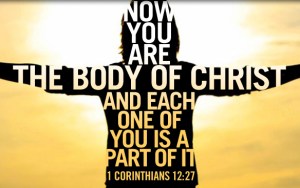
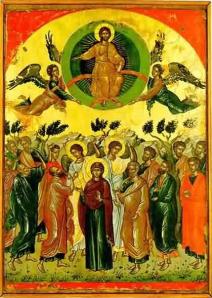





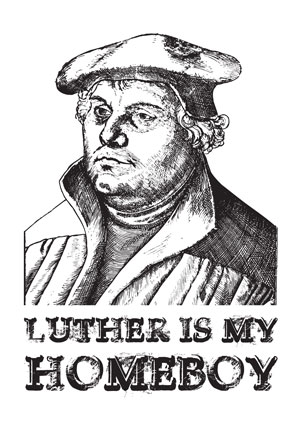
















 2pennyblog