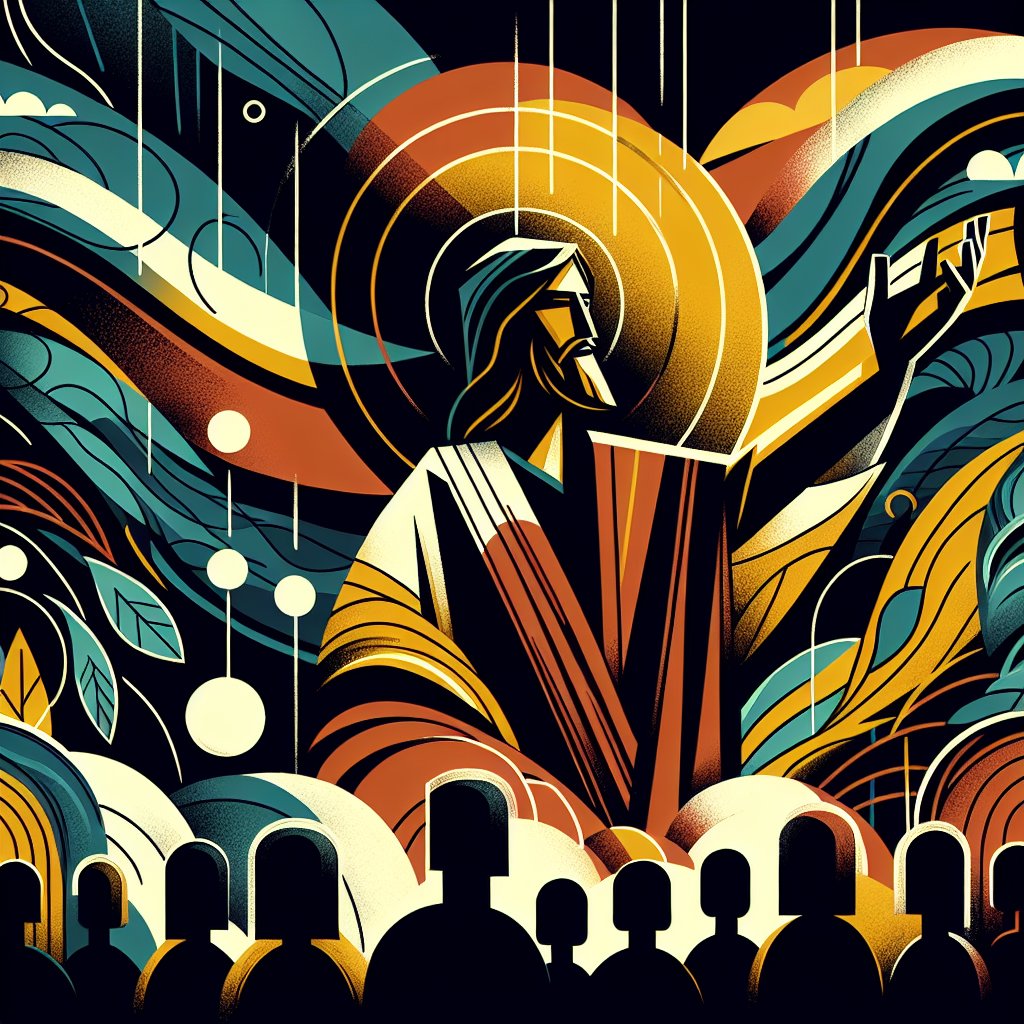
[Digital Art]. By Bible.Art.
The readings for the 20h Sunday After Pentecost, Yr. A were: Isaiah 25:1-9; Psalm 23; Philippians 4:1-9; Matthew 22:1-14. This sermon was preached at Grace & Glory Lutheran Church in Palmyra, VA on September 27, 2026.
Today’s Parable of the Wedding Banquet is no different than any other parables that you might come across. As discussed before, parables are part of an ancient teaching method where students or disciples are meant to wrestle with the story in community to find answers – hopefully the best or correct answer. This means there might be several interpretations for the parable in question – some better than others, some wrong, and yet all interpretations can be helpful in affirming or growing our understanding. We learn as we wrestle. And with all the things going on in the world, I wrestled a long time this week. What should I say and not say.
For example with this parable of Jesus, you might hear among traditions that require baptism before reception of the Lord’s Supper that the one guest who refused to wear the robe in today’s parable was unbaptized. Recall Galatians 3 where the Apostle Paul writes, “As many of you as were baptized into Christ have clothed yourselves with Christ.” That imagery of spiritual transformation into a new person is thought to be represented by the wedding garment. And certainly, at least for the first seven centuries of the Church, many Christian catechumens came to the baptismal waters in their regular clothes, stripped naked, and left wrapped in symbolic white garments as they exited. It was only then that they could participate in holy Communion. This would be known to later Christians and might thus hold some truth for them and us (or those who hold this interpretation of value among us), but this was not yet the practice in Jesus’ time. Thus, this might miss the primary mark that Jesus intended.
Another more modern interpretation is from what is called the Womanist tradition. Womanist theology is a religious and ethical lens that attempts to integrate “the lived experiences, survival, and liberation of Black women.” Three days ago, I came across a Roman Catholic article by Emily Sanna asked the question, “What if God isn’t the king in the parable of the wedding feast?”[i] Instead of focusing on the King and the King’s actions, some Womanist theologians invite us to instead focus on the inbreaking of “God’s just and peaceable Kingdom” first. Quoting others, the author unpacks her challenge accepting a God that seemed so judgmental and harsh as in the parable when one considers other teachings about a loving, fatherly, gracious God found in the Gospel of Matthew. And so, the author asks us to consider:
Matthew’s gospel is full of people who quietly resist state power. The magi go home by another way and don’t tell Herod where to find Jesus. Jesus enters Jerusalem on a donkey, not on a war horse. When Satan offers worldly power, Jesus outright refuses it. What if this man’s garments are another example of this same [kind of] resistance?[ii]
She ponders whether we sometimes have mistaken empire for God’s table.
And yes, we are indeed in a time of growing Christian Nationalism where one can blur the lines between national identities and practices. We can forget that we are part of a universal community of saints, meant to cross worldly boundaries just as Jesus taught. With such bent thinking, we might be tempted to ignore the suffering and needs of other non-US Christians, brothers and sisters to us, never mind the strangers and enemies we are asked to love by Jesus. Our primary identity is meant to be that of “Christian” above any other. It confirms much as John Chrysostom, a 4th Century Christian Bishop, who wrote to the people of Antioch long ago (alluding to Hebrews 11:10), “If you are a Christian, no earthly city is yours. Even if we control the world, we are still immigrants and foreigners, because our citizenship is in heaven.”[iii]
This attitude might also help explain why so many Christians can easily call others “heretics,” “schismatics,” or “apostates,” looking and treating their brothers and sisters in Christ as unredeemable rather than just lost, wrong or misled. Some Christians prefer offering the “yoke of the pharisees.”[iv] People become easily damned and not worth talking to never mind looking for, as the lost sheep that they might be to Jesus. Yes, in the United States, such folks currently tend to be from Evangelical and Baptist traditions, but liberal traditions, Lutherans and other Christians fall into this judgmental trap often. I can at times do that too if I am honest. Within our hearts, it is too easy for us to throw others who disgust or challenge us into hell…the outer darkness Jesus talks about today.
And sadly, as heard recently from Professor Pugh in his presentation at Grace & Glory, some prominent Christians today even argue for what’s called theonomy, a view that the judicial and civil laws of the Old Testament given to ancient Israel still apply and should apply to government. So, if one has participated in adultery, or proves an apostate in their opinion, or is homosexual or is worshipping other Gods (among other laws), you might deserve the death penalty in their minds. They say this out loud! And in the darker corners of the internet through my law enforcement and chaplaincy roles, I have seen these specific desires and threats expressed and planned. It is real. And yet, they somehow call themselves Christian, too.
Then, as this week’s news cycle brings up, many Christians might also forget that every life is sacred even the life of our enemies. (And I am a person who is speaking of this as both a former soldier and police officer, so I have wrestled with this for a long time.) Perhaps someone “deserves death” in a fallen world, but might they not be shown mercy anyway? As Paul argues in Romans 6, we all deserve death. He says that. We all deserve death because no one can fulfill the Law. We are saved by grace through faith alone, not our works. So perhaps we should not rush too quickly to kill others, even when seemingly deserved, or perceived as legal, or thought a just necessary action in our world. For, we ultimately defeat evil with good (Romans 12:21).
Nonetheless, if a government truly deems it a necessity to take a life within our fallen world using our imperfect justice systems – and no matter the country, they remain imperfect because they are made by humans – we might also like to remember our own Savior’s death. He was executed as public spectacle with many martyrs to follow him. Violence as found in the Roman Circus never honored the sanctity of God-given life. It diminished it. That was the intention. And perhaps that’s why totalitarian governments not concerned with Jesus’ teachings are those hosting public executions in modern times – Iran, the Taliban, North Korea, Saudi Arabia, and Yemen. This, too, should give us pause.
So, into this mix, I want to present to you a more ancient view stemming from Jesus’ own context when he first shared it. (It might help, and we can talk more late if you like.) Remember, this parable is offered during Jesus’ last week. He is now in open conflict with those in religious power, and they want to be rid of him. It follows on the heels of The Parable of the Tenants where the son of the landowner is murdered. Jesus explains it more clearly than other parables saying to hypocrites in power around him, “Therefore I tell you [those like the tenants], the kingdom of God will be taken away from you and given to a people producing its fruits” – spiritual fruits. Walter Wilson notes the clear imperial nature of Matthew’s framing, “interpreting the invitees as municipal leaders, ‘their refusal to attend the banquet as an expression of political disloyalty toward the royal family,’ and their violent treatment of the palace emissaries as ‘an act of sedition.’”[v] So, this parable might also be intended to target those religious leaders standing before Jesus for their ongoing actions and attitudes toward “the least of these” (Matthew 25:40).
Although our God is a loving and gracious God, we should not ignore that the Jewish scriptures understood and Jesus taught about a time of eschatological (or End Times) judgement. Judgement Say is real, but this should not frighten us as Lutherans, for we understand and accept that we are still sinners although saved by what Jesus has done…only his works. Professor Carolyn Sharp (Yale Divinity School) rightly reminds us:
“This ‘outer darkness’ [referred to in the passage] occurs also in 8:12 and 25:30 (and not in the Lukan parallels) as the eschatological destination of ‘heirs of the kingdom’ who have proved to be faithless or incompetent stewards of that which has been entrusted to them. The threefold iteration of the motif underscores how serious Matthew is about end-time torment awaiting those who dishonor the invitation of God’s grace.”[vi]
We might also discover the astonishing news that this eschatological banquet serves a bulwark (a protection) against all darkness.[vii] This promised celebration will come to fullness during a time outside time within a new heaven and earth where all tears will be wiped away (Revelation 21:4). Our God is a Mighty Fortress just as we Lutherans so often sing.[viii] Just like Isaiah proclaimed in his writings today. God is a mighty fortress protecting us.
Yet, we cannot become complacent. In our ongoing imperfection, we are to confess our sins and return to the Lord each day…every one of us. Here, Matthew is drawing upon earlier Jewish texts, for “Even those who had accepted the invitation of God but are spiritually unprepared are at risk. In this light, the [witty but truth-filled phrase] ‘Many are called, but few are chosen’” is as it appears in 4 Ezra 8:1, 3 and here in Matthew 22:14. It is meant to be absolutely chilling and challenging to each and every one of us who follow Jesus.[ix] We should look at ourselves and examine our behaviors. Are we loving the least of these well? Are we reflecting the Spirit’s fruits?
As Dietrich Bonhoeffer discovered in the time of World War 2 Germany, the Church becomes too easily filled with people who accept a counterfeit or deformed Gospel; accepting cheap grace with no implications or actions expected in response. We humans can become spiritually lazy rather than striving to be Christ-like with the Spirit’s help.[x] For loving others is hard. No one denies that. It is often against our human nature.
Despite failures, it remains true that in Genesis 3, God made garments of skin to cover Adam and Eve, a sign of God’s grace amidst their own rebellion. There are many instructions and commands regarding the use and care of religious garments in the Jewish scriptures.[xi] Garments were thought to reflect one’s tribe and one’s purpose. In the Psalms, God’s loving activity and light is often compared to a garment. And the prophets speak of putting on the Lord’s splendor like a garment. So, the original listeners could have made many complimentary interpretations.
Thus, I propose to you that the garment is meant to define who we are and who we trust in through faith; faith itself being a gift reflecting that garment worn. One modern Orthodox resource alluded to Baptism, but more so, the author argues we will be examined at the End of Time to see if we have shared in a life of repentance within the Church. (Of course, in his mind, it is only the Orthodox Church alone that’s the Church, but I would suggest this applies to the universal Church.). Did we hunger for God’s mercy? Did we share it with others as we were first loved?
Indeed, Pope Gregory the Great (c. 540 – 12 March 604), a Pope before the breaking of Christendom into East and West, who is commemorated for his Christian life and witness on our ELCA calendar on September 12 each year, argued in a sermon that ultimately the garment is God’s love…God’s transformative love. For, “[Jesus] came as a bridegroom to unite Himself to the Church. There was no other means than God’s love by which the Only-begotten could unite the souls of the elect with Himself. This is why John tells us: God so loved the world, that He gave His only-begotten Son (John 3:16). He who came to [humanity] for love’s sake, calls this love the wedding garment.”[xii]
Of utmost importance, to Gregory, echoing Jesus’ teachings on fulfilling the Law (including in Matthew’s Gospel), this garment has two threads: the love of God and love of neighbor. As Jesus taught in Matthew’s account, this is the greatest commandment. This doesn’t necessarily exclude one referencing the Baptism, the Eucharist, or political and social realties that surround us, but that explicit connection seems a bit forced if Gregory the Great’s argument and many other ancient arguments like it hold true.
Matthew’s Gospel was first written for a Jewish Christian community struggling to find their way forward after the Ascension of Jesus and the faith-challenging destruction of the Jewish Temple by the Romans. They were being thrown out of Synagogues and their families, often persecuted. And yet amidst this uncertainty and perhaps because of it, this time proved perfect to celebrate a foretaste of the feast to come, “the banquest” to come – gathering with the saints to remember Jesus in his appointed Supper, feeding the hungry, healing the wounded, seeking the lost and lonely, visiting those in prison, and offering forgiveness, patience and love to all those trespassing against us, even our enemies.
This is absolutely not the world’s way, but it is the way of the divine Kingdom as Jesus presents it during his first discourse in Matthew, the Sermon on the Mount (see Matthew 5-7) with the Beatitudes. And that passage helps us interpret all that follows. We are no longer to be dressed as wolves in sheep’s clothing (Matthew 7:15), for we have been made new, clothed in Christ’s love. This new garment, Christ’s love, changes our relationship with God and others forever.
Yet know that as with any new clothing, this gifted garment might feel awkward at first as we try to love.[xiii] Growing into it can prove an inside out process to make it fit better supernaturally over time. The Spirit uses our trials, our errors, and our repeated repentance to help perfect us. Rather than offering any perfect, instantaneous holiness, we are invited to participate in this divine movement toward ultimate perfection.[xiv]
Still, we are invited and included to the banquet all the same. We don’t have to give up our seat or fear being cast out because of our struggles with sin. We sinner-saints can celebrate. For as Jesus has taught just shortly before this parable, it is not the will of our Father who is in heaven that one of his little ones should perish (see Matthew 18:14 and 2 Peter 3:9). We can seek to love without fear, as Jesus loved us. Amen.
[i] Sanna, E. (October 8, 2026). “What if God isn’t the king in the parable of the wedding feast?” U.S. Catholic [Digital Edition]. https://uscatholic.org/articles/202610/what-if-god-isnt-the-king-in-the-parable-of-the-wedding-feast/
[ii] Ibid.
[iii] John Chrysostom (c. 387 AD). “Homilies on the Statues” [Homily XVII, section 2 or similar text depending on the translation].
[iv] See Matthew 23.
[v] Sharp, C.J. (October 2026). “Commentary on Matthew 22:1-14.” Working Preacher. https://www.workingpreacher.org/commentaries/revised-common-lectionary/ordinary-28/commentary-on-matthew-221-14-10
[vi] Ibid.
[vii] Ibid.
[viii] Consider the lyrics of A Mighty Fortress is Our God based on Psalm 46.
[ix] Ibid. Sharp, C.J.
[x] I suggest one read The Cost of Discipleship for more on this subject.
[xi] Much of the below is adapted from a blog post I wrote in 2020. In discussing Holy Communion, this parable came up. https://2-penny-blog.com/2020/02/11/whose-dressed-properly-for-communion/
[xii] Gregory the Great. “The Wedding Garment: An excerpt from Parables of the Gospel by Pope Saint Gregory the Dialogist.” OrthoChristian.com. https://orthochristian.com/106276.html
[xiii] Taylor, P.S. (June 14, 2015). “From Robes to Skin: When Christ’s Righteousness Becomes Ours.” Seedbed. https://seedbed.com/from-robes-to-skin-when-christs-righteousness-becomes-ours/
[xiv] I suggest a modern classic text by Dr. Larry Crabb, Inside Out, to explore this further.
Below, please find a video of our worship service. The sermon starts at about the 25:10 minute mark.
© 2026 The Rev. Louis Florio. All content not held under another’s copyright may not be used without permission of the author unless under terms of fair use and properly attributed. Scripture passages when used are from the NRSVue translation unless otherwise indicated.