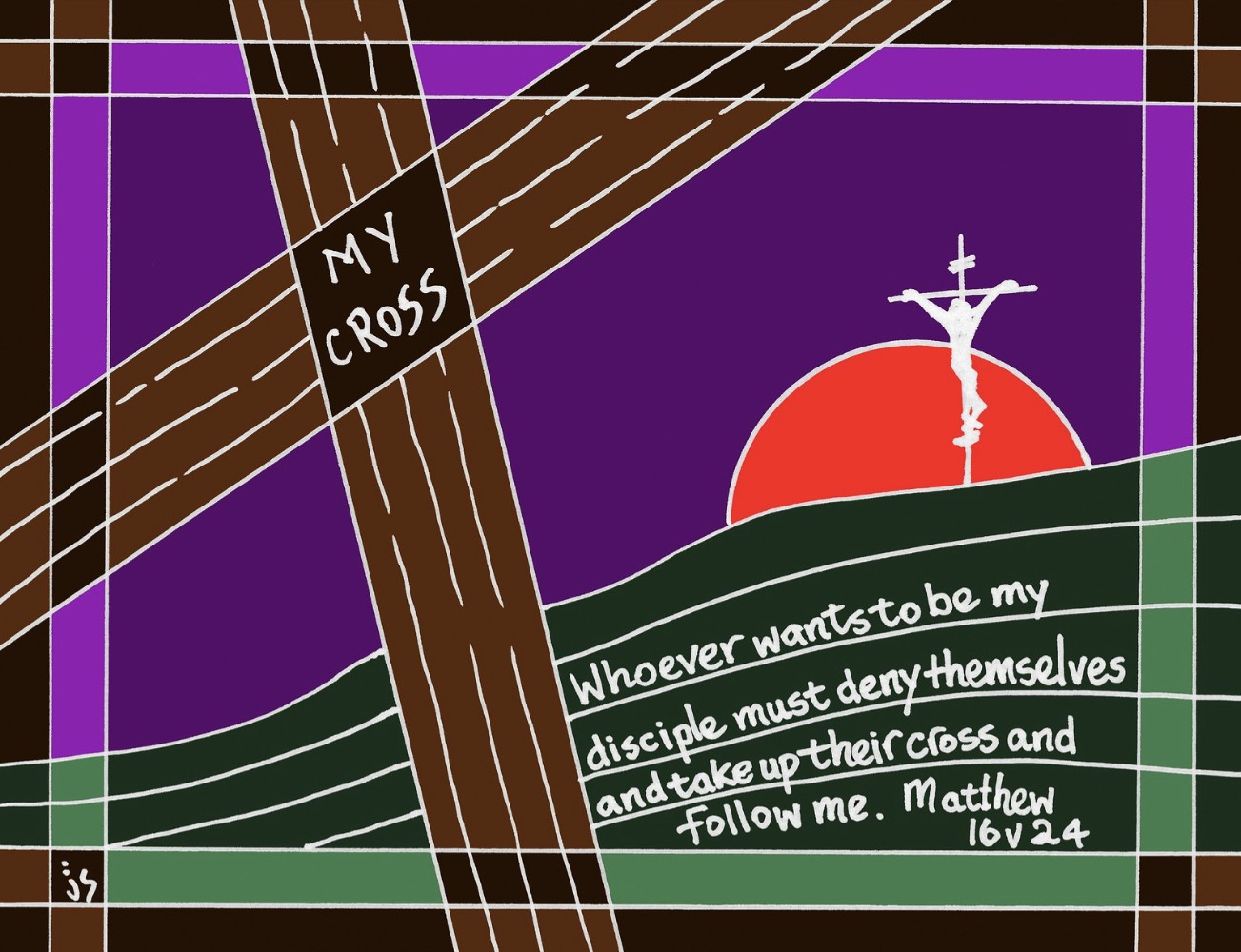
The readings for the 14th Sunday After Pentecost, Yr. A were: Jeremiah 15:15-21; Psalm 26:1-8, Romans 12:9-21; Matthew 16:21-28. This sermon was preached at Grace & Glory Lutheran Church in Palmyra, VA on August 30, 2026.
Those of us old enough might remember the Oprah Winfrey Show while it was on the top of the television talk show pyramid. (That’s back in what might seem like the Dark Ages of television.) The show became particularly noted for the iconic, over the top gift giving segments. For those that don’t remember or maybe never heard of her (this is a possibility today amidst younger generations), Oprah would often give away to the audience products she liked and had profiled one her show.
And if one was really lucky, you might be there when Oprah gave cars to the entire audience. She would say what became almost a tagline and sometimes was made into a joke, “You get a car…And you get a car…and you get a car. You are all getting cars!” And the audience would go wild…Well, at least until the tax bills came.[i]
Well, there is no new car for us in today’s Gospel, but there is a cross. Jesus tries to tell us that in following him, you get a cross…and you get a cross…we are all going to have our crosses to bear. And if that doesn’t excite you, you are not alone. The disciples, too, found this to be a very difficult teaching. And even Jesus in the Garden of Gethsemane asked his Father in Heaven to avoid his cup of suffering and sacrifice…a violent, torturous death on a very real cross.
Yet Jesus’ response was ultimately very different than his disciples. In his humanity, Jesus prefers not to carry his cross, but in his divine perfection being without sin, he does not give into temptation. He accepts his cross. In Matthew (26:39), Mark (14:36), and Luke (22:42), Jesus is tempted, but ultimately, he prays, “not my will, but yours be done.”
Here, I find a comforting lesson. Temptation, that urge or attraction toward something, is not in itself a sin but very human. Ruminating on a temptation can be dangerous, can make us weak, and giving into temptation can prove a sin. Yet everyone is tempted at times. As we see here, Jesus was tempted at times to take the easier road away from Calvary. Yet being without sin, he doesn’t let temptation take root in his heart or mind. He does not give into temptation. He casts it out like the demon’s tool that it can become. “Get behind me, Satan!”
Still, Jesus came to share in our lot including temptation. In fact, we see Jesus tempted throughout his ministry at varied points. Satan tempted him in the wilderness as he fasted at the start of his ministry. He felt tempted in the Garden of Gethsemane at the climax. But many people might prefer to forget the story we heard from a time in between. Peter, likely reflecting the angst of all the disciples, rebukes Jesus in Matthew 16…Think about that…He goes from recognizing Jesus as the Messiah, son of the living God a few lines earlier to rebuking…scolding…criticizing Jesus, his Lord. Peter tempts Jesus.
In response, Jesus angrily (but without sin) calls Peter Satan because that’s the role he is playing…the Tempter. Like Satan in the wilderness but without recognizing it (for sin often happens without our noticing it), Peter is enticing Jesus to veer from his divine path. Peter gets in Jesus’ way. In the original Greek, it specifically says Peter became a “stumbling block.”
Elsewhere in Luke (17:1-2), Jesus teaches, “Temptations to sin [specifically, he says “stumbling blocks”] are sure to come, but woe to the one through whom they come! It would be better for him if a millstone were hung around his neck and he were cast into the sea than that he should cause one of these little ones to sin [stumble].”
So, “Woe to Peter!” Peter is playing God saying what should and should not happen. Peter is being like Satan asking Jesus to ignore God’s will. Peter went from hero (proclaiming Jesus as Lord) to zero (not trusting Jesus) pretty quickly. In truth, so can we all when we seek to deny God’s will or encourage others to do so. This is our collective, shared woe as humans, too.
Yet, there is always Good News. Jesus forgives. Jesus takes this moment of great error to teach them all (and us) an important lesson. As with his first disciples, our crosses will come. Indeed, if any wish to continue to walk the way of Jesus, he says, “let them deny themselves and take up their cross and follow me.” To fulfill the will of God is not easy. To follow Jesus comes with cost. Yet, in humbly submitting to God’s will…in surrendering to Jesus as Lord and Savior…trusting in him…Jesus teaches that we can find abundant, eternal life even amidst what we might sometimes see as our trail of tears.
My goodness, this is a curious method to recruit followers, isn’t it? As a result, some Christians try to bait and switch in their evangelism efforts rather than accept it. They adopt a Theology of Glory, where there’s an expectation of and an over-focus on triumph denying hardship and denial of self as part of the way of Jesus. There might be a reliance on human reason, power, and moral works rather than God’s grace, the activity of the Holy Spirit, and Christ’s suffering on the cross. Among the worst-case examples, particularly popular in the US, Australia, and South America, you have the all too attractive (but false) prosperity gospel. Like the serpent in the Garden of Eden pointing to fruit, we are told that God will reward us with things of this world (an easy life, money, power, etc.) if we only believe hard enough and (most commonly) give enough.
In short, give money receive a blessing. Pray hard enough, be good enough, and get what we want. (Not necessarily what God wants. We decide.) And sadly, I’ve even seen a very Oprah-like move by some congregations right here in Virginia. As I have driven around along roadsides, I have found signs offering door prizes such as televisions and even once the possibility of a car if people would just come to the congregation’s Easter service. (I am not suggesting this to our Evangelism Team.)
Does this sound like Jesus to you? If we look at the life of Jesus, the first disciples, or the witness of the early Church under persecution, we should understand that God’s gracious will does not work that way. Jesus doesn’t trick his followers. He doesn’t bribe them. He speaks plainly of a Theology of the Cross. Particularly if following Jesus, one must expect a cross.
There is a saying widely attributed as being from Martin Luther, but it is likely an aphorism reflecting his teachings. (At least, I cannot find any citation.) It reads, “A religion that gives nothing, costs nothing, and suffers nothing – is worth nothing.” I saw someone I don’t know ask on social media in response, “Are we giving [God] crumbs?” Luther regularly wrote about how following Jesus would cost our old way of life. This understanding of faithful living connects us to Jesus’ cross and ultimately our salvation.
As Jesus taught, Luther argued for a Theology of the Cross – that we are to surrender everything, never seeking our own crosses, but accepting crosses as called. These crosses don’t save us. It earns us no merit for heaven. Yet, it is the way of our salvation as we follow Jesus and cling to him with all that we are – loving God and loving neighbor as ourselves with mind, body, and soul (or as Lutheran Pietists argued, our hearts).
And so, both the Jewish and Christian scriptures teach us that in facing hardship, we should live in hope. In facing challenges, we need to seek to hear and follow God’s will for God loves us. And today, preparing his friends for what is coming, in light of Peter’s confession of faith, Jesus tells them that not only is life generally hard, but we will also specifically suffer as we follow Jesus. Be ready.
Nonetheless, when facing our personal, internal, secret fears, or our real-world enemies, grave illness, or even the end of life, we might also be tempted to give up, lose hope, or try to save ourselves from unavoidable pain. Life happens, and unfortunately, there is sometimes no way around pain. We must walk through it faithfully. This means that we do what we can to make things better. (We aren’t asked to suffer for the sake of suffering.) And we are asked to try to be like Jesus amidst our challenges – forgiving, patient, kind, trusting in the God’s provision…even seeking to love and forgive those who anger or betray us as Paul writes the Roman community this morning.
Certainly, like Peter and the Apostles, we will fail at this at times. We will be brought to our knees by the weight of our crosses. Yet like Jesus did pressing up Calvery, we are urged to get up and walk. Reflecting upon this teaching, Brother Matthew, the current Prior of the Taizé Community, shared these words with some young pilgrims visiting last year; recognizing both our fragile humanity and our eternal hope:
“This evening,” he said, “we heard Jesus say to us, ‘Whoever wants to be my disciple must deny themselves and take up their cross and follow me.’ It is not about denying who we are as people, but of fixing our eyes on Jesus and walking with him. That may lead us to encounter the cross, but if we content ourselves with simply holding onto what we have, how can we discover the fullness of life, that life in the resurrection, that he offers to us all? Are we ready to take the risk of following Jesus at each moment of his journey? That is the challenge that lies before us all.”[ii]
My friends, we are sharing in the ministry and path of Jesus. Jesus lives in us. As his body, the Church, we will face unfair things. Stumbling blocks will come. People will betray us. We might even face forms of ridicule or persecution as we seek to follow Jesus. For we are one with Jesus now, through our faith and baptism, even while living in a fallen, unfair world.
Yet when we are at our lowest, remember the treasure of our faith. With the weight of the world seemingly crushing us, we are asked to raise our heads…to expectantly watch and wait. For, we don’t just have a cross. We have a Savior who loves us enough to die for us, and he will pick us up and carry us when we fall. Just as his suffering body, the Church, proclaims and sings, Jesus is always with us, even as he is coming soon and very soon.[iii] Amen.
[i] Oprah Winfrey’s 2004 car giveaway required participants to pay between $6000 and $7000 in Federal and State taxes. This was difficult for some to do. See for example: https://www.forbes.com/sites/kellyphillipserb/2016/09/13/a-look-back-at-oprahs-ultimate-car-giveaway/
[ii] Br. Matthew of Taizé (August 21, 2025). Remember the Treasure of Your Faith. https://www.taize.fr/en/remember-the-treasure-of-your-faith.
[iii] See Revelation 22:16-21. This inspired the hymn by Andraé Crouch, “Soon and Very Soon.”
Below, please find a video of our worship service. The sermon starts at about the 25:40 minute mark.
© 2026 The Rev. Louis Florio. All content not held under another’s copyright may not be used without permission of the author unless under terms of fair use and properly attributed. Scripture passages when used are from the NRSVue translation unless otherwise indicated.