Tag Archives: god

Welcoming Jesus (Sermon)

Photo by KOBU Agency on Unsplash

The readings for the 5th Sunday After Pentecost, Yr. A were: Jeremiah 28:5-9Psalm 89:1-4, 15-18Romans 6:12-23Matthew 10:40-42. This sermon was preached at Grace & Glory Lutheran Church in Palmyra, VA on June 28, 2026.

In the mornings, I like to scan for breaking news using social media. This morning, I came across a lay person who I know to be active in the Anglican tradition say that if she were preaching, she would focus on our text from Romans. She said people just don’t hear enough about our need for salvation from sin.

Well, that’s true. That can happen. People can sometimes focus solely on the good stuff. Martin Luther called that the Theology of Glory. People skip the need for the cross and go right to the resurrection. Yet, we are Theologians of the Cross as Lutherans. We should be thinking about Law and Gospel always going together.

So in the comments that followed, several people indicated that they would indeed preach on Romans, but one person went so far as to say that if pastors did not preach on Romans they are cowards. Whoa! I thought, “Wow, that’s some Law for you right there.” Yeah…I am not speaking of Romans today. For one thing, we are Lutheran, and Romans is a critical piece of Luther’s on transformation. And so, we speak of that a lot as Lutheran because of its historic importance to our “Lutheran lens.” Also, I think we need to hear about these three short verses in the Gospel. We need to consider how our sin plays into that…how our acceptance of others and offerings to them is something done in effect to Jesus.

So, let me explain. We use what is called the Revised Common Lectionary to guide what texts are covered in our worship services, we do so with many other denominations and individual congregations.  These groups and other people use this lectionary (or list) because we wish to focus on the same texts during worship. It is a sign of our ultimately universal or catholic unity of faith. More than that, it helps us live into our unity more concretely. The Spirit working through scripture seeks to shape the Church and call all to Jesus. Yet, any lectionary is ultimately an arbitrary list discerned by scholars and pastors with the help (hopefully) of that Spirit.

And so sometimes, we have passages that are very difficult that might not otherwise be chosen by pastors and worship committees. Or, this lectionary might break up the sections of scripture a bit differently than your Bible editors might to help better fit the scriptures to the season or echo themes between the Old Testament, Epistle, and Gospel texts. And then like today, one can presented with an extremely short passage and wonder why.

These short sections of scripture might seem easier to digest or quickly understand, but I would suggest that we might be fooling ourselves. We possibly will not be discerning properly in our rush toward understanding. Remember that each book of the Bible, section, paragraph or verse is incredibly rich. As a Puritan reminds us, “God is still speaking,” through those words. We might need to slow down and listen better for the Spirit. Don’t assume it is easily understood because it is short.

For today’s three lines, varied translations of scripture (ultimately the boards that created the NIV, NRSV, and other translations) provide us with headings to help us focus on an understanding of what comes next. The headings you find are not scripture, nor are the verse numbers (the original Greek and Hebrew have no verse numbers), but additions. Yet supplying us with these headings, each can do so a bit differently. For example, in the Evangelical centered Amplified Version and Roman Catholic favored New American Standard Bible, their heading for today’s section of scripture is “The Reward of Service”…which might make sense considering the groups that like it tend to lean into work’s righteousness. The Common English Bible, the English Standard Version, and the NRSV used by the ELCA just say, “Rewards,” which might seem to indicate all kinds of benefits received through grace.  The work of “service” is removed. Meanwhile, the New King James Version used by Episcopalians and others offers the heading, “A Cup of Cold Water,” reminding us perhaps that the smallest efforts offered in love by us to others fulfills Jesus’ teaching. It is a sacred act.

Thanks to the wonders of the internet, I looked at numerous translations, and I was surprised that not one offered the heading, “Welcoming Jesus.” And yet, in my study and our conversation during Bible study, the word “receiving” truly popped out to capture my attention this time around. The Greek word used by Matthew only appears three times in the Gospels, and it is in this short passage. Like another recent Sunday’s Gospel lesson (from earlier in this chapter), there is an element of our being received or welcomed in Jesus’ name. As Paul reminds us, we are his ambassadors.

And so, recall that Jesus is one with us. We represent his name and authority. And like an emissary or ambassador, if we are rejected or mistreated as we come to others in his holy name, Jesus, too, is being rejected. Thus, he says, “Those who receive you [as disciples] are also receiving me, and those who receive me are receiving the one who sent me.” We are connected intimately with Jesus and his divine mission.

Then, Jesus indicates that those people who receive a prophet or righteous person in his name…people who represent well the faith, hope, and love that Jesus came to share and make concrete in our lives particularly through his Church…they receive the reward of those who have come to them in Jesus’ name. If a prophet, those welcoming him or her receive a prophet’s reward…Those welcoming a righteous person (and in Matthew’s use of “righteous” that is a person who who’s life demonstrates an active, internal relationship with God, characterized by mercy, compassion, and inward purity), well, the welcomer receives that reward. The great reward of these awesome followers of Jesus (the prophets and righteous ones) is graced upon those who receive them – just for the welcome! Their honor is shared with those who receive them.

We’ve heard earlier in the chapter that those who reject the servants of Jesus also reject him. Now, we hear that the persons who “receive,” “welcome,” or “accept hospitably” (that same word is used in the Greek for these meanings) the followers of Jesus receive the follower’s reward. In short, by welcoming people representing Jesus’ grace that is reaching out to them through these followers, the welcomer is welcoming Jesus.

As one commentator writes, “This discourse as a whole makes clear that God’s power is now at work not only in Jesus, but in and through his disciples.”[i] So, if you or I believe in Jesus and seek to share him through our words and actions, guess what? We are one with Jesus. We despite all our imperfections and sin, no matter our status, are in a spiritual sense Jesus going to others.

Yet, this passage is not just about sharing in and benefitting from God’s saving grace through our welcome of others. We share the faith that we receive through them. Yes, Jesus does speak about reward, but let’s unpack things further. What about our welcome of still others – the little ones? What about when Jesus sends us the people that need his love…has us cross paths with them…so that we can share what we ourselves have received? Well, we are to receive, accept, welcome, and be hospitable to them too. Jesus says, “…whoever gives even a cup of cold water to one of these little ones in the name of a disciple—truly I tell you, none of these will lose their reward.” So, if we are to take what we experience, learn and receive from other disciples…a lifesaving and nurturing drink of any kind…it is well with us. We are receiving and helping Jesus.

Yet, those “little ones” who Jesus identifies elsewhere as his  children proves to lie beyond his current disciples. His children or little ones include those marginalized by society, the sick and lame, those struggling with sin, the hungry, the imprisoned, the naked, the lonely, and more. About fifteen chapters later in the Gospel According to Matthew (remember it is one cogent whole, and scripture needs to interprets scripture), Jesus teaches, “Truly I tell you, just as you did it to one of the least of these brothers and sisters of mine, you did it to me.”

So clearly, it isn’t just the prophets, righteous ones, or imperfect ones, the children among us…all those Jesus loves need to be received, accepted, welcomed, and treated with hospitality…for Jesus came to draw all people to himself…He loves all people. Thus, this is why Martin Luther in a letter to his sick friend (the Elector Frederick of Saxony, in 1521) writes, “I cannot pretend that I do not hear the voice of Christ crying out to me from Your Lordship’s body and flesh saying, ‘Behold, I am sick.’” Our sufferings are shared by and born by Christ, thus he is in the suffering and one with them.

And if that’s not enough, oh boy, let’s really challenge ourselves. Let’s stretch our minds and hearts further. I am going to share one of my favorite quotes from an Orthodox saint, a nun known for her care of the poor and sick, Mother Gavrilia. Get ready…it is a dozy! …”If you don’t like somebody, remember that you are looking at Christ in the face.” Christ is in those we don’t like calling us to forgive and love our enemies…asking us to forgive and love him. So, for those Republicans or Democrats we judge harshly? Those who, for whatever reason, we think are a lost cause, or too hard to love, or a waste of time? Oh, man…Jesus is in them too…And you thought Elvis was everywhere…

No, Jesus, our Lord, one with our Creator, one with the Spirit that animates us, fully one with our humanity even as he remains fully divine…Jesus is here…God is with Us. In those who go to others in his name…in those who receive his servants…in his children, the little ones, who have so much left to learn or far to go, even all those we greet this afternoon…Christ is in them…calling all of us to accept and love him. Not only that, we are to grow deeper and more intimate in our love.

This truly ancient understanding that comes out of this was encapsulated and shared well by my spiritual mentor of sorts, Br. Roger of Taizé, in his writings. For example, he wrote, praying to Jesus, “Before we even knew you, you loved us.” And so, when we feel overcome by the world or our own struggles with sin, thinking our fire is going out…Br. Roger urged us to remember that we were not the one who lit the fire. Jesus is still there. And when we, the Church, seek to listen, heal, and reconcile, “it becomes what it is at its most luminous—a communion of love, of compassion, of consolation, a clear reflection of the Risen Christ.” 

In this ancient understanding of the Christian mystics, or Martin Luther’s understanding, or the Roman Catholic, Lutheran, or Orthodox belief…although sometimes regrettably forgotten or ignored by us as modern people…Br. Roger prays a prayer that we all can share in no matter how long we’ve been Christian, whether an inquirer or deeply intimate with Jesus, or just the person without faith yet first suspecting the there is a god calling them to rise out of their tomb…In doing so, he prays for us all:

Jesus Christ, Love of all loving, you were always in me and I did not know it.  You were there, and I kept on forgetting you. You were in my heart of hearts and I was looking elsewhere. Even when I remained far from you, you kept on waiting for me. And the day is coming when I can tell you:  Risen Christ, you are my life:  I belong to Christ, I am Christ’s.

Today, as we welcome people of all kinds and faith experiences to our installation service, or tomorrow as we serve others in our greater community, it is not just us being Jesus going out to love others. We are welcoming the Jesus in them. It is his presence alone that makes it possible to understand and love all life as sacred, and his presence that works through others to help save us.

Amen.


[i] S. Saunders. (June 2026). “Commentary on Matthew 10:40-42.” WorkingPreacher.org. Downloaded at https://www.workingpreacher.org/commentaries/revised-common-lectionary/ordinary-13/commentary-on-matthew-1040-42-7 on June 26, 2026.

Post Script: After the service, a few people came up to me to talk about how hard it is to forgive some people who in our view have committed grave wrongs. For example, what does one do about Hitler? Well, nothing I said above means that in the world there cannot be consequences. Lutheran theology has always recognized what Martin Luther called Two Kingdoms, “two simultaneous, overlapping realms through which God rules the world,” (Google AI), in effect the State and the Church. We also talk about three uses of the Law:

  1. The Mirror or Pedagogical Use points to our sin and need of saving, ultimately pointing us to Christ.
  2. The Civil Use restrains evil in society. It basically echoes the much later, scholarly Deterrence Theory. Threat of punishment can restrain sin.
  3. The Guide Use suggests that laws can help us as believers how to live a holy life and express their love for God. One might think of this as “spiritual disciplines,” but always remember that Lutherans do not believe we get “extra credit” for salvation or any saving benefit. Only Jesus saves in the Lutheran view.

So in the world, there can be consequences, and certainly the Bible teaches there is a Judgement Day. We know, as Luther argued that those who trust in Jesus are saved. Beyond that, we risk being unscriptural. On that day, God judges, not us. I am not a universalist, even as I hope those who are lost will experience the mercy of God as I have in my own salvation. The Bible does teach about judgement, and we can not ignore it. Yet, God is more than fair. God is gracious. God is love. So, be ready for surprises.

Yet as we interact with those who have offended and meet out human justice, we seek to always remember a desire for repentance and redemption in that person’s life. We want to protect the community, but we also want to try to remember that there is no justice without mercy. We strive to forgive and want the best for them which includes a relationship with Jesus. If force is necessary, we use the least amount to stop the behavior.

Offering forgiveness is something that also blesses us freeing us from anger which can lead to sin. And if we struggle to do so? Remember that anger is not a sin, but we can be tempted to sin through it. If we do, confess your sin and try to sin no more. Pray for your enemy, the people you are struggling to love. I find that helps free me. Go to a trusted friend, pastor, counselor, or spiritual director to confess your struggles. Yet know, forgiveness might not come fully in some cases. Some offenses are so toxic or harmful they can continue through your life – at least at times. Still, your willingness to work toward forgiveness will result in more peace in your life. Last but not least, some people will never repent or do better. It is ok to shake off your sandals and move on as a last resort, but try to remain open to reconciliation. Ask God to help you.

This is a difficult teaching, but that is exactly why I wanted to speak to it during this sermon. When we sense we are resisting to love someone, it is Jesus who we are ultimately hurting. What we do for or to the least of these, we do for or to him.

Below, please find a video of our worship service. The sermon starts at about the 19:05 minute mark.

© 2026 The Rev. Louis Florio. All content not held under another’s copyright may not be used without permission of the author unless under terms of fair use and properly attributed. Scripture passages when used are from the NRSVue translation unless otherwise indicated.


Leave a comment

Filed under Uncategorized

Valued More than Swallows (Sermon)

The readings for the 4th Sunday After Pentecost, Yr. A were: Jeremiah 20:7-13; Psalm 69:7-18, Romans 6:1b-11; Matthew 10:24-39. This sermon was preached at Grace & Glory Lutheran Church in Palmyra, VA on June 21, 2026. Without any children present, I still wanted to share some of my intended talk with the adults, the “older children of God, as I suspected it would be of interest and a help. So, this sermon is longer than my normal length due to integration of my children’s material.

I was hoping some of the younger children of God would be here with us today, because I was going to show them something…a picture…a picture that was taken for our Office Administrator’s, Cindy’s, seat. Out the office window, there is a lovely bush (a butterfly bush), and there must have been five to six beautiful Goldfinches in that bush. And then one day when I was driving home last week, I was passing the bridge over Lake Anna, and I saw this big, majestic Bald Eagle swoop down, hit the water, and fly off with its prey. Very cool! And then this morning driving to church with my wife, we are driving in and this Turkey Vulture flies up from the side of the road and almost gets hit by our car. That’s not the best ending to the week if that was to happen, but I think it is ironic or some kind of synchronicity that I encounter all these birds, and in the Gospel, we encounter Jesus speaking about two Sparrows.

When we think of God, we often think of Eagles, those majestic birds. Yet, Jesus often speaks about the smallest of birds. We can walk through our day, hear them singing, and we don’t even notice them! They are just part of our background. Yet, Jesus sees them all.

Recall, that just five chapters before in his Sermon on the Mount, the first of five discourses recorded in Matthew, Jesus presents the Beatitudes. As part of that gathering on that mountaintop, he tells the crowd, “Look at the birds of the air: they neither sow nor reap nor gather into barns, and yet your heavenly Father feeds them. Are you not of more value than they?” (Matthew 6:26). And today in chapter 10, what does he do?  He tells us that we are of more value than two sparrows. It is very similar.

Jesus uses this very common imagery of small birds to reassure us of God’s great love for us. Today, he wants to reassure his Apostles (for that is who is talking to) that they are loved despite the bumpy road ahead. Certainly, God loves all of God’s creation, but God loves us more. This repetition or echo of teachings found in chapter five and chapter ten might just be a flag calling us to pay closer attention…to look deeper into this passage today.

You might recall that Moses received tablets with ten sayings on a mountain top. Centuries after Moses, Jesus gives sayings to a crowd on a mountain. Notice, Moses receives from God ten sayings as a prophet, but Jesus speaks or gives sayings to the crowd as God. He does so to help people start to realize with this echoing of the past his authoritative, prophetic status, and to help build a foundation for his new community that’s going to be called Church. The way Matthew tells his story, he hopes that people will start to understand the divine import of Jesus by seeing such parallels.

Yet, the beatitudes, this gift that Jesus presents to the crowd and to us, his Church, aren’t about what we do as the Law of Moses was. (“Thou shall or shall not…”) They are about what God does to bless us by grace through faith within even the most difficult of situations. Jesus wants us to reflect God’s blessings at all times. At the communion table, we often pray, “It is good at all times and every place to offer our thanks to God,” right? Jesus wants us to live into God’s blessings…as his Children…because that’s what we are now. In Matthew’s Gospel chapters five and six prove the lens we need to better understand what comes after in his account.

So as Jesus continues his discourse to expand upon these all important sayings, he says that we should not worry about how we might succeed or even survive. Worry about the future? No! Avoid that. Try to pull yourself back from that ledge. Don’t let fear hold you back. Yet, don’t fear guilt because you are afraid. God gave us that emotion to help us interact with and process our world. Certainly, fear too can be a gift helping us to preserve our life or the lives of other…Fear can save our behind…It is fear shouting, “Look! Danger! Do something!” Nevertheless, fear should never stop us from following God’s will. For we are loved and provided for by God, just like those vulnerable, almost powerless birds and lilies of the field.

So, my flock, vulnerable as we are, we need to listen closely to Jesus’ words today. If we have faith in Jesus…if we dare to follow him…he warns that there will be consequences. Oh, there’s already consequences living in a fallen world…everyone, everyone faces consequences of living in this fallen world…but just as the world rejects Jesus, don’t be surprised when it rejects us.

Using a rabbinical teaching style of his day, Jesus is saying we are his slaves – his emissaries, his ambassadors, or messengers if you prefer. We serve Jesus, and we represent Jesus in the world. And we are being sent in his name. Thus hen we go out into the world (whether to the golf course, work, or school), in that ancient mindset, we fully represent him. In that honor-based society, if we, as his representatives, if we are dishonored by others, it is as if someone is doing something to him.

In the face of this, Jesus says, “Expect it.” It is going to happen sometimes. Expect dishonor. Expect family rejection, and religious persecution, or scorn, being made fun of, being gossiped about…expect it. Expect that in following Jesus, people might misunderstand us enough or hate us enough to even kill us. And we are lucky enough to live in the United States that the threat of death is not always before us, but our brothers and sisters in other parts of the world still do. In trying to love in a world that so easily rejects love…rejects Jesus…there will be costs…The costs might vary, but there will be sacrifices that we have to face.

And just as in the Sermon on the Mount, in chapter 10, Jesus responds to the fear that we might rightly feel as humans. “Do not worry,” he says. For we who follow Jesus…who are his slaves…belong to Jesus. More than that, we are one with him…one with Jesus! And that’s exactly what Saint Paul describes to us. In some passages Paul calls us slaves to sin, but in others slave to God. In faith, we are to be totally dedicated and seeking to follow divine direction as we love those who Christ has entrusted to us, for we belong to Jesus. We represent him in the world. Yet as slaves to Jesus, we are also one with him. And if we die to ourselves or die as martyrs, it is ok. Paul writes, “For if we have been united with him in a death like his, we will certainly be united with him in a resurrection like his.” We are now dead to sin and are alive to God in Christ Jesus. We are something different, fully the Children of God…and thus ultimately free to live, love and serve as called.

We who are called by Jesus to follow him are deeply and intimately loved, for he is one with us. And God chose to create us and call us out of love and delight to accomplish God’s will in the world. So, to help mitigate our justifiable fears, Jesus compares us to sparrows. In those days, sparrows were considered insignificant. As many as they can be, they are small and vulnerable to the environment, carnivores, and other birds. In addition, in Jesus’ time, they were common food for the poorest of the poor. Thus, sparrows have been called “the Poultry of the Poor.”

Additionally in the Torah, the Law of Moses, sparrows could be the poor person’s offering at the Temple, instead of more costly animals. According to Leviticus 14, sparrows were particularly prescribed for sacrifice by lepers…the feared, homeless, isolated, and poor as lepers. As one commentator writes, “The most remarkable thing about sparrows is probably how unimpressive they are. Although you may have seen thirty of them today, you may not have noticed a single one.”[i] Still as with the other birds of the air, or lilies in the field, and now just two small sparrows, God notices. God sees. God cares. More than that, God saves. Yes, “not one of them will fall to the ground apart from your Father.” They are caught within God’s loving gaze, attention, and care…And that’s exactly what Jesus promises for those that believe…who trust in him. And that’s exactly what Jesus promises for those who believe in him.

In the Hebrew scriptures, one of the names we hear for God is el roi (pronounced el raw-EE) which means “the God who sees.” Hagar, the concubine of Abraham who was cast out from the tribe due to Sarah’s jealousy, alone and unseen in the wilderness, uses those words to name God.[ii] At risk of death, alone and afraid, she was rescued by the intervention of an angel who also announced she would give birth to Abraham’s other son, Ishmael. In her suffering, without hope and alone, she understands after this experience that she was seen by God in her suffering all along. And so, she calls him el-roi (the God Who Sees) in her prayers of thanksgiving.

And el-roi sees us, too, even within our doubt, darkness, and suffering…even when we try to run away in our sin like Adam and Eve in Paradise in their shame after eating forbidden fruit. Even when we just feel small and powerless, God sees us and loves us. God seeks for us. More than that, Jesus promises that we who follow Jesus…who serve as his ambassadors and share in his death…We belong to Jesus. He will never let us fall beyond his love’s reach. Never! We are intimately loved and cared for…even when we think we are alone and God has abandoned us…whatever wilderness we find ourselves in. Yes, “even the hairs of your head are all counted” (Matthew 10:30). We are precious to God and loved as if by a perfect mother or father.

Yet since we believe and trust in Jesus, the world naturally rejects us to…For, we are in the world but not of it (John 17:16). We are Jesus’ flock. (Whether you prefer bird or sheep imagery, we are his flock.)…We are no longer slaves but God’s children (Galatians 4:7)…We are claimed as his family. Jesus said, “Whoever does God’s will is my brother and sister and mother.” Saved through our faith and baptism, that’s who we are now! We are saved, sent, and ultimately safe because of Jesus’s steadfast love for us on Judgement Day…whatever we have done or failed to do.

Yet at the time that Matthew’s Gospel was first received, faith in Jesus meant people could be cast out of the family of faith (the Synagogues), their genetic family (as a friend of mine in Africa was), or even their greater community. To be one with Jesus, set one apart and often in opposition to others of this world. So, Jesus encourages us to hang on. We aren’t being called to conflict, but it will come to us since we represent Jesus. In faith, trust him with everything that we have. Don’t let any familial or other loss keep you from Jesus or what he calls you to do. Chose following Jesus first, even if it means facing death, even if dying to oneself as we sacrifice things to fulfill our mission assigned to us…Because as Jesus explains, “Those who find their life will lose it, and those who lose their life for my sake will find it.”

Look also at the prophet Jeremiah, heard from today as well. He was often criticized for suggesting the powers that be were in error. He shouted against the people of his time turning against one another and God. Doing so, he became a distraction that eventually led him to be viewed as an enemy. Until finally, he was cast in a pit to die, and once rescued, later jailed. When Jeremiah finally is released, he is not freed by his people. No, Jeremiah is liberated by the conquering Babylonians, and all those he loves are now in exile and the Temple and Jerusalem are in ruins.

As a human being turning to God, we often hear Jeremiah outline how he feels let down and in need. That’s why he wrote Lamentations. God has enticed and overpowered him, he says. Jeremiah could not resist following God, yet when he does? I can hear him saying, “What kind of trick is this, God?” He has become a laughingstock all day long; everyone mocks him. The powers that be and his people think he’s a joke – his family, friends…it seems that everyone has turned against him…And still then, likely through tears, he decides to trust God.

As Jesus warns us, that kind of rejection and dissension can happen when we try to follow God’s will for us…when we bear the name of “Christian.” Yet, it’s not the name per se. It is more than that. When reflect Jesus in what we do and say we will find the world against us at times. There are a lot of people that will cry out Lord, Lord! And not be saved.

Yet when all was said and done in Jeremiah’s story, we learn that God is big enough to use our enemies, even our imperial enemies, in his case the Babylonians, to do God’s will.[iii] God sees Jeremiah and his stiff-necked people and will save both of them. This is not because they deserve it, but God freely loves them. It takes some time…70 years!

Yet even then, God remains at work. The exiled Jewish people could not make sacrifices at the Temple which no longer existed. The Emperor intended to wipe out their religion and culture to fully integrate them. Many of that time wondered if there really was a God at all. “We are God’s chosen people, so how is this happening to us?” And, then the Rabbinical system began, and Synagogues were established in exile, to help the Jewish people remember their culture, language, and God’s love for them. They heard during their suffering God’s promises, and they hung on…with everything they had. And through that suffering and their faithful response to it, God made them more unified than ever before…more steeped in their faith…more faithful than they had been.

This is just the way God is…God has a steadfast love for us….never ending. We hear this promise throughout scripture. Before time began, at Creation, in Christ’s ministry, and in the world since Pentecost…God is love, and God freely chooses to love us. When Jesus has called us through his Spirit…we might struggle in faith…We might suffer for the sake of righteousness or in this Fallen World…but we are always seen and never alone.

As common as we are…as worthless we feel…or as sinful as we truly might be beyond anyone’s awareness…Jesus will catch us when we fall…like those small sparrows. For when we are one with Jesus through the gift of our faith and baptism, not even death can defeat us. Follow Jesus, we are told, serving and sacrificing as he asks each of us, because there’s nothing to truly fear. God is waiting to catch us. We…you…will not fall to the ground apart from our Father. Amen.


[i] Anon. “God of Eagle and the Sparrow.” Living with Faith. Downloaded at https://www.livingwithfaith.org/blog/god-of-the-eagle-and-the-sparrow on June 19, 2026.

[ii] Ibid.

[iii] Reid, S.B. “Commentary on Jeremiah 20:7-13.” Working Preacher. Downloaded at https://www.workingpreacher.org/commentaries/revised-common-lectionary/ordinary-12/commentary-on-jeremiah-207-13-6 on June 19, 2026.

Below, please find a video of our worship service. The sermon starts at about the 23:11 minute mark.

© 2026 The Rev. Louis Florio. All content not held under another’s copyright may not be used without permission of the author unless under terms of fair use and properly attributed. Scripture passages when used are from the NRSVue translation unless otherwise indicated.

Leave a comment

Filed under Uncategorized

Give Without Payment (Sermon)

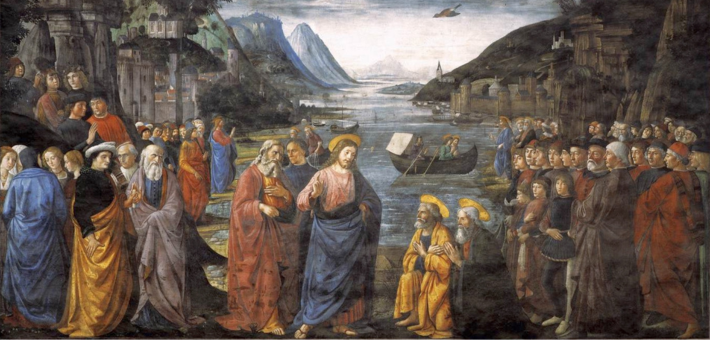
Image: Domenico Ghirlandaio, Detail from “Calling of the First Apostles,” 1481. via Wikimedia Commons.

The readings for the 3rd Sunday After Pentecost, Yr. A were: Exodus 19:2-8aPsalm 100Romans 5:1-8Matthew 9:35—10:23. This sermon was preached at Grace & Glory Lutheran Church in Palmyra, VA on June 7, 2026.

As the Twelve Tribes escaped Egypt with God’s help, we can sometimes wrongly assume too much about them. They did not initiate the Exodus on their own. It was God’s will…God’s loving actions freed them. Indeed, God’s intention all along was to rescue them due to God’s previous promises to Abraham, Isaac, and Jacob.

Yet after generations of slavery, they had lost themselves in those dehumanizing, traumatic, and I must emphatically say evil conditions…I have to say this because despite what people like Doug Wilson and others might be saying on the national stage or social media, slavery is evil and not the will of God. [Just because God tolerated our sin historically does not mean that’s God’s will for us. God wishes the slave to be set free.] And sadly, I know firsthand that some people still abhorrently and ignorantly try to use scripture to make that sin of slavery more palatable within our American history.

Yes, slavery can be on the personal level soul crushing, but it also serves an effective form of cultural destruction if not genocide. Empires and other entities throughout history have treated people like property, but they also in many cases, as with ancient Egypt, sought to erase those they considered “the other.” After the Israelites 400 to 430 year experience, the Israelites were not unified. They were more tribal (more divided) than when their sojourn in slavery began. Thus, God had lots of work to do. They needed time and care to recover from that horrific generational experience. The situation necessitated that they get to know and trust who God was again, but they also had to relearn how to love one another.

So, God would affirm Moses as their leader, God’s prophet, and eventually seventy elders would be appointed to help him. And God would soon (a chapter later) give them the Ten Commandments or as some of our Jewish siblings call them, The Sayings of God, to help build them up and shape them into the people of God our God intended. Yet, it is easy to miss what matters most. God names them saying, “Indeed, the whole earth is mine [everything including you and me], but you shall be for me a priestly kingdom and a holy nation” (Exodus 5c-6a). Deuteronomy recalls God naming them similarly, and perhaps most importantly, a lasting “Holy People of God” (Deuteronomy 26:19 and Deuteronomy 28:9). And within this naming, this proclamation by God, we discern their vocation which shapes all that comes after in the Bible including our Christian texts. God will steadfastly love and help them, but also God’s going to use them to spread faith, hope, and love throughout the Earth. Ultimately, God has set them aside for a holy purpose. Despite sin, despite failure and infighting, gossip and unfair criticism of one another…God will remain willing to forgive and intends to keep them part of God’s plan.

Now after this foundational context, let’s fast forward to our reading about Jesus today. It’s Good News. Jesus’ ministry is up and running. His capabilities and authenticity are starting to attract great crowds, and in the midst of these crowds, his heart is moved toward compassion. In direct opposition to what some religious but un-Christlike people are claiming in the United States these days, compassion is not a sin…Compassion is not a sin….We might err in how we offer our compassion, but Jesus who was without sin, Jesus had compassion on others…the poor, sick, the lame, the poor and cast aside.

We are told in English that these people were harassed and helpless. In the original Greek, the word for harassed literally means flayed, skinned or mangled. This wording as used here signifies that Jesus saw people who were “tired to the bone, continuously annoyed, and beaten down by life’s burdens including by too many of the religious leaders.”[i]  By helpless, the text means “thrown down, cast off, and abandoned…unable to pick themselves up again.[ii] Many of these folks were beyond desperate…some near death in body if not spirit. They were too often enslaved by sin, the powers of death, and the Devil. These many stories of healings, exorcisms, and other miracles accomplished by Jesus out of compassion will reveal him to be the promised Messiah, “God with Us” – but in a bigger way than anyone expected. And as people start to see…dare to hope…that there’s something special going on in and through Jesus, the fully human while fully divine Jesus requires help as Moses did before him.

You see, this work is physically taxing. You will hear that he sometimes needed downtime with prayer in the mountains just to recharge his human body as we all must do at times. Yet, his methodology is not pure circumstance. Jesus knows his mission. Jesus knows the time he has left to complete it and all the effort that will be necessary. And Jesus knows that he wants to create – not just a nation, nothing cultural or political per se – but a vastly expanded “Holy People of God” beyond anyone’s imagination which will ultimately be called, Church. Jesus has come to call all people to himself (John 12:32). 

Now, someone at the Lectionary Bible study asked a wonderful question that got me really thinking. He calls all people to himself, and yet, it seems quite peculiar and perhaps counter to his intention to instruct his new Apostles, “Do not go among the Gentiles or the Samaritans.” That is not in the other Gospels, only Matthew. And Matthew, a Jewish believer himself, was writing particularly for a Jewish-Christian community and those who might join them. If you want to help people identify Jesus as the Jewish promised Messiah to Jewish people, you help them through your story telling…the rhetorical focus of your written or spoken witness. You use these devices to point out things that you think will guide them to a correct understanding of Jesus as Son of the Living God, the fulfillment of all of God’s previous promises to the Jews.

Thus, the Gospel According to Matthew (his account or witness), is chalk full of scriptural citations pointing particularly to the prophets’ description of the Messiah. You can say, “Oh, that sounds like Jesus…that sounds like Jesus. Jesus must be the one promised.” When Jesus teaches, he reports that he did so and was recognized as if he was a wondering prophet or a Pharisee. They were called Rabbi, or teacher. Matthew tells the story in such a way that there are five discourses of Jesus. Five in ancient Jewish numerology already represented and helped identify something having a deep connection to divine power, spiritual elevation, and God’s interaction with the physical world. Jesus gave many discourses as a traveling rabbi. We should not assume there were just five, but Jesus embodies or reflects this cultural understanding and expectation. He wants his audience to come to understand that Jesus is God. Even Jesus being named Emmanuel, God with Us, reflects back to Isaiah, but also Isaiah’s understanding that no matter what happened to the kingdom or its people, God’s promise to Moses still stands. It would makes sense to Matthew’s earliest audiences that Jesus focused on the Jewish people first, for God had promised to “keep them as a treasured possession out of all the peoples” (Exodus 5b). Again, it was through them that all the world would be blessed. So, it makes sense within the Jewish expectation that the promised Messiah would go to the Jewish people first.

Yet in going to the Jewish people first, this does not mean Jesus did not love the Gentiles. His Church, despite hesitation and challenges, would grow out of the Jewish people and mix in people of all races and places where there is no longer Jew or Greek, nor male or female. Why? For as Church, “all of you [the Church, the saints, the Children of God…those saved by through the gifts of our faith and baptism] are one in Christ Jesus” (Galatians 3:28). God used the Jews to move toward a next step in unity, but God has not forsaken God’s promise to the Jews. And God is using us now, too, alongside those with the faith of Abraham. For according to Saint Paul, “For not all who are descended from Israel are Israel,” he says in Romans 9. Or Jesus says that not all who cry our “Lord, Lord!” will be saved (Matthew 7:21).

And so in Matthew 9, we see Apostles chosen and sent first to Jewish inhabitants of the land, but the mission won’t end with them either. Seventy disciples will be sent, then more, from the Jewish people to the Gentiles and throughout the Earth…until Jesus sends you and me. The needs are great, and there will never be enough workers in this world to heal all the pain and suffering. Yet, Jesus will finish this task…when he comes back again to establish a new heaven and earth. And while we wait, we serve. We love. We call others to work with us not using guilt or threat but by invitation. “Come and see. Come and help.”

We are asked to look at the way Jesus walked, and we are to listen to him, not only for our own spiritual benefit, but for the benefit of others. This is not for extra credit either. As Christians, we are supposed to understand and believe that even faith is a gift, and we cannot earn our salvation….not a smidgen of it. It is all about Jesus and what Jesus did. As Martin Luther famously said, “God does not need your good works, but your neighbor does.” What he’s saying is, “Have compassion on them…like Jesus. They are suffering. They are broken and wounded. Have compassion on them like Jesus.”

There are people in need, people without a shepherd feeling lost and alone, and Jesus wants to send you and me. Those people might “coincidentally” cross our path unexpectedly, or we might have to seek them out, but they are out there…It might be just one person that you are supposed to impact, but they are out there. Every sheep matters to Jesus. If you help just one person in your entire life discover Jesus’ love for them…Oh, my goodness. Your life is worth living. Everything you lived through was worth it for that one person who needs to know Jesus. Yes, people are waiting, hungering, to hear about Jesus and be healed. And in our Lutheran tradition, you might recall that we often speak of the priesthood of all believers. We might have slightly different calls, roles, and abilities…we might have different challenges…but Jesus calls us all to do something…something…out of his compassion for the world. 

Remember, the time Jesus walked the earth among us as a human being remained close to an indigenous worldview in many ways…It was still tribal and more connected to the natural world than we might be. So, Professor Zaccharias of Divinity College pointed out in an essay, “In many Indigenous cultures [and I have seen this too having worked in Native communities and nonprofits), leadership is not about hierarchy (Who am I in charge of?) but about service (Who can I help?). A true leader is one who cares for the people, ensuring their well-being. Much like a Wisdom Keeper or Medicine Man, Jesus responds to the needs of the people, embodying a leadership that is deeply relational and motivated by compassion.”[iii] And if you ever saw those eagle feathers that they wear, they can receive those for bravery in battle, but also for the compassion and generosity they show others. We, my fellow Holy People of God, share that exact, same sort of call.

Yet, before anyone starts to feel guilty about not doing enough, you like Jesus need to be realistic about your bodies and other limits, too. It is ok. You might need restorative time in the mountains. And like Paul, hopefully you understand that your call is not my call, and we each have our unique gifts of time, treasure and talent to offer, along with uniquely varied health, abilities, and obstacles. We have to discern what I can do. Furthermore, our calls can change. Being a pastor, for example, is not who I am but what I do.

Amidst this diversity of skill and need, laborers are indeed few. And just as there was an urgency to the Apostles mission due to the cross, there’s an urgency to our mission because Jesus is coming soon and very soon. “You received without payment; give without payment,” Jesus commands us. What can you, me, and all of those who believe do in thanksgiving for the grace and love that we have received? We are being asked to be as patient, generous, hospitable, kind, and generally loving as possible. We are asked to embody and share the Good News of Jesus until our last breath.

Rather than worrying about what we cannot do, consider what we can do. We are the called, chosen, and set apart people of God after all. Life might get harder. We might die before Jesus returns. Yet, we already share in Jesus’ victory. That’s God’s promise too. Be wise but be caring. Value justice but offer mercy. Be good stewards but also be generous. Be bold, but flee or step back if one must at times for our health or wellbeing. You will know when you need to be a martyr. Don’t assume. It is not selfishness to care for oneself if it helps us love God and others all the more tomorrow.

Friends, there will always be poor among us, and we will never get to everyone no more than the Apostles will reach all of Israel, but the promises of God last forever. The mission will be completed to its fulness on the Last Day by Jesus. And yet, he longs for us to share his compassion and love while we wait for the blessed day. Amen.


[i] Etheredge, C. (u.d.). How to Identify Disciples: Helping the Harassed and Helpless (3 of 3). As downloaded at https://discipleship.org/blog/how-to-identify-disciples-helping-the-harassed-and-helpless-3-of-3/

[ii] Ibid.

[iii] Zacharias, D. (2026). Commentary on Matthew 9:35—10:8 [9-23]. Working Preacher. As downloaded at https://www.workingpreacher.org/commentaries/revised-common-lectionary/ordinary-11/commentary-on-matthew-935-108-9-23-3.

Below, please find a video of our worship service. The sermon starts at about the 31:37 minute mark.

© 2026 The Rev. Louis Florio. All content not held under another’s copyright may not be used without permission of the author unless under terms of fair use and properly attributed. Scripture passages when used are from the NRSVue translation unless otherwise indicated.
Leave a comment

Filed under Uncategorized

Sharing Christ’s Suffering (Sermon)

Image credit: iStock. “Way of the Cross or Stations of the Cross, Jesus falls,” by rudall30

Readings for the 7th Sunday of Easter, Yr. A – Acts 1:6-14Psalm 68:1-10, 32-351 Peter 4:12-14; 5:6-11John 17:1-11. This sermon was preached at Grace & Glory Lutheran Church in Palmyra, VA on May 17, 2026.

On a beautiful day participating in worship with the birds singing and sun shining, it seems odd to be speaking about suffering. It appears out of place. Yet that’s life in a Fallen World – good and evil, beauty and ugliness, love and hate tend to be at odds. It is all part of our earthly existence. And so in the season of Easter, we hear for Christ glorified and are reminded of suffering through our assigned readings. Whether the time of Jesus’ earthly ministry or following Jesus today, it remains the same. This is not just “something strange happening to us” alone (echoing Peter’s words in 1 Peter 4:12). Until Jesus returns, we live in a time where the Kingdom is here, but it is not yet in its fullness. There will be suffering at times. We live within the tension of darkness and light waiting for Jesus to put an end to sin, suffering and death.

The Bible is filled with such real-world tensions, and they similarly stare us in the face today. Immediately before Jesus is betrayed and arrested in the Gospel of John…before Judas treacherously kisses Jesus…before his disciples run away in fear leaving him alone and abandoned…and before Peter denies Jesus three times…Jesus prays for his disciples. Jesus asks God to protect them. As fickle, weak and treacherous as his disciples might be at times, Jesus asks, “protect them in your name that you have given me, so that they may be one, as we are one” (John 17:11).

I find that sort of curious. This action of grace appears a bit shocking considering the upcoming disciples’ sin and lack of faith. Think about it…Jesus is about to face the biggest challenge of his earthly life…one that would in the most grewsome of ways end his human existence…and he chose to pray for those who had the propensity to let him down or abandon him…Yet, Jesus prays for his disciples amidst all their imperfections, because they are his sheep. They belong to him, and he loves them. And it is true that with God’s help all things are possible (Matthew 19:26). These disciples will yet be one as Jesus and his Father are one. And that to me seems quite profound.

As Jesus prays, he knows that he will be beaten then hung on a cross until death. That’s been part of the plan for his earthly ministry. His experience of the cross was necessary for some divine reason in order to help bless the world and save us. And to fulfill God the Father’s will, Jesus set his face toward the cross, accepting its indignity, the betrayal, and all pain that came with it, and he could not be turned away from it. Oh, he was tempted to, for remember he also prayed in the Garden of Gethsemane, “Father, if you are willing, remove this cup from me, yet not my will but yours be done.” Still, he could not turn aside. He asks the same of us. We, too, are to accept our crosses in faith.

Thus, to follow Jesus is not an easy gig. We are supposed to love as we are loved…impossibly perfectly. We are supposed to love our enemies and forgive…not easy! We are to seek justice with mercy, care for the sick, provide for the poor, love the aliens in our midst, and share what we have with others. Out of fear of not having enough, we sometimes hesitate. At other times, we are too busy or easily distracted. We are supposed to witness to Christ to the ends of the Earth reflecting faith hope and love…which can be awkward and uncomfortable…can take sacrifice. Sometimes, we are afraid to witness to our next door neighbor.

And especially for we Lutherans, we sometimes joke that sharing faith seems impossible. We are “the frozen chosen” – too stoic, too silent, too shy perhaps…uncertain of how to share our faith. And on our own, it is impossible to be confident…We will fail…BUT we are not alone…and God can transform even a Lutheran. For, Christ promises that he is with us. The Holy Spirit sanctifies, guides, protects, and even prays for us. Whatever we have done or left undone, we can move forward towards our goal just as Jesus did, seeking to bless others on our way. Loving them as they are is our start. Sure, we will fail Jesus like the first disciples did at times, but he calls us anyway. We don’t need fancy words or a degree. We need the authentic love of Jesus to shape our lives, and the willingness to take up our cross knowing that we might stumble and fall as Jesus literally did on the way to Calvary. Unlike God’s love, our love will never be perfect, but we need to try to love anyway. It is ok if we make mistakes, or stumble on our words, or don’t do so perfectly. Seek to love.

Now, sometimes suffering seems void of meaning. Bad stuff can happen to good people…all…the…time. It can happen. We can even cause our own suffering. And, Jesus taught that God the Father makes the sun rise on the evil and on the good and sends rain on the righteous and on the unrighteous alike (Matthew 5:45). What he is saying is what we often feel….This life is often unfair. Suffering is part of life.

And although suffering might come, we aren’t to seek out martyrdom or pain for its own sake. For example, Paul avoided arrest until he couldn’t, ultimately being put to death. Just like Jesus, he died when the time was right. And because suffering is not always glorifying Jesus but a consequence of evil, sin, and the imperfections of a fallen world, it can be just what it is…suffering with no redeeming value to our eyes. It stinks. It’s hard. It’s messy. And just like the prophet Jeremiah, we want to lament. And still even then, because God loves us, we are told that God can use suffering…even the most meaningless suffering for our good…somehow, some way, at the right time for our individual or collective good. It might lead us to knew relationships or opportunities or wisdom for just a few examples. Our suffering can be used to prove Jesus’ steadfast love for us and bring glory and thanksgiving to God in a way we might never understand until we are with Jesus on Resurrection Day…but that’s God’s promise.

Yet it doesn’t feel great when you are in the midst of suffering. The Apostle Peter knows this firsthand, and so does the community he is writing to. In their case, they are facing social hostility and family rejection. Those who have tried to attend Synagogue are being cast out and abused. There’s been unjust suffering because they believe in Jesus and are trying to shape their lives in a way to reflect his life and teachings. This is not just suffering but suffering for Christ’s sake. Yet, some are losing hope, and some are walking away.

This letter was meant to be circulated around the congregations of Asia Minor: “Pontus, Galatia, Cappadocia, Asia, and Bithynia” (1 Peter 1:1).  Recognizing that these fellow disciples are not of this world although still in it (John 17:16), Peter (tradition indicates it is Peter, but scholars debate this) addresses his readers by calling them “exiles” (1 Peter 1:1) and “aliens” (1 Peter 2:11) as the letter began. They aren’t going to fit in, and the powers of the world will rage against them at times, because that’s what happened to Jesus too. So, with great eloquence, he argues for us to do what we can but also hope…hope in the promises and steadfast love of Jesus.  

Seek to accept the suffering for what it is…often unfair. Grieve it, deal with it as best one can, confess to God that you don’t want this cup, but we are to humble ourselves as Jesus did in the Garden recognizing this suffering might not be avoidable. “Cast all your anxiety on him, because he cares for you,” Peter writes. No matter how big or small the suffering, no matter plain old suffering or holy suffering, Jesus cares about us…about you! God’s in the mix “working for your welfare not for woe” as Jeremaih similarly reminds us. Paul asked, “What then are we to say about these things [the sufferings of the present]? If God is for us, who is against us?” (Romans 8:31). Oh, our suffering is real, and it hurts, and I don’t want to suffer either, but it will come not just because of our vulnerability as humans but also because we are trying to live like Christ.

Yet, if we remember whose we are and who loves us, it can help us through. And if we don’t? Jesus intends to help us through anyway. That’s why he came. That’s why he accepted his cross. It is why he claims to be our shepherd, and he calls us his sheep, his children, and his brothers and sisters. He cares about us. He wills to save us. Trust this: suffering will never have the final say, God will…God has already spoken the final Word in Christ Jesus. God is a god who loved us enough to suffer and die for us.

So, even with all the suffering the world can send at us, even as we are down and out, confused or dismayed with our eyes filled with tears, our hearts sinking, and our heads spinning….at the point of giving up, remember this….Jesus cares for us…Jesus cares for you. Strive to make the next decision, take the next step, do the right thing and fight the good fight in Jesus’ name. Trusting that all will be well, seek to always follow Jesus. Yet, it is never really left up to us to succeed at this. It never was or will be. Jesus has already asked for our protection, for we are his, and he wills us to be one, as he is one with the Father. It will be so whether we can fully believe it or not. We share in his victory as gift through faith.

“And after you have suffered for a little while, the God of all grace, who has called you to his eternal glory in Christ, will himself restore, support, strengthen, and establish you. To him be the power forever and ever. Amen” (1Peter 5:10-11).

Below, please find a video of our worship service. The sermon starts at about the 19:20 minute mark.

© 2026 The Rev. Louis Florio. All content not held under another’s copyright may not be used without permission of the author unless under terms of fair use and properly attributed. Scripture passages when used are from the NRSVue translation unless otherwise indicated.

1 Comment

Filed under Uncategorized

Knowing the Unknown God (Sermon)

Image: The Via Egnatia, by Philipp Pilhofer – Own work, CC BY-SA 3.0,

Readings for the 6th Sunday of Easter, Yr. A – Acts 17:22-31; Psalm 66:8-20; 1 Peter 3:13-22; John 14:15-21. This sermon was preached at Grace & Glory Lutheran Church in Palmyra, VA on May 10, 2026.

In the Book of Acts, we encounter the early Church on the move. Starting in Jerusalem on Pentecost, we hear of its spread from person to person through large cities toward what was considered at the time to be the center of the world in every sense –  Rome. This movement depicts the fulfillment of Jesus’ command (if not prophesy) heard in Acts 1:8 that receiving power when the Holy Spirit has come upon them, his disciples will be Jesus’ witnesses to the ends of the earth. This is that exact same power that we receive through our faith and baptism. Our little church community is directly connected to this grand, miraculous, universal story…Our faith has come person through person, generation through generation, until the source of that story called us to gather here today including those on Zoom.

Also, please note that this movement was not haphazard even as it spread in unpredictable, sometimes uncontrollable, willy-nilly ways. Yes, the Apostles likely discussed and planned their evangelism. (There’s evidence of this in scripture.) Yet ultimately, it was Spirit-activated and led. Relationship by relationship, crisis through crisis, the Holy Spirit used people and circumstances…even what seemed the worst of circumstances…to introduce Jesus to the world…to make Jesus known.  

So just imagine St. Paul moving from town to town along the Via Egnatia, a primary Roman road connecting the eastern and western parts of the Empire. He traveled primarily (most likely) on foot, but occasionally by ship. On his way, Paul picked up work as a tent maker and leather worker to help pay his way, but it also introduced him to strangers who were soon to become his siblings in Christ. Paul traveled over 10,000 miles…hard to believe, but true…often with great risk and personal cost. Yet, he didn’t just pass through. He left a mark as his life touched the lives of others – the mark and seal of his own baptism, Christ’s cross was shared.

Certainly, the growth of the church was facilitated by the modern roads and ships of that time, just as the digital age helps us get the word out, but it was ultimately ordinary people who brought the Good News to others that proves critical. Someone must speak of Jesus for the Good News to spread. Someone must model his love and make it concrete in a world so in need of love. The prophet Isaiah rightly proclaimed, “How beautiful on the mountains are the feet of those who bring good news, who proclaim peace, who bring good tidings, who proclaim salvation, who say to Zion, ‘Your God reigns’” (Isaiah 52:7).

In knowing the “unknown god,” we inherit some responsibilities. According to the theologian, Carl Braatan, and others, our very own Martin Luther saw the Church as “an acoustical affair” (ein akustisches Geschäft). Echoing Romans 10:17, Luther emphasized that faith primarily comes through hearing the preached Word of God, rather than through visual spectacles, works that we do, or any internal contemplation. “Stick your eyes in your ears,” Luther is reported to have said. Rely on the spoken word, particularly as we hear in scripture. More than visual evidence or human reason, that reveals Jesus. In contrast to the non-Reformation congregations of his time, he argued that the churches of the Reformation were “mouth-house churches” (Mundhausen) where God’s work was spoken. The Word of God is heard through the liturgy and the readings. (If you look closely, you can find scripture in our liturgy.) The Word, which is Jesus, is couched somewhere within every sermon (even bad ones, he argued). And he highly valued music and hymns famously saying, “Next to the Word of God, the noble art of music is the greatest treasure in the world.”

Yet, we all know that not everyone will come to our building. And we ourselves cannot stay here. The Church must go out into the world. “So go into the highways and byways, and invite everyone you find to the wedding feast,” Jesus taught through a famous parable (Matthew 22:9-11). As this congregation’s first pastor taught as recently shared in a congregational history, the Church is not ultimately the building…it is us with all the saints. And the Church should not allow any walls to close us in. In our daily lives, our sacred callings (our vocations lived out in roles at school, work, or retired life, in and out of family or within tribal boundaries), we are the Church in the world. Trying to break out. Trying to share the love of Christ with everybody. For, where we are God is with us too, and more than that, we are declared to be Christ’s body.  

Shortly after the Reformation had begun in 1522, Luther preached:

“When a prince sees his neighbor oppressed, he should think: That concerns me! I must protect and shield my neighbor….The same is true for shoemaker, tailor, scribe, or reader. If he is a Christian tailor, he will say: I make these clothes because God has bidden me do so, so that I can earn a living, so that I can help and serve my neighbor. When a Christian does not serve the other, God is not present; that is not Christian living.[i]

What he is saying it that how we live our lives and relate to others is a kind of sermon too. It testifies to the God we know in Jesus.

In the time of Acts, the Church grew by fits and starts despite persecution and setbacks. St. Luke who wrote the Book of Acts shares this experience in such a way that the story juxtaposes those who resist the Gospel with those who accept it. We need to remember that Acts was originally to encourage and urge on early believers facing rejection from their families, economic consequences for their faith, and in some cases, outright persecution and death. Even the great Apostles are shown at times in Acts to doubt, argue, or make mistakes. So despite struggles or want, Luke wants us to remember that this process is the will of God and Spirit-led, and all things will work for the good of those that love God (Romans 8:28).

Today we hear that while waiting for Silas and Timothy to rejoin him, Paul addresses Epicurean and Stoic philosophers on Areopagus Hill (also known as Mars Hill). Our true God, Paul indicates, was already reaching out to them before these wise philosophers and teachers ever knew God by any name. This was evident by the altar he saw dedicated to “the unknown God.” Inherently, they somehow knew that there was more to be found, understood…known. Paul points out that God might use the ordinary and even profane to connect us…to invite us into a relationship…with the One we have been waiting for…Jesus. Nothing can stop God’s will, and as Christ’s disciples share the Good News of Jesus in the marketplace, synagogues, and homes, others become enfolded into God’s purpose. They come to know Jesus and believe.

Now please understand, there is no “one size fits all” formula for evangelizing. Like Paul, we, too, have to consider our context, abilities, audience and obstacles. First, I would suggest that we all come to understand and trust that God is all around us and always with us. We can indeed encounter the Risen Christ through all good things. This is how Julian of Norwich came to understand that even in the simple beauty of a lone hazelnut one heard preached that God made it, God loves it, and that God keeps it. This is why Luther would speculate (inspired by Romans 8) as he deeply grieved the death of his beloved dog that he fully expected to meet him again at the Resurrection, and he would have a golden tail. It is why John Calvin later taught in his systematic theology that even a sunrise can be used by God to draw a person outside of themself and ultimately toward Jesus Christ. Like the people in Athens, the person might not understand who this unknown god is (not yet!), but they hear something calling them, and they know it hints of the sacred…the ultimate love, beauty and truth we know to be God – Father, Son, and Holy Spirit.

Second, we, too, as human beings are created “things,” a being in our shell of a body. And yes, as people often say, God is in our hearts. Our selection from John 14 this morning spoke of this new reality with the Risen Christ. Christ is in us and we in him. Jesus might be seen in us as we serve, but he is also crying out from the bodies of those oppressed, hungry, or suffering in anyway…crying out for us to help him.[ii] My past spiritual mentor, Br. Roger of Taizé, argued (echoing ancient teachings of the Church) that Christ’s light shines within us, transforming inner darkness, but it is also calling us to recognize the same “silent wait of a presence” at work in all people. There’s a divine spark or light already burning within the hearts of other before they know it; waiting to become known and grow in its brightness.  

How can we serve God at all times and every place? I understand that we are not the great Apostles. Yet, we can seek to model Christ and his teachings in all our dealings as they did – loving God and neighbor along the way. We need not be afraid to speak of Christ…acknowledging him as Lord of your life…as why we try to do what we do…even amidst our imperfection, hesitancy or doubt. Don’t deny or hide that we follow Jesus. Just speak of Jesus, as we know him in our life. This does not require a seminary degree. It does not mean you must understand every theological argument or scriptural attestation about Jesus, but if you are a Christian…why? Who encouraged you? Who shared this faith with you? What calls you? Why do you do what you do? Start there, testify to what you do know, and the rest will come later within God’s timing and plan.

In sharing our faith, we don’t need to be pushy or performative. We don’t need to know it all. Instead, let the authentic, gentle nature of our own love and own seeking (our questions) be what attracts others to faith in Christ. Martin Luther and many other spiritual masters argued that faith should not (could not) be forced. Jesus invited people to follow him, but he always left it up to them to do so or not. No one can identify Jesus as Lord without the Spirit’s help. As we relate to others, offer them the patience, the forgiveness and love that we ourselves have received first. We can trust the Spirit will do something, although we might never know exactly what in our lifetime. And if we don’t have the answers, point them to someone who might and offer to lovingly wait with them for their answers.

Third, as found in Hebrews 10:25, don’t neglect the assembly. In worship, fellowship, stewardship and service, you are part of the body of Jesus Christ, and it cannot be whole without you…It cannot be as vital as it is intended to be if you are missing. Yet know this, too…Through your intentional, sincere participation…whether on Zoom, in the worship space, serving, or praying for others or the Church and its concerns…as you are able to; not with guilt or obligation but out of joy…your own faith will grow as well. Absolutely, Jesus will be made more known to you. You will meet the Risen Christ as you continue to knock, seek, and serve. Your presence might also encourage someone else’s participation in our shared life faith in ways you will never know.  

Our Orthodox brothers and sisters tell a story where one man asked a priest: “If God is everywhere, what do I go to church for?” To which the priest replied, “The whole atmosphere is filled with water; but when you want to drink it is good to go to a fountain or a well.” Through fellowship, the sacraments, the preaching and teaching, our shared service, and even quiet times, grace enters more deeply into our lives. We need to gather at times in our homes including through our Shepherds’ Team, through the internet, in the sanctuary and elsewhere out in the world.

Yet never forget, even apart, we remain part of this communion called Church. We are connected to all those believers that have come before us, those that gather throughout the world in the present, and all those believers yet to come. We are never alone…always connected by the Holy Spirit. “Since we are God’s offspring, we ought not to think that the deity is like gold or silver or stone, an image formed by the art and imagination of mortals.” Oh, no…our true God is much more than that. God is very much alive in the creation around us, in the Christ who is risen, and on the move in and through us and the world around that surround us as the Holy Spirit blows us toward where God needs us to be. Jesus will never leave us orphaned (John 14:18), my friends, and he wills to be made known in and through our lives. Amen.


[i]  Luther. M. (October 25, 1522). Sermon in the Castle Church at Weimar. D. Martin Luthers Werke: Kritische Gesamtausgabe (Weimar edition), Vol. 10/3:382.

[ii] Martin Luther argued this in a letter to his friend.

Below, please find a video of our worship service. The sermon starts at about the 27:15 mark.

© 2026 The Rev. Louis Florio. All content not held under another’s copyright may not be used without permission of the author unless under terms of fair use and properly attributed. Scripture passages when used are from the NRSVue translation unless otherwise indicated.

1 Comment

Filed under Uncategorized

Come to Die (Sermon)

Cross located at Hochhädrich, Austria (2018). Photo by Thanti Riess on Unsplash

The below sermon was preached on Palm Sunday, March 29, 2026, as I served as a supply preacher at Madison Presbyterian Church. Readings included Matthew 21:1-11, Isaiah 50:4-9a, Philippians 2:5-11, and Matthew 26:14 through 27:66.

When Jesus arrives in Jerusalem to the shouts of “Hosanna!” (meaning Save us!), Jesus embodies the fulfillment of prophesy. The Essenes, those responsible for the Dead Sea Scrolls, were an ascetic and apocalyptic Jewish sect living in the desert. They and many others expected the Messiah to come to Israel’s political if not spiritual salvation on a warhorse. Yet the true prophets of God did not focus on the promise of a worldly, powerful warrior but rather that of a suffering servant…a Messiah who was willing to die for us.  

You might recall that the prophet, Zachariah, lived at a time coming out of the low ebb in the flow of Israel’s long history with God, the later 6th Century BC. The Temple had previously been destroyed by the Babylonians, and the people, especially the elites, had been sent into exile. The Babylonians hoped to eradicate any resistance as the Jewish culture, religion, and society was forcibly mixed into Baylon’s own.

Then, after the Babylonians were defeated by the rising Persian Empire under Cyrus, the Israelites were allowed to return to Israel. For, Emperor Cyrus had a different idea about ruling conquered peoples. He assisted them, aiming to win their favor so that they would become a faithful vassal state. Thus, Cyrus and several of the rulers following him wanted to help reestablish the Jewish cult in Israel, the center of which would be a second, rebuilt Jewish Temple.

This benevolence, seen as something directed by the hand of God, is why the prophet Isaiah calls Emperor Cyrus a messiah…not the Messiah mind you, a messiah (with a small m). Cyrus was an earthly king who would help reestablish the Temple and Israel’s religious laws. He would help regather the people of Israel, but it was never likely that he would bring world peace and the knowledge of the one true God to all peoples as the Messiah would.

Certainly, Zechariah lived in a difficult, transitional period under the later Persian Emperor, Darius. It was a time of external and internal threat and uncertainty. Therefore, much of his writings encouraged the returned exiles to rebuild the Temple (the Temple of Jesus’ time, but before Herod the Great’s grand expansion), and he urged them to repent from pagan and unfaithful practices.

Under the thumb of Persia’s power, Zechariah hoped that the Messiah would prove a truly victorious king, but he also had some curious prophetic insights to share. He foresaw a humble Messiah entering Jerusalem on a donkey. This shepherd-leader, a suffering servant, would be rejected for 30 pieces of silver. And eventually through a final battle, God would restore Jerusalem. All nations would come to worship God because of him, and the city would become a new Eden with living waters.

If this sounds like what you know about Jesus and the story of his intense suffering and death, the Passion as people call it, or even the establishment of a new heaven and earth at Jesus’ Second Coming, this is no mistake. Indeed, as Jesus enters Jerusalem, we hear Matthew clearly identify Zechariah’s text as pointing toward Jesus as the Messiah. We are supposed to see and understand the connection. Jesus came on a simple donkey. Not just that, it clearly states that it was a colt. For those with the eyes to see and a memory of scripture, Jesus was claiming the humble, messianic role.

So, it is no wonder the crowds under the thumb of Roman cruelty cry out, “Hosanna! (Save us!).” They have huge hopes after seeing or hearing about his miracles and authentic preaching. Right before them, Jesus is fulfilling prophesy! Liberation is at hand! Yet, as we will see, the crowds and even his dearest friends do not yet fully understand that Jesus is offering a very different kind of salvation than they expect.

After Palm Sunday, Holy Week rapidly transitions our focus. We move from triumph to intense grief followed by ecstatic joy. Each day through assigned lectionary readings, we can follow Jesus and his friends during his final week of human life until we come to the Great Three Days – Maundy Thursday, Good Friday, and Easter – a microcosm of the overall rollercoaster that is Holy Week. After his Passover meal, Jesus will be arrested at night, tried in secret by religious and secular authorities, suffer horribly, then die the death of what his contemporaries might consider “the worst of the worst”[i] – a criminal’s death under the Roman Empire’s rule. The process of public crucifixion from scourging to hanging on a tree where one dies slowly through blood loss and suffocation helped assert and solidify Rome’s worldly rule. It served as a stark warning to others challenging Rome’s claimed dominion.[ii]

Amidst all the jubilation of Palm Sunday hosannas and the bookend of Easter alleluias, we are asked to remember the cost…Remember the cost of the cross…not gloss or rush over it toward Easter. Jesus had predicted this death, as did prophets before him. Jesus willingly came to Jerusalem to die…He had come to die! Christians debate about the mechanics, about the why and how of his suffering, death, and resurrection, and how it redeems and saves us, but within this “mystery of faith,” we are asked to understand that thanks to our faith in Jesus and because of what he has done…that alone…nothing to do with our own efforts…we become eternally saved.

Yet even then, the mystery does not end. Jesus himself taught that we who hope to be his disciples must pick up our own cross and follow. For although Sin, Death, and the Devil are defeated with his resurrection, the Kingdom is not yet here in its fullness. We have work to do sharing the Gospel with others through word and deed. Or as one of my favorite theologians, Dietrich Bonhoeffer, similarly proclaimed, “When Christ calls a [person], he bids [that person] come and die.” We die to ourselves. We die in our surrender to God’s will amidst times of trouble. We die as we try to love the Jesus in others as Jesus loves us. We might face rejection for following Jesus, and some of us might even die as Christian martyrs.

Now, we are not talking about some sort of a bait and switch here. For, Jesus is clear. To follow Jesus in a fallen world which often rebels against him infers the likelihood of suffering for Love’s sake…for God’s sake…or in other words, to fulfill God’s will for our lives and the world. This true Christianity of costly discipleship is antithetical to any false prosperity gospel, unhealthy Christian nationalism, or worldly selfishness. Through it, we discover that our good behavior does not prevent our own suffering in a fallen world.

Instead, we are asked to both love others and trust in God no matter what happens, for thanks to Jesus, our resurrection day will come. In fact, we are already victorious… we are conquerors Paul writes in Romans 8:37… redeemed…saved…whether we feel it or not, understand it or not, or fully trust in this or not. Jesus declares this, and that one day, every tear and suffering will be wiped away…just not yet. This promised perfection will only come at the Parousia, the Second Coming of Jesus.

Yes, our baptism or conversion of heart always comes with a cost. By divine necessity, we must die, yet God will be glorified in and through our suffering and sacrifices made in love…always. Love is never wasted, and Jesus will be with us. The Spirit will pray for us with a groaning too deep for words. And someday, we will rise as Jesus did to be with our Triune God forever. Death no longer has power over us, so why do we so often act as if it does?

As we heard Paul write to the church in Philippi (2:5-11), Jesus nonsensically and willingly lowered and sacrificed himself. He is no victim. He knew what he was about. It hurt emotionally and physically. He struggled, shedding tears and sweating blood in the garden (something that science shows can happen under extreme duress). Jesus even experienced all the horrors of crucifixion. And yet, he humbled himself, “becoming obedient to death even on the cross.” He trusted and understood that resurrection day would come.

Many love the exuberance of Palm Sunday, but the cross? Ah, it seems easier to skip forward to Easter, for the cross remains a scandal to many, even at times for those of us who believe. No, not all of us are called to be martyrs. I’m not saying that, but day by day, we are called to die little deaths[iii]…to offer our lives for others (perhaps figuratively, but offer them nonetheless)…to go without at times in order to help others…to offer our time, treasure and talent because of who we are, out of love, not what we might get…to give even when it hurts or doesn’t make sense only because it is the right thing to do and pleases God. We are asked to accept the realities of suffering while never giving up hope nor stopping our attempts to alleviate it.

Yes, Jesus loves us still even amidst our shortsightedness, struggles, or failures…and he has called us to this time and place to be his body. Yet make no mistake, we come to die…Still what of it? We can rejoice amidst our sufferings (see Romans 5:3-5), even if through tears. For, Jesus never lies. Resurrection Day is on its way. Amen.


[i] The “worst of the worst” reference might remind us of current immigration policy where political entities have falsely called people with administrative issues criminals and peaceful protestors terrorists.

[ii] Perhaps this, too, might bring to mind the modern dominionists who long for theocracy and theonomy, or those who dream of a political American empire shaped by Christian nationalist fervor and bad teaching.   

[iii] One of my Pastoral Care professors at Union Presbyterian Seminary, The Rev. Dr. Charles Brown, often reminded us of this.

© 2026 The Rev. Louis Florio. All content not held under another’s copyright may not be used without permission of the author. Scripture passages are from the NRSVue translation.

Leave a comment

Filed under Uncategorized

Don’t be so quick with the table flipping

Have you seen this recent meme and posts about it?

First off, she never said this. We really need to have our yes mean yes and our no mean no just as Jesus said. Disinformation is problematic and often harmful in the long run if we claim that we want any kind of justice. I have seen people write about this as if a quote. It doesn’t matter who we are or how we vote, our personal honor is important because it builds trust, helps build relationships, and over time, what we say might eventually influence people in surprising ways. Please be careful reposting memes and quotes, as people can be mislead.

Why is this important? We live in caustic times. If people don’t trust us, we lose the opportunity to positively influence others. If we are correct in our opinions or beliefs, left or right, why lie of tolerate those who do? I think we should not, and yes, that should include lies from those in political parties and authority of any kind. It should not matter if we agree with their stated goals.

Attorney General Bondi did say it was unacceptable to interrupt services and federal authorities would charge those who do it. This leads to my second point. Virginia already has laws on the books against this kind of protest action or disturbance dating to the 1950s. I suspect others do as well. Just as with the mask laws, it seems the law was partly in response to the KKK and other such groups active at the time due to struggles over Civil Rights. I’d like to suggest there are better ways to influence change including peaceful protests outside the church or faith community. That seems to generally be the law already. To become what we say we hate – again left or right – is a grave error often making things worse and hardening hearts. It can become fodder for more untruths or questionable legal actions.

All faith communities should be protected from unlawful interference as with our homes. It matters not if their theology or politics is bad in your view, because someone could claim the same about your faith community and take action. And if someone does not believe in a god, they should not be harassed. That’s what the constitutional mandate for Freedom of Religion protects. We should seek to love and respect the humanity of other humans even if deemed our enemies. We should seek to encounter people as the individuals they are, not say, “All (fill in the blank) are bad.” This does not negate social repercussions, law suits, or convictions when the group opposed to us doesn’t live to this standard, but our giving up our moral and ethical values to achieve our goals often proves like a cancer long term. I recognize the risks, but particularly if a Christian, we should understand that doing the right thing often comes with costs. It is why Jesus taught so often that we must take up our own cross and follow him.

If Jesus is Lord, and I believe he is, we must try not to act out of fear, and we should humbly seek to listen to one another. In the end, we might be the ones who are wrong. Regarding this meme people have pointed to Jesus’ “cleansing of the Temple” as a defense of the protesters. I think it’s important to note that he didn’t enter the inner sanctum. He was in the courtyard. Jesus was trying to embody scriptural prophesy, and he likely knew he was provoking authorities to precipitate his arrest and crucifixion. I don’t think Jesus’ situation and purpose fully informs our own. We are not Jesus. Otherwise, there would be plenty of churches having tables flipped every Sunday for their lack of love or other sinfulness. He might even chase you or me with that whip of cords, for at times, we likely all deserve it.

Art by Balage Balogh. See more of his work at Archaeology Illustrated here.

Fight for justice? Yes, but seek to love all the more – even those who persecute us. For God has promised a full and lasting justice is on its way.

Postscript: Sadly, on the evening of this post, I read that the White House X account changed a photo image itself. A woman arrested for her part in the above incident was altered to make it appear that she was crying. Presented as if true, the falsity of the image was soon identified. The person in charge of the White House account answered bluntly and unrepentantly, “Enforcement of the law will continue. The memes will continue.” Forgive us, Father, we know not what we do.

© 2026 The Rev. Louis Florio. All content not held under another’s copyright may not be used without permission of the author. Scripture passages are from the NRSVue translation unless otherwise indicated.
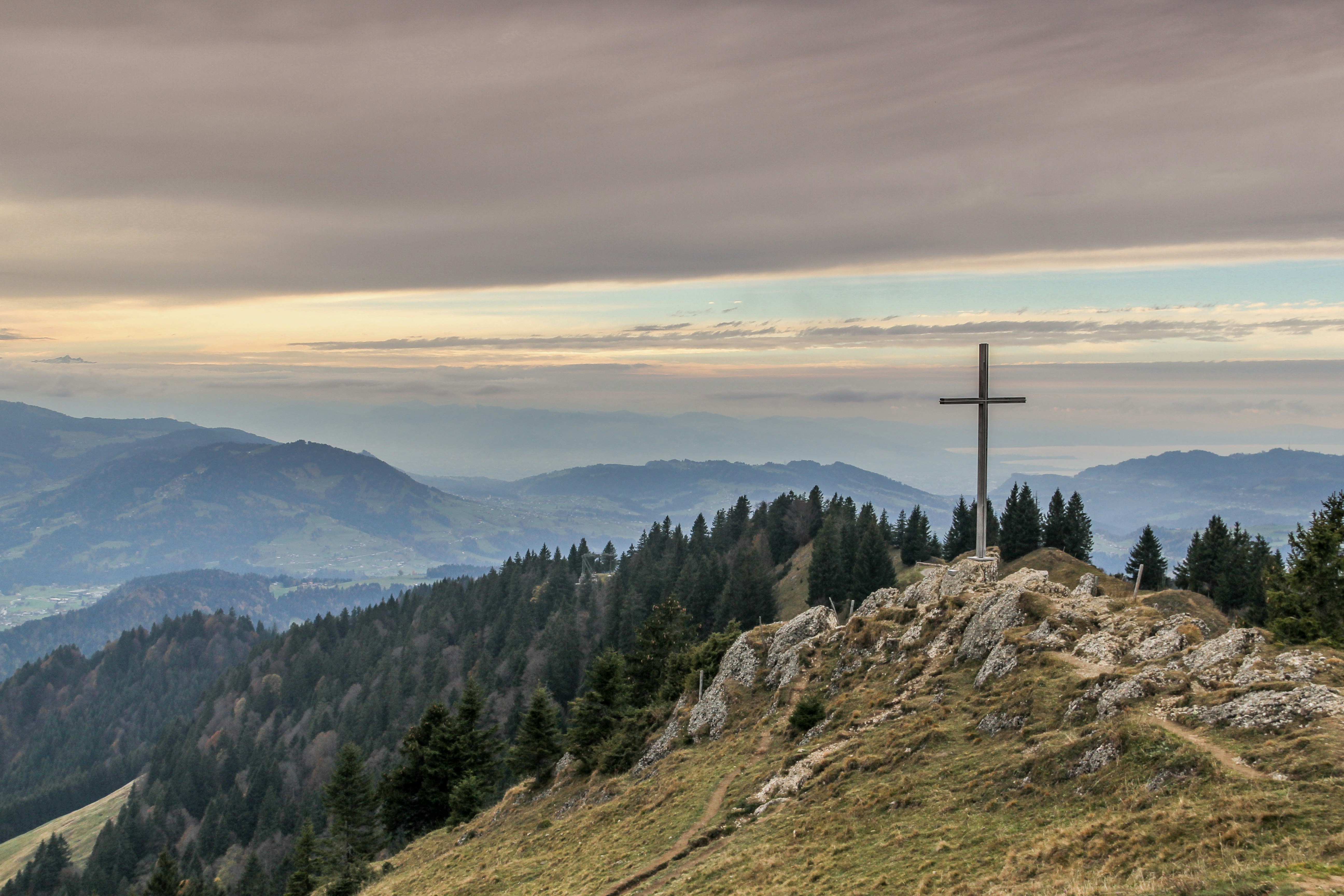
1 Comment

Filed under Uncategorized

Here we stand: The Holy People of God (Sermon)

Image: Charles O’Donnell, Detail from “Ancient city of Jerusalem with Solomon’s Temple,” ca. 1871. Public domain, via Wikimedia commons.

The below sermon was preached on Reformation Sunday, October 26, 2025, following the Narrative Lectionary (Year 4). The preaching text was 1 Kings 5:1-5; 8:1-13.

For those who might not know, the Books of First and Second Kings were originally one book. The stories within cover an expansive narrative of Israel’s kings from the end of David’s reign through the Babylonian Captivity. (That’s about 400 years.) In them, you can discover ancient history with moral and ethical high points, and often people who fall short in their love for God and neighbor.

Today, we join King Solomon, David’s son, blessed with great wisdom by God, as the nation dedicates its long-awaited Temple for their God on Mount Moriah in Jerusalem. With that gift of wisdom, Solomon had led his people well. Israel was experiencing both peace and prosperity. His God given gift has led to this great blessing for the people of Isreal. They are a people whom God has declared Qodesh Olam, “the Holy People of God.” Yet, they aren’t Holy because of anything they do. They are holy because God has chosen them, loves them, and wishes to live among them.

Yet hold on to your hammers and nails, you good Lutherans out there (it is Reformation Sunday after all), because there’s much more to this story. The Temple Mount and the Temple itself have long been a part of salvation history before we ever come to this day of Temple dedication – the Temple being what becomes the center of all priestly activities and place of cultic sacrifice. You might recall the story of Abraham binding Isaac so that Isaac might be sacrificed on a mountaintop in the Land of Moriah. In lieu of this, God provides a ram to be sacrificed. This is believed by many Jewish, Christian, and Muslim persons to be the site of what is now called the Temple Mount. You can find a large bolder there located under the present-day mosque which people suggest is where it all happened.  

As the story of the Jewish people unfolds through a time of slavery in Egypt and beyond, we eventually get to King Saul. The people have been tribal and nomadic once in the Holy Land. The were anxious to move from governance by tribal leaders, known as Judges, toward governance by kings. God indicated that the Israelites did not really need a king. God was their ultimate king. Still, God said, “OK.”

Then, when David replaces Saul, he conquers a city, named Jebus, owned by a foreign people. Now firmly Isreal’s, David renames the city, Jerusalem. It will become their capital. He joyfully dances before the Ark of the Covenant as it is carried to be placed within the Tent of Meeting. As the Tent of Meeting and the Ark moved through the desert with Moses’ people, wherever they people camped, it was always placed in the center of the Tribes. Symbolically, this reminded them that God and their Holy Covenant was to remain central to their lives within community. The city itself was also chosen to be the capital because it was in a relatively central, neutral location between the twelve tribes, had strong defenses, and was where the story of Abraham and Isaac occurred. Jerusalem would become where the Tent and Ark would now dwell.

As the nation grew and David and his people looked around at other growing nations or city states, David began to think, “Hmmm, maybe we need a great Temple to honor God as well as our nation.” That’s what all his neighbors had after all, so why not Israel? Well, through the Prophet Nathan, God basically says, “I was perfectly happy traveling with you in the wilderness within the Tent of Meeting. I don’t need a Temple…but if you do, ok.” God relents once again. Yet because of David’s sin and other faith issues, always still beloved by God, God decrees that the Temple will not be built until David’s son becomes the king. This is not too unlike Moses when he was not allowed to see the Promised Land. David never gets to see the Temple.

Finally, we arrive back to the glorious dedication of the Temple with Solomon. Seven years have passed since work began with a great financial cost, the investment of lots of sweat and toil, and like modern construction sites today, perhaps at the cost of some lives as well. That would be likely. Great excitement and joy must have been generated in the city as the Israelites prepared to move the Ark from Mount Zion to the neighboring Mount Moriah.

Again, today this location is known as the Temple Mount. All the religious and political leaders are there (the “insiders”), but all the commoners and less than common people are there too (the average people and the “outsiders”).  All the people, no matter how rich or poor, weak or strong, perfect or imperfect, have been decaled the Holy People of God, so they are there. The covenant and promises made with Abraham, Moses, and other patriarchs include each and every one.

God will reside in the inner sanctum of the Temple, an area available only to Priests and hidden behind a large curtain. (This curtain will tear as Jesus dies. Some suggest this symbolizes the Kingdom breaking into our world through Jesus’ death and resurrection.) Golden cherubim located opposite one another over the Ark will sit with wings spread toward one another. This will continue to serve as God’s throne, his “mercy seat,” where God’s presence was said to dwell, and the ultimate God would mercifully deign to speak to and bless his Holy People. They must have thought that the Temple might last forever just like their God…but it didn’t. Babylon will invade Israel and destroy it. Cyrus the Persian will defeat the Babylonians and rebuild it. It will be defiled later by the Greeks and even later conquered by the Romans.

Then, Herod the Great, will be installed as a vassal king serving Rome, and he will look at the Temple and think in his pride, “We need better to reflect my glorious reign.” And as we know from scripture and historians of the time, he was not a great believer, but Herod the Great understood politics. His expansion of the Temple would beautify a place for faithful people to gather, but it was also a place to reflect his own glory as it becomes through its size and splendor a Wonder of the Ancient World.

Yes, Herod the Great’s work will become the Temple that Jesus and his Apostles would know and love. It will be the Temple the Apostles will marvel at before Jesus’ death because of the large and ornate stones. Yet Jesus would respond, “As for these things that you see, the days will come when not one stone will be left upon another; all will be thrown down” (Luke 21:5). Later, Jesus will declare that he will become our cornerstone (Luke 20:16-18). The Apostles and world will soon learn that life has never been about just nations or kings, tents or temples, sacrifice or worship. Jesus wanted to build a Church out of you and me and millions of others like us. Over the centuries as had happened with the Jewish People, what will matter most is that God comes again and again, despite our pride or mistakes, success or failures, to form us into one Holy People of God. We will stand together forever through God’s power, promises, and help.

 And when the Temple is finally destroyed in 70 AD, and all that fine furnishings, holy vessels, and wealth were carried away by the Roman Legion to Rome, we see that Ecclesiastes was right. “All is vanity.” The earliest Christians finally came to understand promises of old in a new way. From Ezekiel we hear, “I will give you a new heart and put a new spirit in you; I will remove from you your heart of stone and give you a heart of flesh. And I will put my Spirit in you and move you to follow my decrees and be careful to keep my laws” (Ezekiel 36:26-27).

No temple, church building, or anything else is needed other than faith in Jesus. For through faith, we become a “living temple” where God has longed to reside. Yes, it was God’s plan all along. Just as a cloud filled the Temple, the Glory of the Lord hungers to fill us and overflow. It desires because of love for us to dwell in our hearts and make us one through God’s own Spirit.

As Professor Amy Oden suggests,[i] I think people do like to try to put God in one place…to restrain God and define God for their own advantage or comfort…or to limit or doubt the capacity for God to save (perhaps not always wittingly)…or maybe it is because they don’t yet fully trust God’s love or love God fully with their hearts. Despite human doubts and darkness, or any evil of this world, likely because of it, we are told the Spirit is on the move (Genesis 1:2, Acts 2:1-4). God is doing new things (Isaiah 43:19). And God guides and blesses us on our way as we move through valleys of darkness and the heights of joy (Psalm 23).

Certainly, temples can be destroyed. People and their congregations will die before Jesus returns. Yet, we are to always trust God’s great and steadfast love for us. For even as we stand between hope and despair, God becomes our bulwark defending the weak and helpless (Psalm 9:9, 12:5). “Nations are in uproar, kingdoms fall; [God] lifts his voice, the earth melts,” and yet, the God of Jacob proves our mighty fortress (Psalm 46:6-7, NIV translation).

Friends, we might not always feel like it, nor live up to it, but God has declared that we are the Holy People of God. We have become Christ’s body by our faith and baptism through grace alone. Whatever comes our way, through fire or pouring rain,[ii] as the Evil One devises any plans,[iii] we need not be shaken. Although our own strength might fail us, God never will.[iv] God’s love and mercy will see to it that the Holy People of God will stand eternally. Amen.


[i] Ogden, A.G. Commentary on 1 Kings 5:1-5; 8:1-13. Working Preacher.

[ii] Bethel Music. “We Will Not Be Shaken (Live).” We Will Not Be Shaken, Bethel Music, 2015.

[iii] The Imperials. “Let the Wind Blow.” Let the Wind Blow, Myrrh/Word Records, 1985

[iv] Martin Luther, “Ein feste Burg ist unser Gott.” 1529.

© 2025 The Rev. Louis Florio. All content not held under another’s copyright may not be used without permission of the author. Scripture passages are from the NRSVue translation unless otherwise noted.

If you would like to listen to the above sermon or watch our service, the video can be found below. The sermon begins at about the 29:15 minute mark. 

Leave a comment

Filed under Sermon

Holy Ground (Sermon)

Image: VMI Cadets on House Mountain, from House Mountain Reserve and the Virginia Military Institute. They retain all rights. The words below are my own, and do not reflect the views of these or any other entities or persons.

The below sermon was preached on the Sixteenth Sunday After Pentecost, September 28, 2025, following the Narrative Lectionary (Year 4). The preaching text is Exodus 2:23-25; 3:1-15; 4:10-17:

Thirty-nine years ago, among a crucible of challenges faced as I began to attend the Virginia Military Institute, New Cadets (nicknamed “Rats” for their lowly position at the school) were “invited” to hike up House Mountain. This mountain is a beautiful mountain indeed shaped a bit like a house, and it reaches about 3600 feet in elevation. It stands uniquely alone in the skyline, a bit separate from the other mountains of the Shenandoah Valley, and it is clearly visible from the Institute.

This annual event made the mountain a bit like holy ground for us. The forced march, a very fast one, up a very steep and fatiguing incline, was a tool used to bind us closer together. On the way, New Cadets were not only expected to challenge themselves individually, but they were also to help and encourage one another on the way – carrying their “Brother Rats” if necessary. And once the arduous climb to the top is done, you look around at the beautiful expanse of the valley below you, and you feel pride for your accomplishment, but also a deeper connection to those around you and to those who came before. Dare I say that you get the sense that you find yourself in a kind of sacred space and time. To this day, whenever I drive up and down route 81 and see that mountain, I remember the importance of that cherished experience.

There’s something empowering about mountaintop experiences. Sure, the climb can be challenging and the view spectacular, but I find that I often get the sense that amidst my smallness, I am part of something greater than myself. Throughout history, mountaintops have been used for signal fires, monuments, and just a place to see the scenery, but they also have been used for religious rituals and prayer. They have often proved the site of important spiritual awakenings or experiences for people throughout time and across cultures. This is much as the Lakota and Cheyanne look at Bear Butte in South Dakota as a sacred site…praying on and around the mountain, performing rituals or leaving sacred offerings at the top. We might come to understand why the “high places” so often referred to in the Bible were outdoor religious sites on mountaintops. Where was Abraham to sacrifice Isaac?[i] It was to be on a mountaintop, much as the pagan religions around him sacrificed their children. When we lift our eyes to the hills (to the mountains or high places), from whence does our help come from?[ii] God is the answer, for God has dominion over the high places. El Shaddai is one of the names for God used in Jerusalem meaning “God Almighty.” In the most ancient times, it appears that among what would become the Jewish people (as with other peoples around them), the gods were often associated with peoples and places, especially mountains. And in the Akkadian language, the earliest known Semitic language, the root of Shaddi – shadû – means “mountain.” Some suggest that El Shaddai conceives of our God as holding dominion over their regional high places.

Therefore, I don’t think it should surprise us that Moses’ own call story takes place on such heights. Indeed, it was already thought to be sacred ground, “the Mountain of God.” It was a place said to be where God rested at times, but it was to become a place where Moses’ life and the life of his people would be changed forever. Though, it really isn’t the ground or the elevation that’s key to this story. It is the relationship forged between Moses and his God that truly matters. Within our text, we can see a number of ancient hints for this. For example, Moses takes off his shoes to approach the burning bush. That’s an ancient sign of respect. Through the outward sign of humbling oneself, one is reflecting an inward sign of reverence and worship. For God’s part, God calls Moses forward while reminding Moses of past powerful relationships, “I am the God of your father, the God of Abraham, the God of Isaac, and the God of Jacob.” The three covenants or promises made by God to Abraham, Isaac, and Jacob – three being itself a symbol of perfection and fullness in Judaism – still hold. God broke into these lives with the intention of changing the course of history, and that remains God’s will. With this mountaintop experience, God intends to break into and claim Moses’ life so that he can be used for a sacred purpose. We are witnessing what is known as a call story.

And in the face of such power (as displayed by a burning bush which really didn’t burn), Moses turned away. Ancient peoples believed that if a mortal was to look upon such immortal power, one would die. Instead of destroying Moses, God chooses to be humble and approachable. God offers Moses a sign of friendship…a name, “I am who I am.” In ancient cultures through the indigenous cultures of today, a person’s name is deemed sacred. It is thought to have a kind of force. Yes, it might identify one’s heritage or family, or represent what they have experienced or hope to accomplish in life, but it commonly was believed (and in some cultures is still believed) to give one person power over another. That is why one usually blesses or curses using a name in most traditional cultures, and the ancient Jews refrained from using the Lord’s specific name for a fearful respect of the power it represents and could unleash. This Jewish traditions is captured in our modern bibles when you see LORD (in all capital letters) in lieu of speaking God’s name. We even baptize in the name of Father, Son, and Holy Spirit, but also officially give infants a name. We are said to Christen them.

Through this account, we are witnessing something extraordinary. Our perfect Almighty God from on high comes down to meet Moses (and us) as imperfect as humans are. Unlike other gods, our God is not distant and uncaring. God hears the groaning of God’s people and acts when the time was right. This is just as we are told later – Jesus came when the time was right (Galatians 4:4-5). It is still that way as Paul writes, “Likewise the Spirit helps us in our weakness, for we do not know how to pray as we ought, but that very Spirit intercedes with groanings too deep for words” (Romans 8:26).

Yes, this powerful yet merciful god was calling a very ordinary, imperfect human to do great things. Still as many humans do…all humans at times…Moses resisted. He doubts instead of trusts. No wonder God gets angry? I think of Jesus, too, who was so often frustrated by his disciples’ unwillingness to trust him no matter how many miracles were performed. Yet to be fair, Moses by many human standards was a very unlikely prophet. Remember, Moses descended from a lowly people, slaves. He was a murderer, killing an Egyptian slave master. Moses was only a poor shepherd with an adopted family and home. He had no great family name or social status. Significantly, Moses apparently had a speech impediment. As Professor Fretheim of Luther Seminary in St. Paul wrote, “Moses raises sharp objections to God regarding this calling. One could name a total of eight objections on Moses’ part, ranging from issues of competence to knowledge to the nature of the situation and the kind of people (and God!) involved.”[iii]

In this very dynamic back and forth of confrontation met by assurance, God basically reminds Moses by word and deed…as God will do throughout the entire cycle of the Exodus story over and over again…“I am with you…I am your God…I am yours, and you are mine.” Where Moses is so hesitant to give of himself, God offers the divine-self to Moses. As Moses seeks to trust and move forward, than trust and move forward a bit more…trust grows…a heart of faith based on a personal relationship with God begins to flourish. Our God is willing to be present in Moses’ life and work through it…that’s what gave his life and our lives true meaning…that’s what makes an ordinary human extraordinary.

Eventually, Moses will prove to be one of the greatest of God’s prophets. No, he will never be perfect. Just like us, Moses will struggle to trust at times, and with his people, grumble or drag his feet. Yet in the end, Moses will walk on in trust…step by step into the unknown but seeking to trust the god revealed to him. This revealed and now known god, our God, is with him. It is God that gives Moses his vision…a vision that directs Moses’ life through many adversities in order to help his faith grow and bless others.

Yet again, it isn’t the high ground, or Moses, or his staff who has the power and glory…it is God alone. Despite any of Moses’ flaws or hesitation, even his sin, God wants to work through Moses and with Moses to change the world. Much as with Moses, God wishes to interact with us…to enter a powerful, personal relationship with us. Yes, we can confess our weaknesses to God. We can speak of our faults or fears…even our doubts. Yet, we can’t let them shape our lives. It’s God’s presence and promise that matters.

Through our faith and baptism, God is always with us…truly with us. And by Christ’s death and resurrection…through the Holy Spirit (reflecting the power of Pentecost)…we have an ongoing, intimate, most powerful and lifechanging access to God in ways that Moses did not. True, we might never prove to be an Abraham, Isaac, or Jacob, but we are their descendants through our shared faith. We may never be a great prophet like Moses. As recent days remind us, we can surely be a lowly, sinful people. Yet, God still claims us and is with us. At any time, where we walk might become like holy ground for us as we sense God’s presence more clearly, feel the holy communion with Christ’s Church more dearly, or sense the Spirit’s call to love, forgive, and serve others and our world. [This is much as St. Richard of Chichester, (c. 1197–1253), prayed: O most merciful redeemer, friend and brother, may I know thee more clearly, love thee more dearly, and follow thee more nearly, day by day. Amen.]

In response to such an invitation, we should seek to answer our unique call from God. This might in the end be just to do small but hard and necessary things within the sphere of influence where we have been planted – helping as we can, loving and forgiving with God’s help, being patient and gracious toward others, maybe not saving the world but just saving or positively shaping or redirecting even just one life that we come in contact with. God can use us in that way to change the world, too.[iv]

Indeed, we are used by God daily…aware of it or not…when we just try to love as we have been loved by God. For through this messy, stressful, frightening life, God is leading us together toward the highest ground…an eternal life to be shared with the one revealed to Moses as “I am who I am,” and comes to us as Jesus and the Holy Spirit. Amen.


[i] Genesis 22:1-19

[ii] Psalm 121:1-12

[iii] Fretheim, T.E. (October 1, 2017) “Commentary on Exodus 2:23-25; 3:1-15; 4:10-17.” https://www.workingpreacher.org/commentaries/narrative-lectionary/gods-name-is-revealed/commentary-on-exodus-223-25-31-15-410-17

[iv] There is an ancient Jewish precept, “Whoever saves one life is considered as if he saved an entire world.” This highlights the infinite value of each life and our interconnectedness.  

If you would like to listen to the above sermon or watch our service, the video can be found below. The sermon begins at about the 11:14 minute mark. 

© 2025 The Rev. Louis Florio. All content not held under another’s copyright may not be used without permission of the author. Scripture passages are from the NRSVue translation.

Leave a comment

Filed under Sermon

Meeting Jesus on our Road (Sermon)

Photo by Emma Simpson on Unsplash. Used by Permission.

While serving at Christ Lutheran, I have not had many opportunities to participate in any concrete, personal ministry serving those with intellectual disabilities or those on the autism spectrum. Yet, such experiences remain a deep part of who I am. They have shaped my vocation, my relationships and theology, even my personal relationship with God. People experiencing these issues have always been part of my life, and they have taught me a lot…even helped me experience Jesus…if not see him.

Long before I was born, my grandmother chose to keep my Aunt Therese at home after she was born with intellectual disabilities in the 1930s. Many relatives pressured my Nana to give her daughter up…to institutionalize her and move on with her own life. That was the way things were back then. Instead, my grandmother (with my grandfather’s support) ensured that my aunt learned how to read and write, manage household tasks, and was educated about Jesus and the importance of loving others. As a result, Aunt Therese was eventually able to find a job in a factory, serve on her congregation’s altar guild, and even drive. Later in life, she could live alone with the proper support in place. When I came along and still a child, I only saw my aunt as my aunt. There were no labels yet in my mind. She was just another person to love and care for me. And I loved her. I still love her although she died many years ago.

In high school, I was one of several students chosen to assist physical education teachers during the school day. One day, a coach came over to ask me if I would be willing to help a teen new to the school with intellectual disabilities. He was having a hard time adjusting, had loads of energy, and was prone to act out as a result. My job, if I accepted it, was to help accompany him…to model and teach sportsmanship and relationship…and try to get some of his energy out in a healthier way. I was maybe 15 years old, and I must confess I was intimidated. This was not my aunt. It was a new experience.

Yet, I said yes, and my relationship with that young man led me to a new kind of joy. I was eventually asked to help the Special Education Teacher at our high school on a regular basis, and I made more friends who just happened to have disabilities as a result. I also discovered that these students who were sometimes made fun of by others, discounted, ignored, or cast aside, could teach me more things than I ever taught them – especially about kindness and the acceptance of others. Those who were often called the least of these proved to have an inestimable value.

Once in college, I was on a vocational retreat exploring service in the Church. We were in the Appalachian region of Kentucky, and as part of the ten days, we stopped by to visit and help residents at an underserved nursing care facility. Brother Cal, the group leader, invited me to help feed a young woman who was restricted to a life reclining in a special wheelchair. She was physically, and intellectually, severely disabled. She was also almost blind, only able to see shadowy figures. I believe I’ve shared with some of you this experience, for my fear and reluctance turned to a profound joy with new understandings as she responded to my male voice, felt the contours of my face and stubble of my unshaven chin (in order to “see” me in some way), and giggled like a small child as she felt words and noises come from my mouth. I came to sense a kind of holy relationship form between us. Although brief, I still sense our connection as I speak of her or when I think of her. It created a kind of mystical and life-changing communion like that which we speak of in our prayers.

Later remembering these experiences and many others, I would come to support Special Olympics as a police officer after college. You likely know that police officers love to support Special Olympics. (It’s a thing.) Still later as a pastor, I therefore quickly volunteered to Go Over the Edge for Special Olympics Virginia, rappelling down the 26-story Sun Trust building in Richmond for donations. “Push your pastor over the edge” was my tagline, and apparently many people wanted to do just that! I raised over $6,000 that first year. And in following years, other pastors and Lutheran lay people (including Pastor Anne) were crazy enough to join me on that rooftop. In three outings, Lutherans in Virginia raised nearly $20,000 for Special Olympics. This went not only to high quality training and sporting events for those with intellectual disabilities but also to school programs, health and dental programs, along with family support. These are all the activities of Special Olympics.

This became one factor leading to my being invited to serve on the Board with Lutheran Family Services of Virginia, now called enCircle. The nonprofit began with adoption related care in the 1800s, but it now helps with foster children and adoption, geriatric issues, schools for at-risk youth, counseling services for individuals or family, some migrant and refugee assistance, and many other things. Their efforts, of course, include services helping those with intellectual disabilities and autism. They offer day centers, in home care and support, and options to live in community.

I served for nine years on that board, and eventually came to also serve with a L’Arche community in Richmond. L’Arche is an international Christian program that supports and promotes people with different levels of ability living together in community. At one worship service at Messiah Lutheran, my former congregation, a severely autistic young woman, a member of L’Arche, could not wait for the Lord’s Supper and ran up to the altar with great abandon and joy to stand next to me. In her hunger and excitement for Jesus, she taught me something holy that day. And as with everything else I mentioned, I learned a lot about myself, life, and Jesus.

In reflection, I recognize that I could feel my heart burning inside me. There was something…is something…sacred about all these relationships and experiences. In summary, I agree with the words of Father Henri Nouwen, famous for what he learned through his involvement with L’Arche communities:

Giving yourself to others is only possible when you have been fully received…only when you know yourself as unconditionally loved – that is fully received by God – can you give gratuitously. Giving without wanting anything in return is trusting that all of your needs will be provided by the one who loves you unconditionally. It is trusting that you do not need to protect your own security but can give yourself completely to the service of others…When you know yourself as fully loved, you will be grateful for what is given to you without clinging to it, and joyful for what you can give without bragging about it. You will be a free person….Free to love! (As quoted at Apprenticeship to Jesus.)

I do not share these experiences to brag, but hopefully to help point you a way down your own road…a way available to all of us…to help us encounter the Risen Christ. In life, too often, the stressors of our day, the fears over our tomorrows or potential want, and the sin that is at work in us and around us can blind us. We forget God’s promises, and we fail to see Christ’s presence…even though he is right before us!

Today, we heard of Cleopas and another unnamed disciple (possibly his wife, Mary, according to some early authorities) traveling to Emmaus after stories of Jesus’ resurrection had begun to spread. Think about what they had just experienced… profound grief and fear. They were likely still in shock over the death of their beloved Jesus…Now, they were to believe in his physical resurrection? It would be unthinkable for many of us. We would likely be overcome with perplexity and confusion just as they were. Again, fear remained like a specter before them as well.

Then unexpectedly, Jesus appears. He’s in a form where they do not recognize him at first. He’s just another traveler on the road as far as they are concerned…an uninformed one at that. So, they begin to share their dilemma. They speak of Jesus and all that was seen and heard. Jesus finally has had enough. How foolish they are! They seem not to remember all that Jesus and the scriptures before them have taught. “Then,” scripture says, “beginning with Moses and all the prophets, [Jesus] interpreted to them the things about himself in all the scriptures.” He unpacked the scriptures for them…held them up…so they might see how the scriptures touched their lives.

As they near the day’s end, they must have found some comfort or inspiration from their time with this supposed stranger. “Please do not go. Stay.” They perhaps hoped to help him, as he had helped them. This is the context in which their food is shared…a mutual, caring relationship. As Jesus blessed and broke the bread, only then do they see Jesus for whom he is. They ask in wonder, “Were not our hearts burning inside us?”

It is highly unlikely that Jesus will appear to us in a dream or a vision. (It is not impossible, but it is unlikely.) It is even more unlikely that we will see him in the flesh until our own resurrection. Yet, we are promised Jesus is here. Sure, scripture can help us catch a glimpse of Jesus. The sacraments rightly practiced and received in faith might give us a glimpse of Jesus sparking a fire in our hearts. These are both true, but they are not the totality of where we might see Jesus.

Let us recall Jesus’ parable about the judgement of the nations at the end of time for help. To those at the King’s right hand, he will say: “‘Come, you who are blessed by my Father, inherit the kingdom prepared for you from the foundation of the world, for I was hungry and you gave me food, I was thirsty and you gave me something to drink, I was a stranger and you welcomed me, I was naked and you gave me clothing, I was sick and you took care of me, I was in prison and you visited me.’ Then the righteous will answer him, ‘Lord, when was it that we saw you hungry and gave you food or thirsty and gave you something to drink? And when was it that we saw you a stranger and welcomed you or naked and gave you clothing? And when was it that we saw you sick or in prison and visited you?’ And the king will answer them, ‘Truly I tell you, just as you did it to one of the least of these brothers and sisters of mine, you did it to me.’” (See the complete parable at Matthew 25:31-46).

Indeed, in our faith and baptism, we become the vary body of Jesus as we serve. Yet, Jesus is reminding us that he is all around us in the world. He’s in all those who are suffering need. Jesus is even in the hearts of our enemies and those who don’t know him yet…trying to set a spark of recognition…wanting to warm their hearts. He can be spotted at the oddest times…when ordinary kindnesses are seen as the sacred things that they are meant to be…binding us together as one…helping us learn more about Jesus and the life he himself exemplified.

Today’s story tells us of a great miracle, but, oh, how foolish we remain and how slow of heart to believe all that the prophets have declared!…We are slow to believe what Jesus himself has taught us. Our life is meant to be sacred…a life where Jesus is not only made known but fully made present. We might only catch a glimpse, but he says he is there. Can you not perceive him? Have you ever slowed down enough to try. We can so often be like those travelers – seeing people for what they do or don’t do, or maybe as the world labels them, blinded by our own shortsightedness or our concerns for self. It is too easy to prove blind to Jesus who is always with us!

Yet, Jesus wills to not leave us in our blindness. He comes to us again and again in the need we find around us. In our ordinary life, we are called to a holy purpose that we might not ever fully recognize…or maybe we might never know and understand in this world…Still, there is something Jesus would have us do. If we want to glimpse…just glimpse…even a shadow of the Risen Christ in our lives, we have to look up and around us. We must walk the roads and byways aware and alert for those in need but also those marginalized and easily overlooked. For Jesus will be there.

Yet, we live in a world that often sees things otherwise. The autistic and intellectually disabled are sometimes said to not provide value. For too many, they are not seen as fully human. The homeless deserve what they get, some say, and those suffering mental weakness might be labeled as weak. The old are an inconvenience, a drag on finances. To have empathy and compassion is said to be against Christian values. (Some Christians say that!) These are all things I have seen, heard and read over the years…not just these last months. The day is over, and things are getting dark.

Who might Jesus be calling us to break bread with, so that he might be seen? It might be through serving others or in the sacraments. We might catch a glimpse of him in the forgiveness and kindness we offer others. It could be just non-anxiously accompanying someone through a life’s challenge, not having answers but being willing to listen and care as we walk with them.

These kinds of opportunities to see Jesus can happen when we least expect it…when we are so tired or stressed that we think that we cannot take anything else on…or present themselves at the most inconvenient of times. Yet Christ’s love is a fire, and his love burns in our hearts. When we feel it, we must pay attention to it…no matter how small a spark or even if it might lead toward our own sacrifices or death. For it is at just those times, we and others can be profoundly gripped by the wonder of Christ’s love. We will come to know that we are loved, and we will be better able to find a road forward loving others; leading us to a deeper communion with God; taking us to places where we will come to see Jesus face to face…together. Amen.

If you would like to listen to the above sermon or watch our service, the video can be found below. The Gospel text and sermon begins at about the 18:45 minute mark. The preaching text is Luke 24:13-35.

© 2025 The Rev. Louis Florio. All content not held under another’s copyright may not be used without permission of the author. Scripture passages are from the NRSVue translation.

Leave a comment

Filed under Uncategorized